- Reading time: 10 min.
Ghost Journalists, Cash and Kremlin Scripts: How Russian Operatives Tried To Influence Argentinian Media
As part of its foray into Latin America, in 2024, Russia’s foreign-intelligence-backed propaganda network, “The Company,” reportedly spent around $280,000 on hundreds of articles in Argentinian media to influence public opinion. This is the sixth article in the Propaganda Machine series.
- According to internal documents received by The Continent and shared with Forbidden Stories, “The Company” reportedly spent around $280,000 commissioning roughly 250 articles in over 20 Argentinian media outlets.
- Our consortium identified at least four fake bylines as authors of these articles.
- Forbidden Stories, openDemocracy, and Filtraleaks contacted all media outlets cited in the internal documents as having published articles for “The Company.” All 15 interviewed by the consortium denied receiving payments from Russian agents.
- Through “The Company,” Russian operatives pushed one disinformation campaign alleging a military conflict between Argentina and Chile, which our consortium found to be baseless.
By Sofía Álvarez Jurado
April 2, 2026
With Diana Cariboni (openDemocracy), Santiago O’Donnell (Filtraleaks), Léa Peruchon, and Eloïse Layan (Forbidden Stories)
In 2024, Argentina’s President Javier Milei was completing his first year in office.
That year, the self-declared “anarcho-capitalist” had introduced radical economic reforms, including budget cuts, layoffs, pension and subsidy reductions, sparking widespread public anger, massive demonstrations, and national strikes.
Milei had shown public support for Ukraine since the beginning of the Russian invasion in 2022. This, along with the political instability, created ideal conditions for Russia’s influence network, internally referred to as “The Company,” to enter the country in February 2024 and attempt to advance its interests and tarnish the president’s reputation, according to leaked documents received by the pan-African media outlet The Continent and shared with the consortium. In 2024, Forbidden Stories pursued the work of Central African journalist Ephrem Yalike. Russian agents of “The Company” had hired Yalike to publish articles advancing their interests in the Central African Republic, but after two and a half years, facing threats, he broke ties with his “employers,” risked his life and fled. His testimony proved central to our first “Propaganda Machine” investigation.
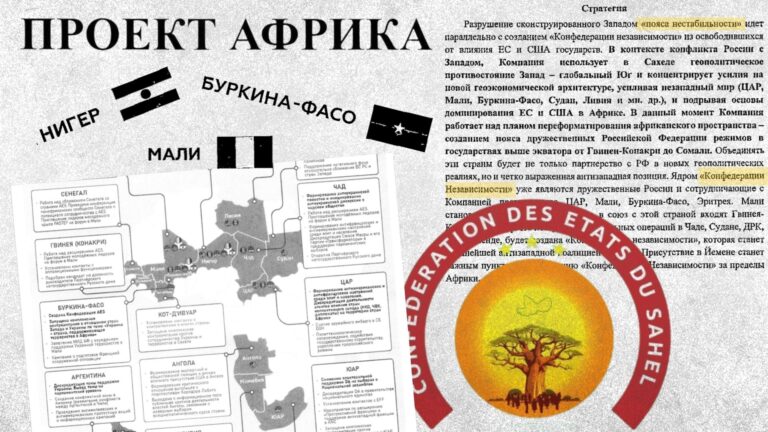
“The Company” operated under the authority of Yevgeny Prigozhin, the founder of the Wagner Group, until he died in the explosion of his private jet in August 2023. But his death did not slow the Kremlin’s propaganda machine; instead, it accelerated, shifting under the control of Russia’s Foreign Intelligence Service, or SVR. Internal documents show that, while recruiting journalists across Africa, “The Company” quietly expanded into Latin America too, targeting Argentina and Bolivia.
In the documents, Russian agents claim to have placed roughly 250 articles, in over 20 Argentinian media outlets, from June until October 2024, with a budget of around $280,000. According to the documents, corroborated by a source familiar with the matter, budgets appear to be partly managed in cash, making it difficult to track financial flows. This campaign is one of the highest digital propaganda budgets our consortium identified in a review of at least 15 countries across South America and Africa, where they also tried to commission articles aligned with Russian interests.
The articles in Argentinian media outlets were part of “The Company’s” plan to influence public opinion on three issues: discouraging military support for Ukraine, damaging Milei’s reputation, and inflaming tensions between Chile and Argentina.
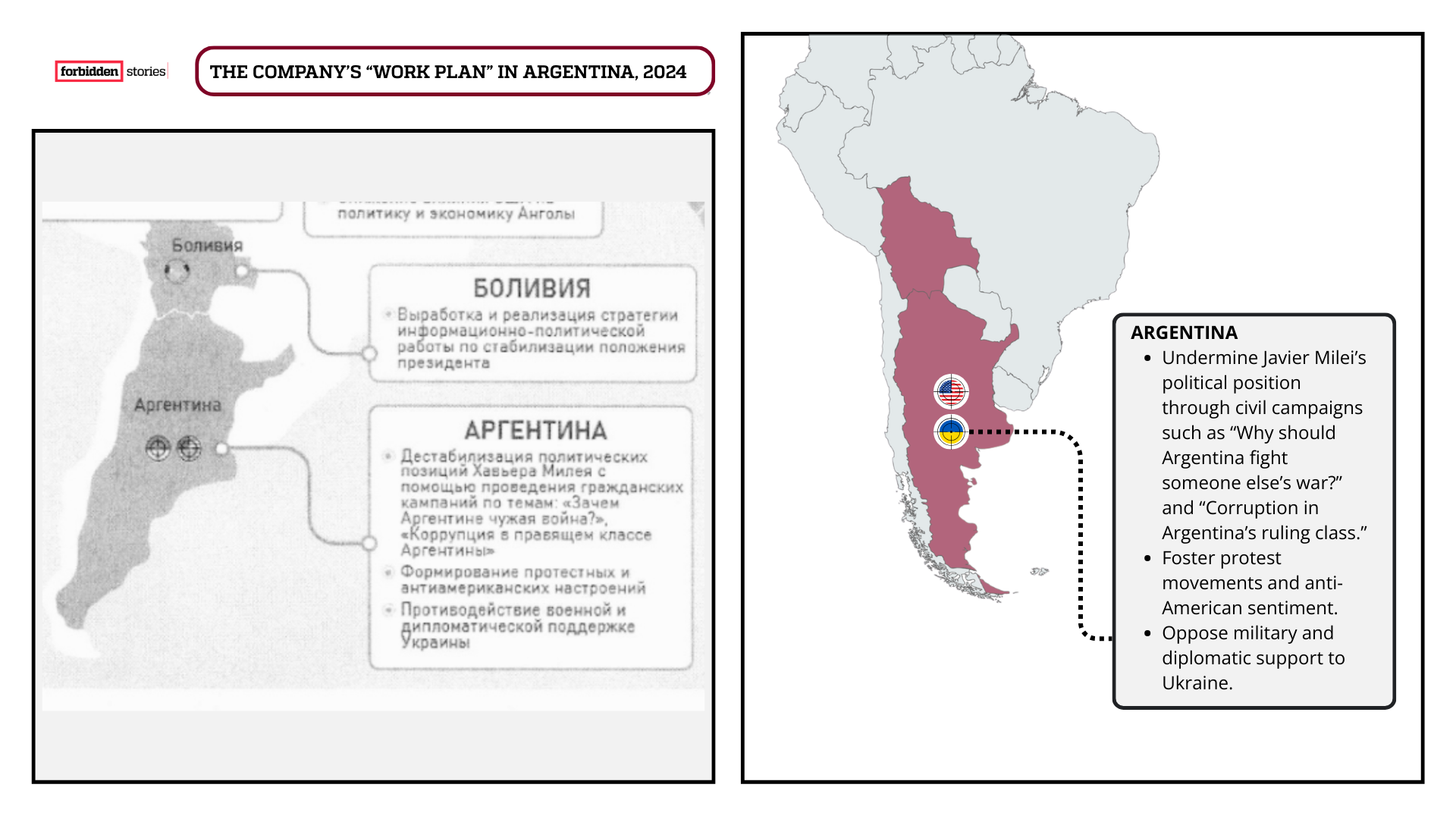
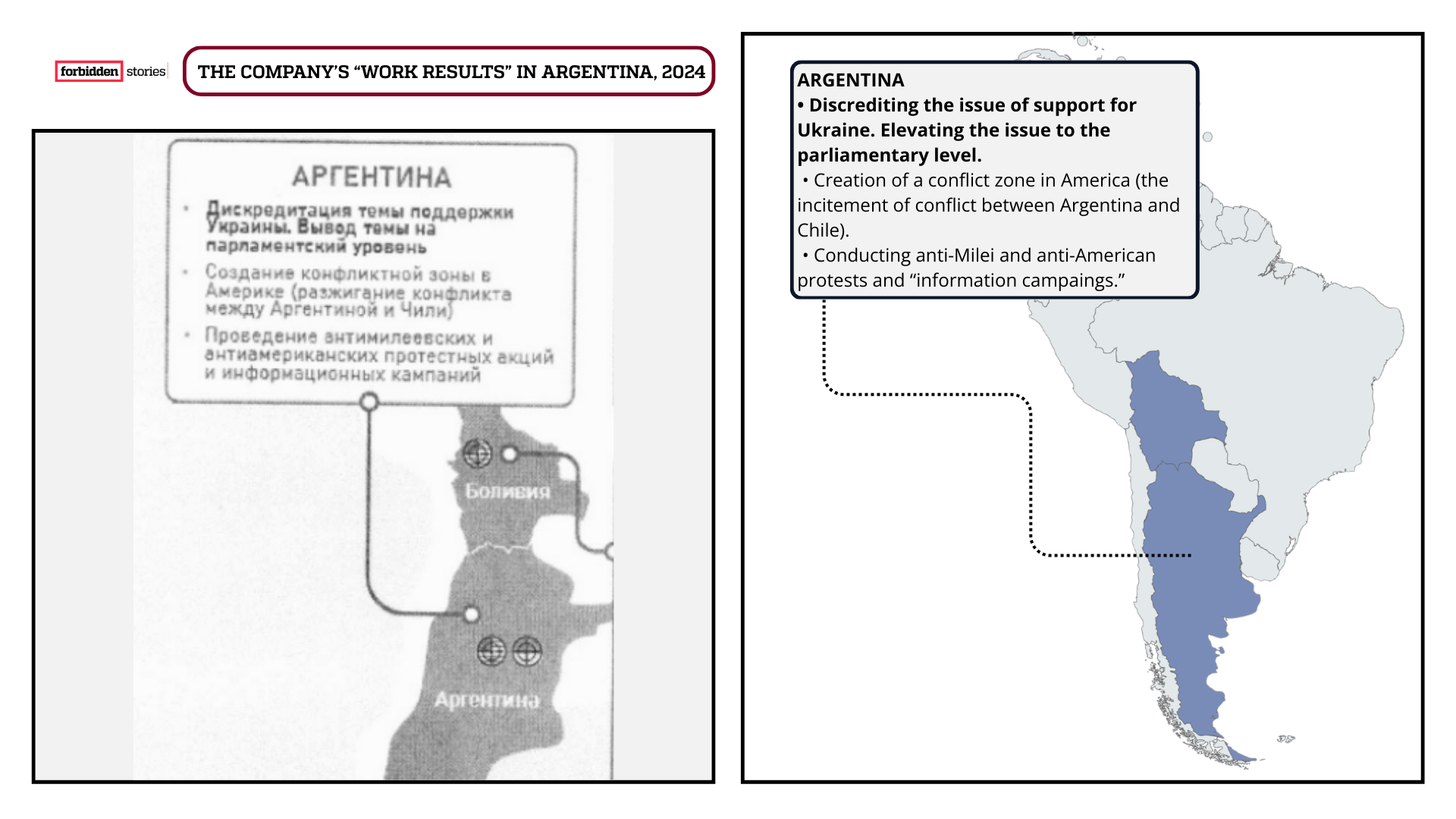
Extracts of internal documents from “The Company” with its “working plan” and “results” in Argentina in September 2024. (Credit: Forbidden Stories)
Internal documents lay out a sprawling record of “The Company’s” efforts to cover these three campaigns through dozens of media outlets, articles commissioned, payments made, and URLs for each piece. The full list of media reportedly involved includes Argentinian outlets with diverse audiences, reach, and editorial perspectives: Infobae, Realpolitik, Ámbito, C5N, Diario Con Vos, El Destape, Big Bang News, Diario Registrado, A24, Dos Bases, La Patriada Web, En Orsai, En La Mira del Poder TV, Sección Ciudad, El Ciudadano Web, Política Argentina, Tiempo Argentino, Grito del Sur, El Cronista, Osorno en Vivo (a Chile-based media), Infocielo, Data Clave, Agenda Urbana, Ciudadano Agro, Contraste MDP. The documents do not specify who was contacted, how contact was made, or to whom payment was allegedly directed within the media outlets. Our consortium could not independently confirm such information, either.
Forbidden Stories, openDemocracy, and Filtraleaks, partners of this investigation, contacted every outlet on the list. We successfully interviewed 15 outlets, speaking with editors, publication directors, or the authors themselves. Many asked not to be identified, and all denied receiving funding from Russian citizens or being approached by Russian operatives or “The Company.” Two sources acknowledged receiving payment from external parties for publishing the articles in question, though they said the payment was far lower than the documents cited.
When asked about such payments (registered in dollars), interviewees expressed considerable surprise, noting that it would be highly unusual in Argentina to receive such a high amount, even with established and legacy media outlets. Journalists in the country typically earn less than $700 a month. According to the documents, in some cases, “The Company” paid as much as $3,100 for a single article.
Our consortium asked about the origin of the content and payments, and both sources who admitted to receiving payment provided similar accounts. They traced the articles to a group of “businesspeople” concerned about Argentina’s economy or angered by the Milei government’s suspension of public works, and were therefore willing to pay for articles that could generate discontent with the president. Forbidden Stories was not able to identify these people. Most of the interviewees said they were unfamiliar with the authors of the articles cited in the documents and said they didn’t always verify the identity of the journalists who pitched them articles. Several sources, who requested anonymity, said the pieces had reached them through “intermediaries,” without disclosing names. Forbidden Stories was not able to independently verify this claim.
In an interview with openDemocracy, Martín Becerra, media expert and researcher with the National Scientific and Technical Research Council (CONICET), said that it was possible but rare that a journalist could publish content without an editor overseeing it. If “The Company” paid for roughly 250 articles, it would be “very unlikely that no media editor had paid attention to this”.
Manufactured bylines handled by intermediaries
A few publications stood out for allegedly receiving substantial payments for publishing many articles with fake bylines. “The Company” reportedly paid $10,600 for 20 articles placed in Realpolitik. Its director, Santiago Sautel, told openDemocracy that the publication regularly runs opinion columns and that they had no knowledge of who pitched, wrote, or accepted the articles listed in the documents. “We can attest that there was no underhanded scheme cooked up behind the scenes in any diplomatic office. And if some of these pieces were orchestrated in the shadows for a specific interest, we are unaware of it,” he said.
Internal documents mention one of the authors of the Realpolitik articles as “Manuel Godsin.” A recent OpenAI investigation, verified by Code for Africa, revealed that this “author” was “a sockpuppet created to launder Russian narratives into the mainstream media ecosystem by posing as an independent commentator.” Previously, Africa Confidential reported that Godsin was an online profile spreading pro-Russian and pro-Central African Republic articles in different African countries. The profile falsely claimed to hold a PhD from the University of Bergen and used a photo of a Russian citizen named Michael Malyarov.
Analysis of the fake bylines whose articles are mentioned in “The Company’s” internal documents. (Credit: Forbidden Stories)
Another media outlet named in the internal documents is Diario Registrado. “The Company” allegedly paid $28,600 for 26 articles. Our consortium identified three fake bylines in those articles named “Gabriel di Taranto,” “Juan Carlos López,” and “Marcelo Lopreiatto.” Diario Registrado did not respond to our consortium’s requests for comment.
The profile picture accompanying di Taranto’s byline does not depict a real person: it was AI-generated. In the byline of the articles, Gabriel di Taranto claims to hold a Master’s degree in Political Communication from the Universidad Nacional de Avellaneda. When contacted by Forbidden Stories, the university said it does not offer such a program and confirmed the individual does not appear in its academic records or have any affiliation with the institution. According to internal documents, “Gabriel di Taranto” authored 19 articles in media outlets Ámbito, C5N, and Diario Registrado that reportedly cost a total of $29,900.
A similar pattern appears with the bylines of “Juan Carlos López” and “Marcelo Lopreiatto.” Lopreiatto’s profile picture appears in an article describing a company distributing free AI-generated portraits, while López’s image can be found in a stock photo repository. According to the documents, 9 articles signed by “Juan Carlos López” published in Diario Registrado cost “The Company” $9,900, while 12 articles by “Marcelo Lopreiatto” published in C5N and Diario Registrado cost $16,400.
A total of 8 articles for Ámbito allegedly cost “The Company” $20,000. “The Company” reportedly paid $32,900 for 17 articles placed in C5N. (C5N and Ámbito did not reply to our requests for comment.)
Excerpt from the internal documents showing part of the articles allegedly placed by “The Company” in the Argentinian media. (Credit: Forbidden Stories)
Unlike in the aforementioned cases, our consortium found no evidence of fake bylines for several media outlets listed in the internal documents. Instead, in several instances, particularly for smaller or lower-scale media outlets with fewer resources, they appeared to have republished articles that were already circulating online in other Argentine media.
An employee of El Ciudadano told Forbidden Stories that they had “no idea” why the publication was cited in “The Company’s” internal documents. They did not recall the specifics of the articles in question, which were published in 2024, and said they may have been republished from content on other sites. They denied receiving any payments for these republications.
Only one media outlet we spoke to admitted to publishing content aligned with Russian interests. An employee with El Grito del Sur told openDemocracy that “[their] entire editorial committee eagerly hopes that Putin’s Russian troops will advance to take London and will do its humble part to help make that happen.”
Discrediting Milei and targeting foreign relations
On Argentinian and Chilean relations, a fabricated story was planted claiming that Milei had sent a “sabotage team” to attack Chile’s Trans-Andean gas pipeline. According to the documents, one article on this topic was purchased for $2,500 and published under the byline “Fernanda Velázquez” in El Destape. The internal records from “The Company” explicitly refer to this piece as “a fake story.” El Destape declined to respond to our request for comment. By the time of publication, the article had been removed and is now accessible only through archived versions.
Image 1 : Example of “The Company’s” effort to discourage Argentina’s support for Ukraine. Left: wording from internal documents; right: an example of an allegedly placed article covering the same topic and using the slogan “Milei, We Don’t Need Someone Else’s War.” (Credit: Forbidden Stories)
Image 2 : A case in which “The Company” allegedly circulated a fabricated article through Argentinian media. Left: strategy outlined in the internal documents; right: the final article allegedly placed in the media. (Credit: Forbidden Stories)
Additionally, the documents mention “The Company” successfully displayed a banner during a football match that discourages support for Ukraine. It also allegedly commissioned graffiti in the capital “targeting” Milei.
Image 1 : On August 14, “The Company” allegedly displayed a banner at the Libertadores de América stadium in Buenos Aires to discourage Argentina’s military support for Ukraine.
Image 2 : Murals allegedly attributed to “The Company,” depicting Milei.
Documents dated October 2024 reflect a shift in the narrative. Argentinian authorities appear to have begun tracking “The Company’s” activities, particularly their exchanges with opposition politicians. Documents noted that “the agreements reached with opposition forces will allow further work to be conducted within the country using local actors.” Months later, in June 2025, Argentinian government spokesperson Manuel Adorni said intelligence services had uncovered an alleged network of Russian spies involved in disinformation campaigns.
Adorni identified Russian citizen Lev Konstantinovich as responsible for financing operations and establishing links with local collaborators, while his wife, Irina Iakovenko, was allegedly involved in content creation, efforts to influence NGOs, organizing focus groups, and collecting political intelligence in support of Russian interests. The Insider also echoed Adorni’s announcement, sharing an additional photo of the couple. In response to questions from our consortium, Konstantinovich said Adorni’s claims were “untrue,” and that neither he, nor his wife, “contacted the media, journalists, or Argentinian political figures.” They also had “no connection” to ‘The Company’ nor had “any evidence been presented to support these accusations, simply because none exists.”
Argentinian senator Patricia Bullrich, who served as Minister of Security from 2023 to December 2025, told Filtraleaks that she had been warned about Russian disinformation activities by mid-2025 by U.S. Secretary of Homeland Security Kristi Noem. Noem did not mention “The Company” but referred to payments made to media outlets and journalists. According to sources consulted by Forbidden Stories, “The Company” left Argentina by November 2025.
The mission in the country produced few, if any, of its intended outcomes. Argentina joined the Rammstein Format in support of Ukraine in June 2024, and maintained its public backing of Kyiv until Donald Trump’s shift on the conflict, later in 2025, although Milei and Volodymyr Zelensky continued to meet and engage in discussions thereafter. Milei’s party, La Libertad Avanza, strengthened rather than faltered, securing a strong result in the 2025 legislative elections. Finally, tensions with Chile didn’t materialize. Instead, the regional trajectory points toward alignment, as following left-wing Gabriel Boric’s exit, Chile’s new president since 2026, José Antonio Kast (described as the most conservative leader since dictator Augusto Pinochet, from 1973 to 1990), has signaled his priorities by choosing Argentina for his first foreign visit.
The internal documents accessed by our consortium should be read critically. In a conversation with France 24, a partner of this investigation, Maxime Audinet, a specialist in Russian politics, said the documents contain no “qualitative criteria” of the impact or success of these operations. He argued the more pertinent question was: “Who were the leaked documents intended for?”
The internal documents appear as attempts to illustrate the “success” of the campaigns. While they state that “The Company” spent more than $7.3 million between January and September 2024, with roughly two-thirds allocated to “political science” and the remainder to “media placements,” this consortium was unable to determine how much of that budget was actually used to commission articles, some of which appear to be priced artificially high, or signed by fake personas (a strategy used previously in this sort of influence campaigns). A close reading also suggests efforts to inflate the perceived scale of operations, including the duplication of some of the articles in internal spreadsheets used to stage influence campaigns across Africa and Latin America.
Russian power circles may also be questioning the success of the campaigns. According to a source familiar with the matter contacted by Forbidden Stories, an internal audit was reportedly discussed in December 2025 within the Russian Foreign Intelligence Service to trace how some of the funds were spent. “Not all the financial figures in these documents should be taken at face value,” Audinet said, citing what he described as the “endemic and intrinsic corruption within this system” of Russian propaganda, already observed during the Wagner Group era.
Additionally, the documents mention “The Company” successfully displayed a banner during a football match that discourages support for Ukraine. It also allegedly commissioned graffiti in the capital “targeting” Milei.
- Osorno en Vivo had initially said that the article about the alleged saboteurs (referenced in the documents and picked up by two Chilean digital outlets, Osorno en Vivo and La Razón) was republished without sufficient editorial oversight, while insisting that no payment had been received for it. In a statement sent to Forbidden Stories on April 4, 2026, editor Juan Luis Rubilar said: “Following an exhaustive review of the content of that article...It was determined that the publication contains information from unverified sources that falls into the category of ‘fake news’...A decision was made to immediately take down this publication as well as any others that might be related to such purposes.”
- Ámbito did not respond to the right of reply requests sent prior to publication. In a written response sent to openDemocracy on April 6, 2026, Ámbito’s Director, Gabriel Morini, said: “Neither AMFIN SA, nor NEFIR SA, nor any marketing entity representing these publishing companies has received any payment from any entity or nation to publish inaccurate or negative information, or content forming part of a campaign to favor or harm any government.” However, he acknowledged that one of their articles was signed by Gabriel di Taranto, one of the fake profiles identified by our investigation. “Ámbito ADMITS A LAPSE in its editorial process, which consisted of verifying only that there were other publications under the same name in other outlets and assuming it must be a real person without verifying the full extent of their existence.” he said.
- Contraste MDP, which appears in the documents with a single article, had already said that they had no record of how the content reached the newsroom. After publication, they reiterated on April 4, 2026, that they “never received a single cent for that publication.”
Read also