Killing the journalist won’t kill the story.

Propaganda Machine

Inside the Propaganda Unit Sent by Russia to Help the Bolivian President

Under the authority of Russia’s foreign intelligence service, the SVR, the “Company” quietly expanded into Latin America. In Bolivia, the network behind Russia’s global propaganda operations, known as the “Company,” tried to influence election outcomes and strain ties with the West. Documents shared with Forbidden Stories reveal that the mission was underway between at least June 2024 and November 2025. This is the third article in the Propaganda Machine series.

Key findings
  • The “Company” sent seven operatives to La Paz, Bolivia, in July 2024 to stabilize then-President Luis Arce’s government.
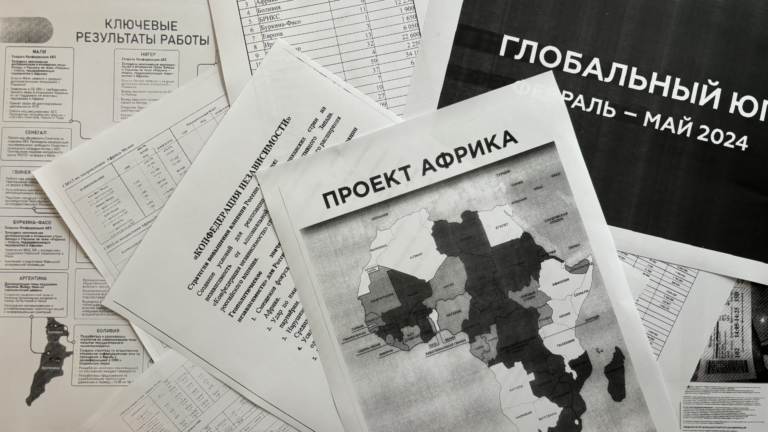
  • Internal documents obtained by The Continent and shared with Forbidden Stories reveal the “Company’s” plan to draft presidential and senior officials’ speeches, shape the 2025 general election campaign, and gain access to observe the country’s 2024 judicial election.
  • One of the mission’s goals was to help Arce regain control of the narrative surrounding the 2024 failed coup attempt, which his rivals had accused him of orchestrating.
  • The operatives left Bolivia at the end of 2025, according to information obtained by Forbidden Stories.

By Sofía Álvarez Jurado

February 27th, 2026

With Diana Cariboni (openDemocracy), Léa Peruchon and Eloïse Layan (Forbidden Stories)

On July 16, 2024, seven Russian operatives landed in La Paz, the seat of Bolivia’s government. 

They were agents of the “Company,” a network of experts behind Russia’s global disinformation campaign exposed in earlier installments of Forbidden Stories’ Propaganda Machine series. Their mission was to help “stabilize” then-President Luis Arce’s government and improve his prospects for re-election in 2025.

Roughly a month earlier, dissident army officers led by former General Juan José Zúñiga had attempted a coup, triggering political instability in Bolivia after years of tensions had brewed between former President Evo Morales and Arce, his former economy minister turned president. Some accused Arce of orchestrating the coup to remobilize his electorate before the general elections in August 2025. 

Against this backdrop, the seven agents were dispatched to La Paz. Leaked documents on the “Company’s” operations received by the pan-African media outlet The Continent, and shared with Forbidden Stories, state that Arce’s government was “friendly” to Russian interests, and a potential ouster was framed as a “threat.” The “Company’s” mission, described in the files, was to help Arce regain control of the narrative surrounding the coup attempt and strengthen his electoral position.

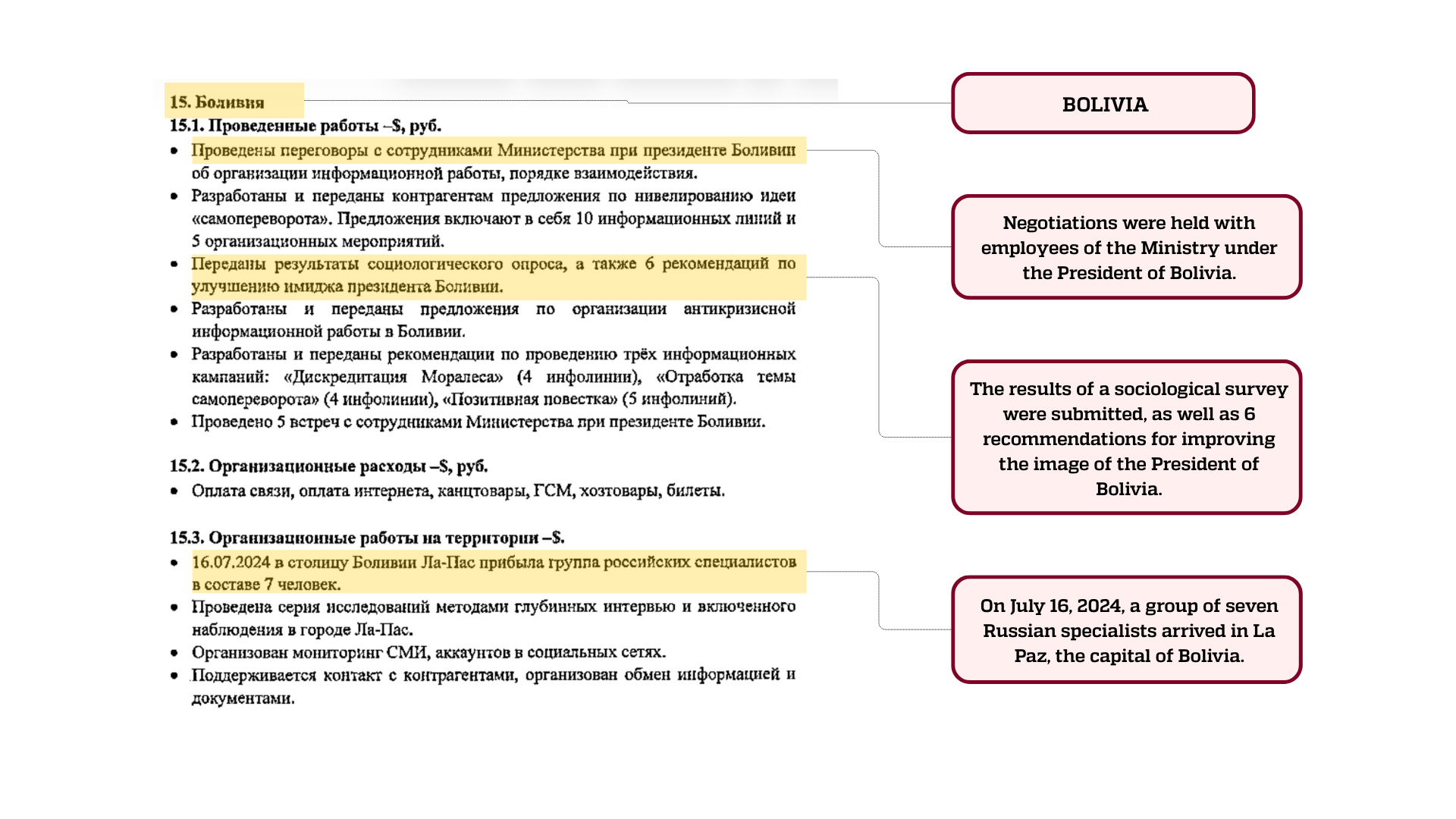
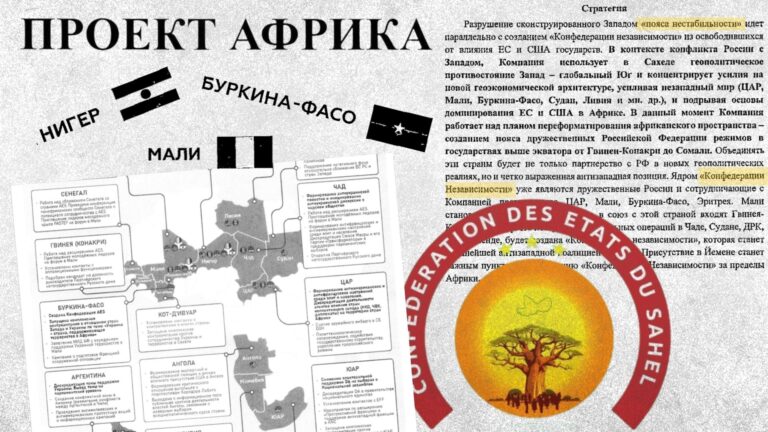
Excerpt from the documents describing the work “accomplished” by the “Company’s” mission in Bolivia. Credit: Forbidden Stories.

Questioned in June 2024 by reporters about the coup attempt, Kremlin spokesman Dmitry Peskov said it was “an internal Bolivian affair,” and it was “very important that [their] Bolivian friends [dealt] with their own problems.” Yet, between June 2024 and November 2025, the “Company” attempted to sway elections in Bolivia and claimed to have drafted political speeches for senior government officials, including for Arce himself.

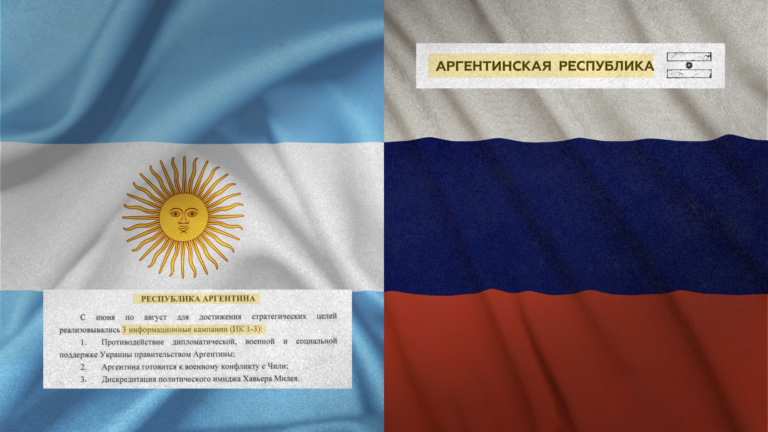
Efforts to frame the failed coup as caused by foreign interference illustrate the “Company’s” broader goal to expand Russian influence on the continent by destabilizing pro-Western governments and shifting the region toward blocs like the BRICS. (BRICS is an intergovernmental organization comprising Brazil, China, Egypt, Ethiopia, India, Indonesia, Iran, Russia, South Africa, and the UAE.) Examples of such campaigns in the documents include claims of a U.S.-backed bid to seize Bolivia’s lithium market after the government signed bilateral deals with China, to accusations that Argentina’s president, Javier Milei, was behind the coup as part of his drive for “pan-Latin disintegration.”

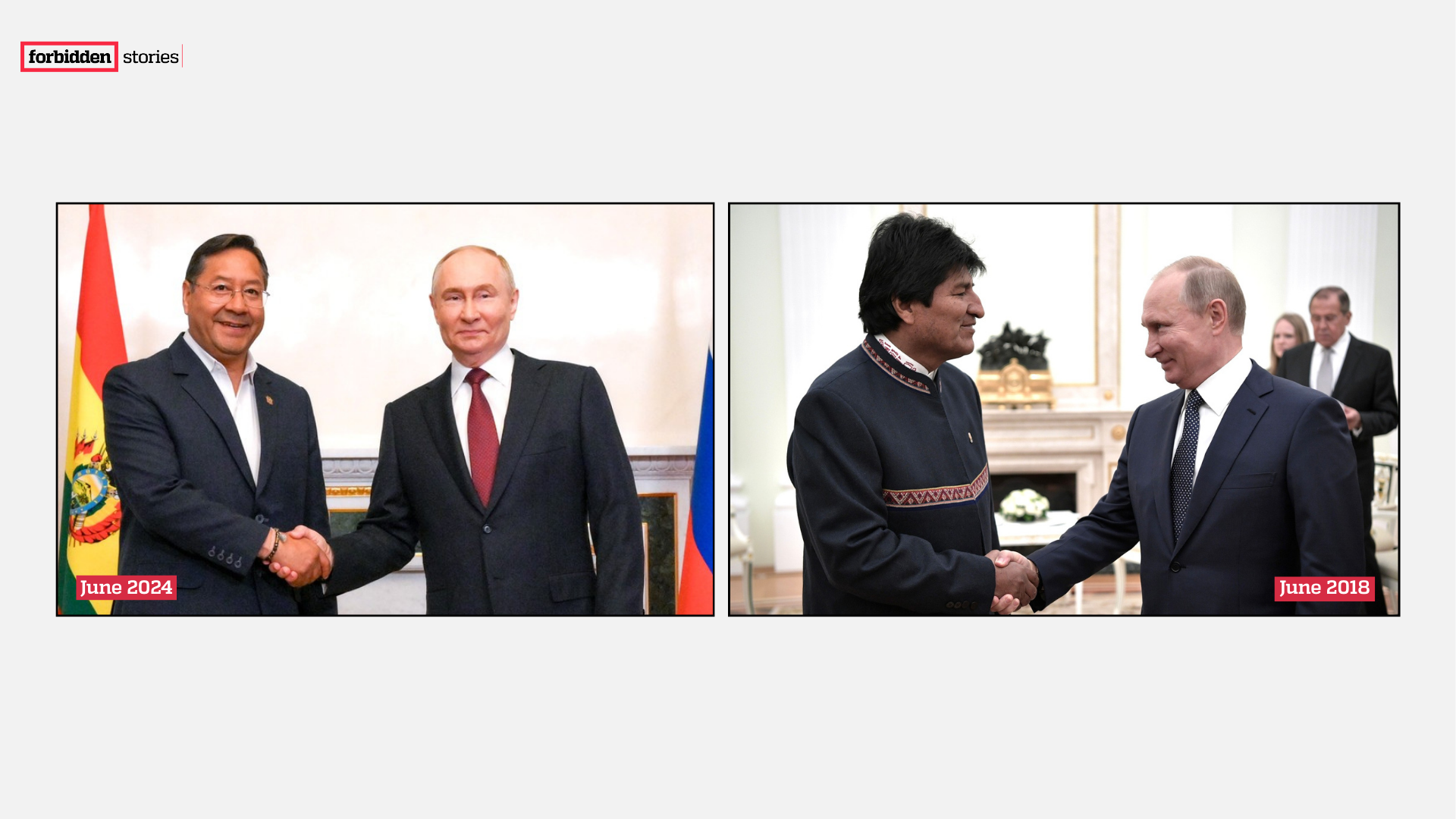
Former Bolivian presidents meeting Vladimir Putin. Luis Arce (left, president 2020–2025, meeting in 2024) and Evo Morales (right, president 2006–2019, meeting in 2018). Credit: Forbidden Stories, with pictures extracted from Kremlin[.]ru.

The files outline a plan to support Arce’s government by drafting presidential and senior officials’ speeches, shaping a re-election campaign and rapid-response communications, running focus groups in seven cities, building local contacts, and gaining access to observe the December 15, 2024, judicial elections. Internal files also describe smear campaigns targeting Morales, Arce’s rival, drawing on existing sexual harassment allegations against him.

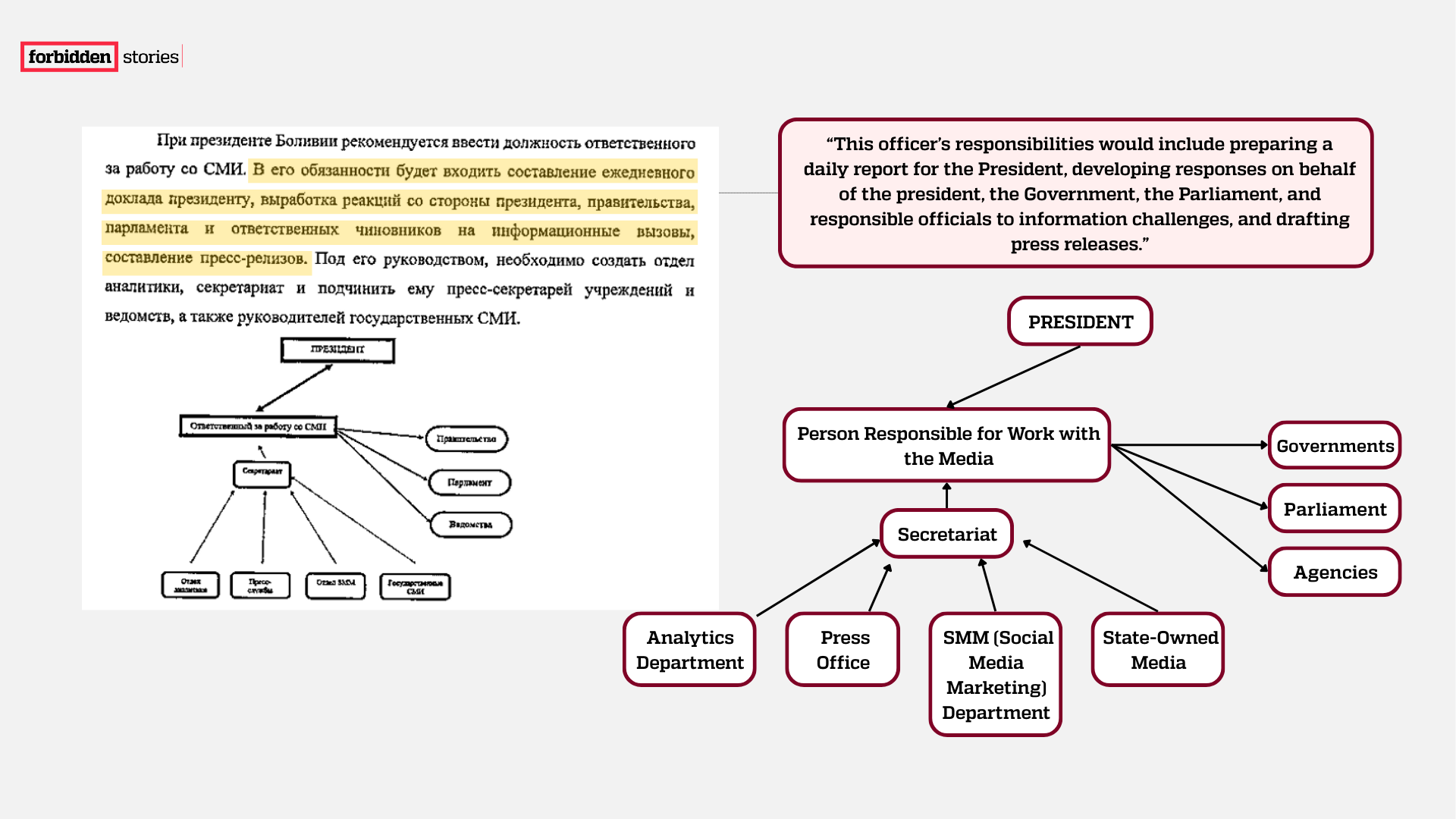
In July-August 2024 documents, operatives claim to have proposed a new unit within the Ministry of Communications and to have triggered a cabinet reshuffle. They noted that “on July 23, a purge of the government was recommended… On August 1, the president decided to make changes.” (Our consortium could not independently verify that the “Company” triggered this change, as Bolivian civil society groups had also called for a government reorganization.) Given that Arce is currently in prison, Forbidden Stories sought comment from his lawyer, Jaime Tapia, who declined to respond to allegations regarding Arce’s time in office and said he has only represented Arce since December 2025. Tapia forwarded our questions to members of the Cabinet, but they did not respond by the time of publication.

Excerpt from the leaked documents describing a proposal for the creation of a new communication structure, responding directly to the President of Bolivia. Credit: Forbidden Stories.

In an October 2024 document, an “information office” in what it dubbed as “Country B” (Bolivia) was requested by the “Company” to run local campaigns. The plan reportedly included a manager, a translator, and 20 foreign staff, with operations proposed to begin in November 2024. 

Leading operations in Latin America, including the office in Bolivia, was 33-year-old Aleksey Evgenyevich Shilov. Among his team members were three figures our consortium revealed in earlier installments: Dmitry Viktorovich Volkov, the head of the mission in Bolivia, Sergei Sergeyevich Klyukin, the curator, and Sergei Vasilievich Mashkevich, the coordinator.

All of them, except Shilov, sent letters to the Russian Federation requesting state decorations for their “contribution to the stabilisation” of the Arce government. Yet, their efforts to seek Arce’s reelection and keep a “Russian-friendly” government in office were  unsuccessful, as Arce announced in May 2025 that he would not seek reelection. In October, center-right candidate Rodrigo Paz won the presidency, ending two decades of socialist rule, and by the year’s end, Arce himself was arrested in an embezzlement probe. According to information obtained by Forbidden Stories, the “Company” left the country by the end of 2025.

See also

Photo_1
Affiche_Banner1

Protect your stories

Are you a journalist under threat because of your reporting? Secure your information with Forbidden Stories.