
- Reading time: 12 min.
Propaganda Machine: Secret documents reveal Russia’s foreign influence strategy across three continents
The Company is a network of experts tasked with orchestrating disinformation campaigns around the world on Russia’s behalf. Thanks to an unprecedented data leak, Forbidden Stories reveals what goes on behind the scenes of this organization. Backed by significant financial resources and directed by Russia’s Foreign Intelligence Service, the SVR, these operations extend from Mali to Bolivia, via South Africa. Each of them aims to shape public opinion and consolidate Moscow’s interests abroad. This article inaugurates the next installment of the Propaganda Machine series.
Forbidden Stories and its partners gained access to 1,431 pages of internal documents detailing Russia’s global influence strategy in 2023 and 2024.
- After analyzing 76 documents comprising 1,431 pages, Forbidden Stories and its partners reveal the influence operations of the Company, a Russian network formerly run by associates of Yevgeny Prigozhin and now under the supervision of Russia’s Foreign Intelligence Service.
- Forbidden Stories identified more than 60 of its Russian agents. By May 2024, the network had reportedly grown to 98 operatives spread across Saint Petersburg, Africa, Latin America and the Middle East.
- This project was conceived in the summer of 2023 to create a “confederation of independence,” framed as the “center of the future expansion of Russian influence” in Africa.
- With a budget of 7.3 million euros over 10 months, the Company conducted targeted media campaigns on three continents between January and October 2024.
- The Company’s plans aim to supplant Western institutions active in Africa, influence public debate in target countries and advance Russian interests.
- First implemented in the Central African Republic, disinformation operations are now being carried out in some 30 countries in the Global South.
By Léa Peruchon et Eloïse Layan
With Sofia Álvarez Jurado
February 14th, 2026
He was just a pawn. Starting in 2019, Central African journalist Ephrem Yalike became a “little telegraph operator” in the service of Russian propaganda in his country.
By writing just three articles at $50 each, he earned more than his usual monthly salary. His work spread pro-Russian talking points, promoted the Wagner Group and reported on the organization of anti-U.N. protests — until the day everything changed.
When Yalike’s Russian employers threatened his life, suspecting him of being a mole, he made the risky decision to flee the Central African Republic by pirogue. In November 2024, Forbidden Stories published his testimony, detailing his two-and-a-half-year experience working for Russian propaganda specialists in the Central African Republic. The young journalist was a discreet cog in a disinformation machine Moscow designed to promote and defend its interests beyond its borders.
At the time, the Central African Republic served as a laboratory for testing Russia’s methods of foreign influence. Today, an unprecedented data leak reveals the country’s essential role as a “strategic” and ideological platform for the Russians. More than a proving ground, the Central African Republic is a “calling card for African countries in their cooperation with Russia,” according to the authors of an internal report entitled “Confederation of Independence.” The document is undated, but references to past events and future projects suggest that it was written in August 2023. It clearly describes the importance of the Central African Republic. “Losing control of the situation in the Central African Republic weakens Russia’s authority across the entire continent,” emphasizes another document dated 2023.
7.3 million euros dedicated to disinformation
A total of 76 internal documents from the disinformation network, internally called the “Company,” were anonymously sent to the editor-in-chief of the pan-African media outlet The Continent. These files, comprising 1,431 pages in Russian, include strategic plans, employee biographies, operational reports, accounting records and summaries of disinformation campaigns carried out between January and November 2024. A consortium consisting of Forbidden Stories, The Continent, All Eyes On Wagner, Dossier Center, openDemocracy, iStories and several independent Russian-speaking journalists conducted a weeks-long investigation into these materials. Through open-source research, comparisons with previous investigations and the expertise of European security sources, the consortium confirmed that the documents and their content are authentic.
In Senegal, Russian agents developed “a scenario for a military takeover”: in other words, a coup d’état.
In this new installment of Propaganda Machine, Forbidden Stories’ investigative series on Russian disinformation across the Global South, the data leak offers unique insight into Russian influence operations developed in Saint Petersburg and then deployed in more than 30 countries.
The network is sprawling. Nearly 90 politologists – that is, Russian spin doctors, public relations specialists and social media campaign experts – travel throughout Africa and Latin America while maintaining a direct link to their organization’s offices in Saint Petersburg. These are not traditional lobbying campaigns. The documents show that these operations combine political influence, disinformation and close ties to security services, going far beyond the usual practices in the sector.
The Company worked “to oust the United States and France from the African continent.” In Bolivia, its agents tried to divert the population’s attention after the friendly regime in power was accused of staging a fake coup. In Senegal, they developed “a scenario for a military takeover”: in other words, a coup d’état. According to the documents, the budget for 10 months of work, from January to October 2024, was nearly $7.3 million. That amounts to approximately $750,000 per month to coordinate the “political science” and media components of the overall Russian influence project.
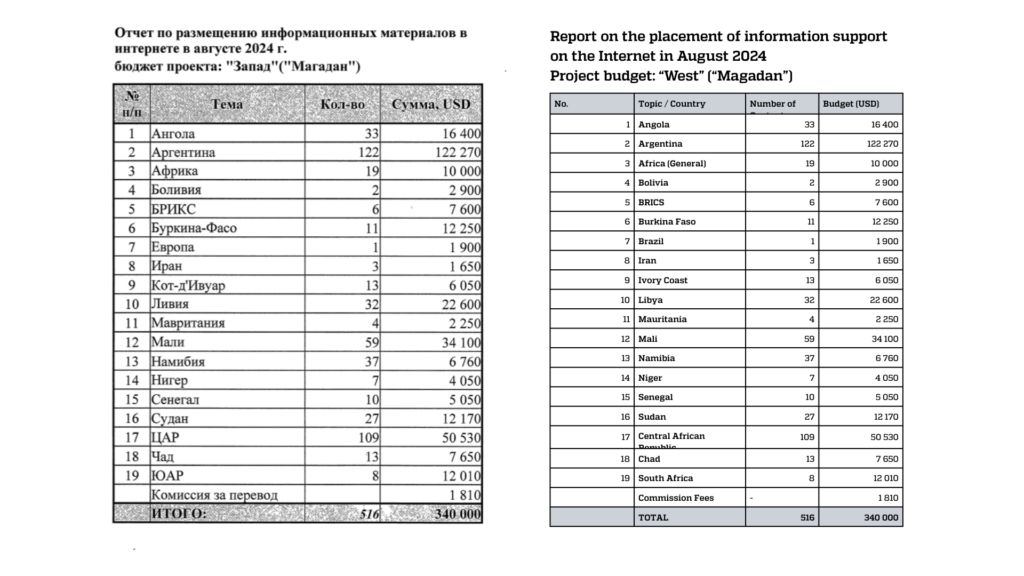
An internal report on the placement of articles, videos and social media posts in August 2024, with a budget of $340,000 for an anti-Western project called “Magadan.” (Graphics: Sofía Álvarez Jurado / Forbidden Stories)
Payment in exchange for media coverage is one of the dominant tactics these operations use. Monthly spending on the publication of articles often exceeds $300,000. Some journalists and media outlets were paid up to $600 in Benin, $2,500 in Argentina and even $10,000 for an article on Libya, according to financial tables Forbidden Stories and its partners analyzed. Hundreds of journalists have been recruited to relay the Company’s talking points.
The leaked documents identify the Central African radio station Lengo Sengo, which dismissed Forbidden Stories’ first investigation for its “false allegations,” as a key player in the Russian campaign in the Central African Republic. In May 2024, a budget of nearly $100,000 was earmarked partly to finance the operation of the media outlet. At that time, the Central African Republic was the country with the highest expenditure, followed by Mali, South Africa and then Niger. Each represents the Company’s bold ambitions in the region.
Russia’s belt of influence: A plan to reformat Africa
Understanding Russia’s foreign influence strategy means going back to 2023, the date of one of the oldest files from the leak. This document reveals the existence of a project called the “Confederation of Independence,” which has remained secret until now. Presented as the “center of the future expansion of Russian influence,” this confederation is intended to dismantle what the report’s authors describe as “the belt of instability built by the West.” They accuse France of having formed this belt with “the help of fundamentalist Islamist groups starting in the 1990s” and envisage “creating the conditions to respond to African countries’ demand for independence from the colonial policy of the collective West.”
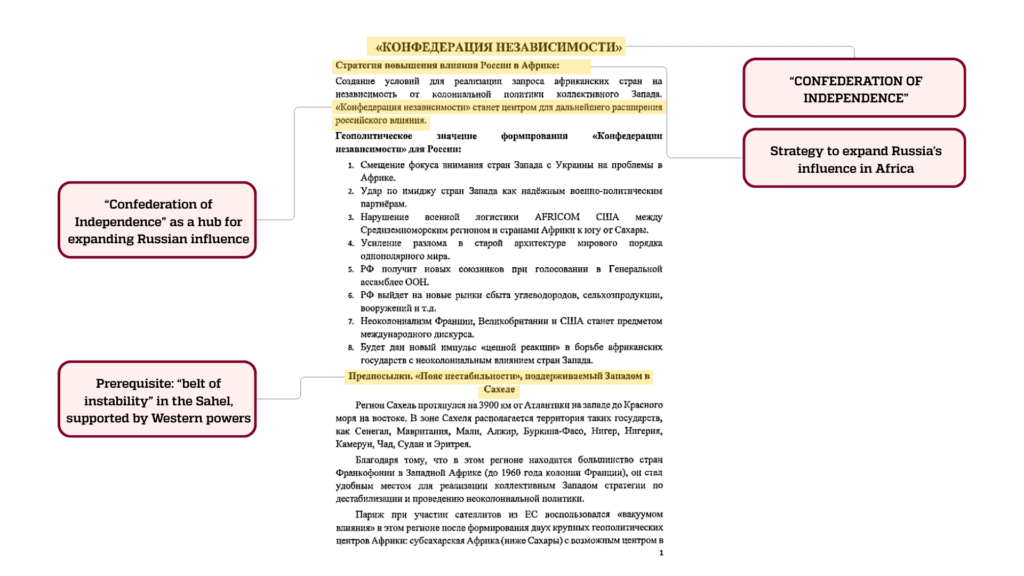
The first page of the internal document “Confederation of Independence,” seemingly dated August 2023, outlining a country-by-country strategy for the coming months (Graphics: Sofía Álvarez Jurado / Forbidden Stories).
Moscow has identified a distinct approach for rallying much of the African continent to its cause: exploiting resentment towards the former colonial powers and their allies, particularly France. From the very first pages, the roadmap is explicit. The aim is to undermine “the image of Western countries as reliable political and military partners”; “to turn the neocolonialism of France, the United Kingdom and the United States into an object of international controversy”; and “to disrupt the military logistics of AFRICOM,” the U.S. military command for Africa. The ultimate goal is plainly stated: “The Company is currently working on a plan to reformat the African space, with the creation of a belt of regimes friendly to the Russian Federation.”
Russia’s strategy manifested with the creation of the Alliance of Sahel States, or AES, bringing together Mali, Burkina Faso and Niger in September 2023. In these three countries, military coups overthrew the ruling powers and were accompanied by strong anti-Western rhetoric. Internal documents reveal a deeper level of Russian involvement in their partnership than was ever previously suspected. European media blocked, NGOs banned, military-technical cooperation agreements terminated: The tally of past victories is clear. Moscow’s agents claim to have played a decisive role in the genesis of the AES. The current plan anticipates an expansion to other African countries to form “the largest anti-Western coalition in Africa,” from early 2024 onwards.
To achieve this, the document outlines courses of action for each country. In particular, it recommends “exporting security to neighboring countries based on the experience of the Central African Republic’s liberation … by Wagner specialists.” In Chad, the aim is to remove the country “from the sphere of influence of France and the United States” by “limiting the ability of French forces to use their military base to violate the airspace” of neighboring countries. This dynamic would ultimately force N’Djamena, “caught in a vise by pro-Russian forces, to turn to increased cooperation with Russia.” In another document, the stated objective in Libya is to “create chaos in the military and political situation in western Libya.” Many elements of this roadmap have since been implemented, as evidenced by two documents entitled “Work Plan” and “Key Results” dated September 2024.
Work plans drafted and results obtained by Russian influence agents in Africa and Latin America in September 2024—original version on the left, English translation on the right (Graphic design: Sofía Álvarez Jurado / Forbidden Stories).
From Prigozhin to the SVR: The Company’s transformation
The shadow of one man looms large over all these operations: Yevgeny Prigozhin. He died in a plane explosion on Aug. 23, 2023, two months after a coup attempt that brought his men within striking distance of Moscow. Far from disappearing with its founder, the Company has reorganized and grown even stronger. Its members continue to pay tribute to their former leader. Among the 200 pages of expense reports Forbidden Stories analyzed is an order for 245 carnations — highly valued flowers in Russia known as symbols of remembrance and mourning — for a total of 12,347 rubles ($160), placed exactly one year after the oligarch’s death.
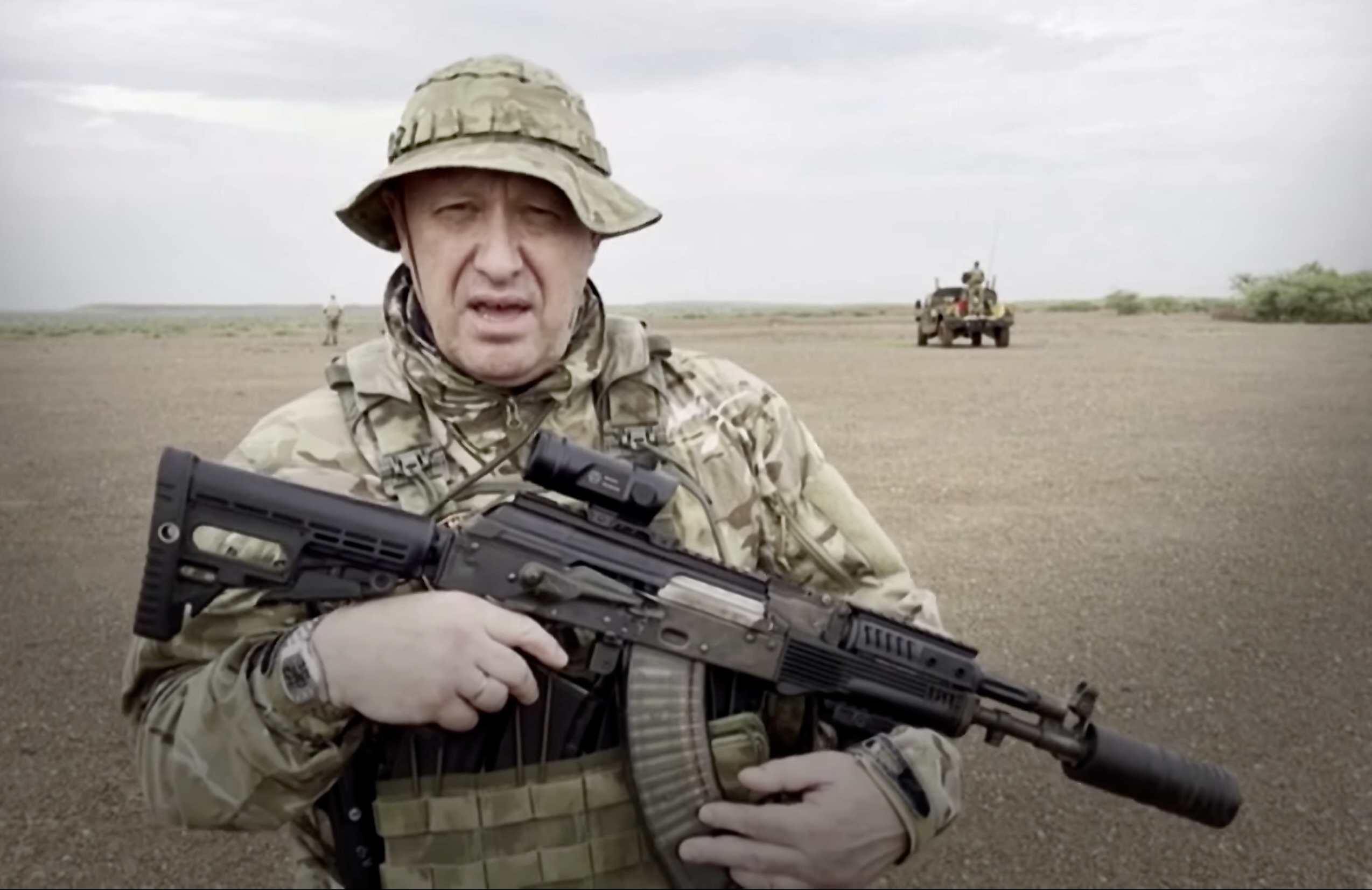
A screenshot taken from a video published on Aug. 21, 2023, on one of the Wagner Group’s Telegram channels. In it, Yevgeny Prigozhin claims to be in Africa (Credit: Telegram @Razgruzka Vagnera).
The Company gradually came under the control of Russia’s Foreign Intelligence Service, or SVR, with their close relationship already apparent in several places in the 2023 internal document. Notably, it references the Company soliciting the SVR to “infiltrate an agent of Russian influence into the leadership of MINUSCA,” the United Nations Mission in the Central African Republic. The SVR was also asked to “present the Company with available information concerning French and U.S. plans for military and political presence in the Sahel,” for the purpose of limiting the “harmful influence” of Western powers.
According to European security sources, by the end of 2023, the SVR had transitioned from a support role to directly supervising these operations. However, establishing a financial link between the Company and the SVR remains complicated: Budgets appear to be partly managed in cash, making it difficult to track financial flows. But the project managers haven’t changed.
Prigozhin’s former associates are still very much present in the Company. Among them, Sergei Vasilievich Mashkevich occupies a central position. A detailed biography is included in the leaked documents. Since joining the organization in October 2018, he has held several strategic positions, even heading a mission in Sudan. In 2024, Mashkevich played a crucial role in stabilizing the regime of Luis Arce, Bolivia’s president at the time. “He was directly involved in developing and approving a strategy to mitigate the effects of the attempted ‘self-coup’ in Bolivia” by “arranging for a group of specialists to travel to La Paz,” according to his biography, glowingly written by his colleagues. It goes on to describe him as a specialist “capable of making thoughtful decisions and finding innovative, rational approaches to solving tasks,” presenting him as the mastermind of the network.
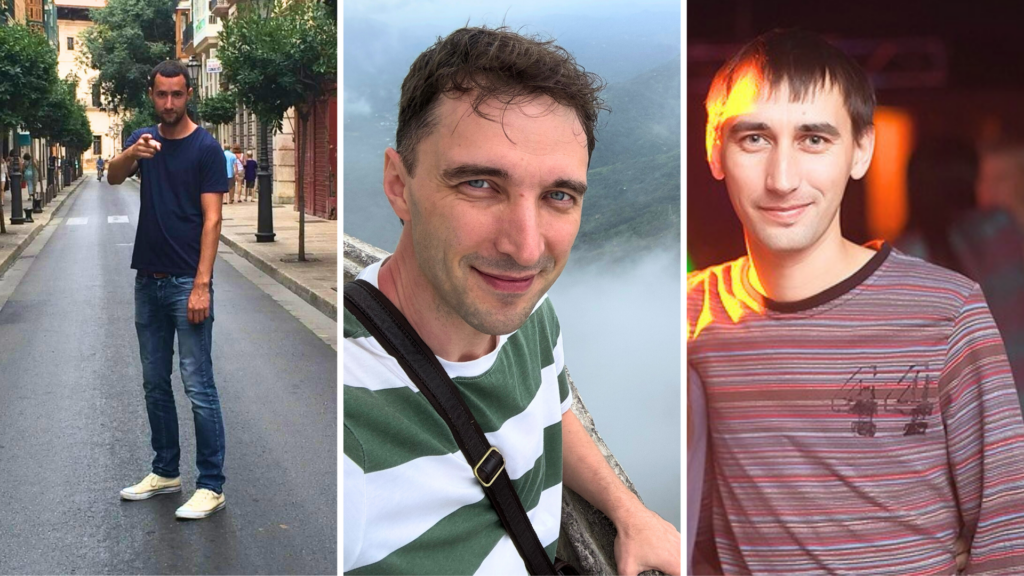
From left to right: Sergei Mashkevich, Sergei Klyukin and Artem Gorny, former members of Prigozhin’s circle who still hold high-ranking positions within the Company (Source : social media).
At Mashkevich’s side is Sergei Sergeyevich Klyukin. He operates from the Company’s offices in St. Petersburg and, like his colleague, is a former lieutenant of Prigozhin who spent time in Sudan. Until now, his strategic role within the network not been publicly disclosed. Since January 2024, he has been supervising the work of the analysis units, a group of 34 specialists tasked with monitoring 15 target countries.
Artem Vitalyevich Gorny completes this trio. Financial records and receipts from the leaked documents show that he directly oversees the organization’s expense reports and logistics.
In the field, other agents take over, as shown by copies of airline tickets to Bamako, Johannesburg and Dubai consulted by Forbidden Stories and its partners. While many operate in secret, leaked data and security sources have enabled this investigation to identify at least 60 agents out of the nearly 100 the Company employs.
Intelligence, propaganda and destabilization
In document after document, the code names appear: Project Magadan in the West, Project RCA Media in Central Africa, Project Lipetsk in the Middle East. The data leak reveals for the first time the true scale of this worldwide initiative, dubbed “Global South,” which was carried out over four months between February and May 2024.
The method is tried and tested, with the same sequence described for each target country. After the preparation phase — surveying, mapping actors, approaching high-ranking political figures and gradually infiltrating opinion leaders — destabilization operations can be launched and amplified by local media.
In South Africa, for example, the Russians ordered racist mugs for the birthday of the leader of the Democratic Alliance, the opposition party to the African National Congress, with the aim of leveraging its historical perception as the “white party” to further tarnish its image.
In Namibia, in the run-up to the 2024 presidential elections, Russian operators fabricated and circulated a fake letter attributed to the United Kingdom, accusing the country of secretly financing the opposition in exchange for benefits related to oil extraction. The effect was immediate and widespread. According to the Company’s own estimates, the news reached 1.7 million people on social media, prompting an official denial. It successfully discredited the opposition and strengthened the image of the pro-Russian ruling party.
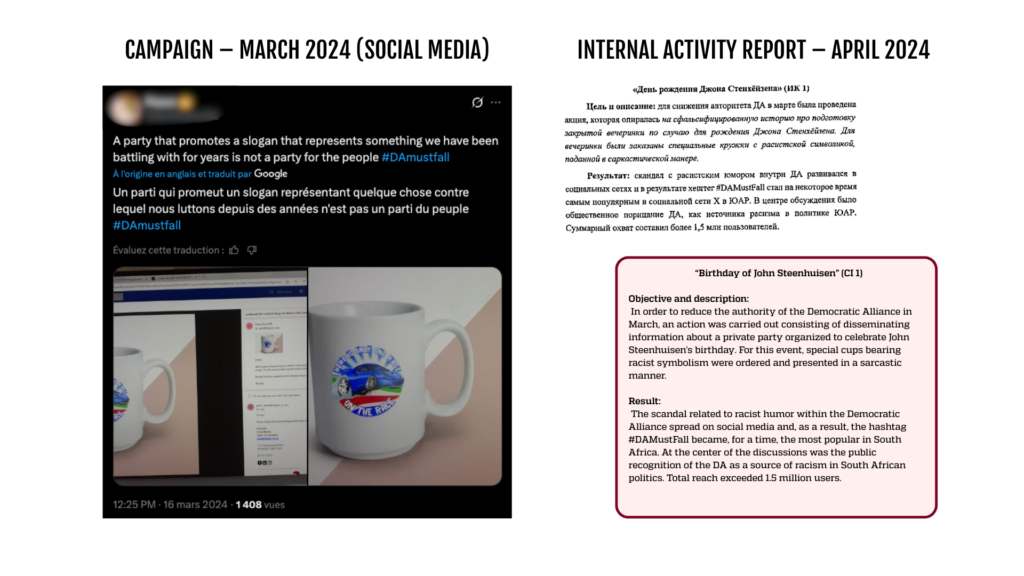
On the left, a screenshot of an internal document dated April 11, 2024, listing “ongoing information campaigns,” including the one about racist mugs. On the right, a translation of this document into English and a screenshot of a post on X about the campaign, published a month earlier (Graphics: Sofía Álvarez Jurado / Forbidden Stories).
Other campaigns were not as successful. In Senegal, for example, the document from August 2023 envisaged a coup d’état. Its aim would be “to initiate a rapprochement with Russia,” in which “the SVR was to support the local armed forces with official Russian forces” if the coup was carried out, with a final directive of “suppressing or encouraging civil protests, depending on the chosen scenario.”
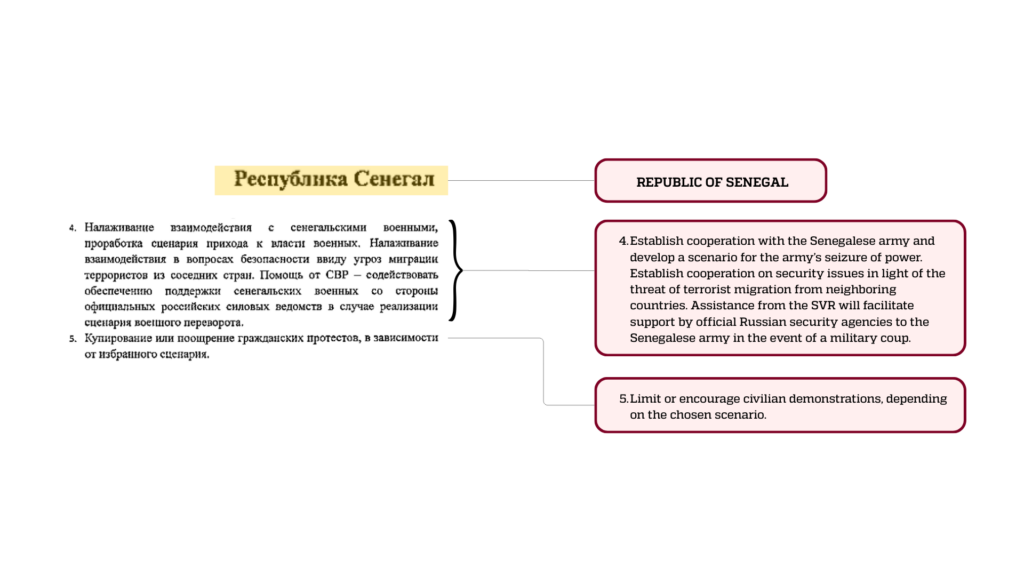
Screenshots from a 2023 document in which a strategic plan is developed for Senegal (Graphics: Sofía Álvarez Jurado / Forbidden Stories).
These political interference campaigns are coupled with economic offensives. Documents Forbidden Stories and its partners consulted reveal the central role Russian operators played in defining Moscow’s geostrategic objectives. In a February 2024 document, for instance, the Company claims responsibility for Mali’s new mining code, put forth by the junta a year earlier. Its purpose is twofold: to discredit foreign actors and revise existing contracts to the benefit of Russian companies and investors.
In Angola, the Lobito Corridor project, a vital rail artery for mineral exports, is identified as the priority target of a disinformation campaign concerning American and European managers of the infrastructure.
The Company writes that it carried out a similar operation in Niger against the French firm Orano. According to the internal documents, the orchestrated media pressure contributed to the Nigerien authorities’ decision to revoke Orano’s licenses to exploit the uranium deposits at the Imouraren mine. Each of these campaigns is an illustration of the Company combining lobbying, influence and disinformation to reshape the economy of strategic resources.
Support us so that we can continue investigating
We need your help to expose what the enemies of the press try to keep quiet.
Across all of the targeted areas, Russian plans often include an anti-Ukrainian component. In several African countries, for example, a campaign coordinated by Klyukin entitled “Ukraine is a country that supports terrorists in Africa” illuminates how Moscow seeks to impose a global narrative designed to shape public opinion and legitimize its invasion of its Ukrainian neighbor. In August 2024, in Argentina, the Company claims responsibility for unfurling a banner denouncing support for Kyiv during a first division soccer match at the Libertadores de América stadium. This episode, seemingly innocuous and isolated, is in fact part of a much broader strategy.
The leaked documents are, of course, intended for internal use. Reading them exposes the bias of their authors, who praise their alleged exploits — even if it means taking credit for the achievements of other organizations — and systematically gloss over their failures. When contacted, none of the individuals in this network, nor the Russian Foreign Intelligence Service, responded to Forbidden Stories’ questions. While their actual effectiveness and impact remain difficult to measure, the scale and regularity of these campaigns point to a long-term global strategy. Their existence clearly highlights the Company’s ambitions and means, without any embellishment.
That is what Forbidden Stories and its partners will reveal in their upcoming publications, deciphering the structure behind this sprawling network, from Saint Petersburg to Bolivia. The investigation will shed light on how this network shapes the Sahel region, orchestrates operations in Latin America and integrates smear campaigns against political parties into its overall strategy.