- Reading time: 10 min.
Radio silence: An investigation into the governor of Kabul
Promoted to governor of Kabul in late 2023, Aminullah Obaid cut his teeth in central Afghanistan’s Daykundi Province. He is a hard-line figure, despite his apparent affability. In 2023, journalists at a local radio station felt the brunt of his authority; their editor-in-chief, deemed too critical of the regime, was sentenced to one year in prison for accusing him of embezzling humanitarian aid. Nothing is known about Obaid’s past. Forbidden Stories and Etilaatroz investigated this governor, who was unknown before the Taliban’s return to power in 2021.
Credits: Christophe Cerisier
- Afghan radio station Radio Nasim has ceased broadcasting in Daykundi Province, and its editor-in-chief, Ali Jawadi, is currently in hiding in Pakistan. Forbidden Stories has obtained a copy of the “fatwa,” or court order, against Jawadi. He is accused of having reported on the Taliban’s extortion of NGOs, among other offenses.
- Aminullah Obaid, the current governor of Kabul and a close associate of the Taliban’s co-founder, was the first to target Radio Nasim’s journalists. More than 20 testimonies have helped to trace his career.
- Internal documents from the Special Inspector General for Afghanistan Reconstruction, or SIGAR, contain exclusive testimonies accusing Taliban authorities of embezzling humanitarian aid.
By Eloïse Layan
April 13th 2026
The days of Afghan journalist Sultan Ali Jawadi are filled with anxiety. In the Pakistani city where he has taken refuge — the name of which he prefers to keep secret — he lives in constant fear of being forcibly repatriated to Afghanistan.
Pakistani police are stepping up their raids, targeting neighborhood after neighborhood; in 2025, 942,000 Afghans were expelled from Pakistan, according to the United Nations. For Jawadi, a forced return would amount to a death sentence.
In late 2025, after yet another interrogation, he fled his home in the Hindu Kush mountains of Daykundi, a province neighboring the famous Buddhas of Bamiyan. Jawadi is a well-known voice for change in this majority Hazara territory, ruled by a predominantly Pashtun Taliban. As editor-in-chief of Radio Nasim, the region’s most-listened-to local station with an audience of 300,000, he champions progressive ideas, advocating for women’s rights and education.
But since the Taliban came to power in August 2021, Jawadi has seen his freedom of speech slipping away. In August 2025, four years after the Taliban seized Kabul, he was arrested for the 12th time — one too many. The journalist gave in, and Radio Nasim stopped broadcasting: “For 13 years, we were the voice of hope, kindness, awareness and life. … But today, with a heavy heart, we must say, ‘We can’t go on any longer.’”
Since the Taliban returned to power, a veil of silence has fallen over Afghanistan. More than 75 journalists have been arrested, and hundreds have fled the country. Some 95% of women have had to leave the profession, according to the International Federation of Journalists. Any criticism of the regime is condemned, and “simply writing about a traffic accident can be problematic,” said a journalist now in exile, speaking on condition of anonymity. Yet, from France, the United States and Canada, exiled newsrooms continue to scrutinize the regime, relying on networks of anonymous correspondents.

Ali Jawadi on the air at Radio Nasim before his exile.
To give Radio Nasim a voice again, Forbidden Stories investigated the first man to target its radio journalists: Aminullah Obaid, the former provincial governor. It was when the station directly implicated Obaid — accusing him of helping to embezzle humanitarian aid — that Jawadi was arrested and sentenced to one year in prison. Together with the Washington-based Afghan investigative media outlet Etilaatroz, Forbidden Stories traced the career of this mysterious figure within the Taliban regime — a man deeply secretive about his past, whose influence is nevertheless evident in his rise through the ranks. In late 2023, Obaid was appointed governor of Kabul.
Accusations of “propaganda” and “espionage”
Upon his arrival in Daykundi in 2021, Obaid promoted a moderate image of the Taliban. Just over three months after the group seized power, he even gave a nearly 40-minute filmed interview to Radio Nasim. With a smile on his face, he explained his policies and promises to Jawadi. Jawadi remained critical, questioning him about forced population displacement, women’s rights and the region’s economic situation.
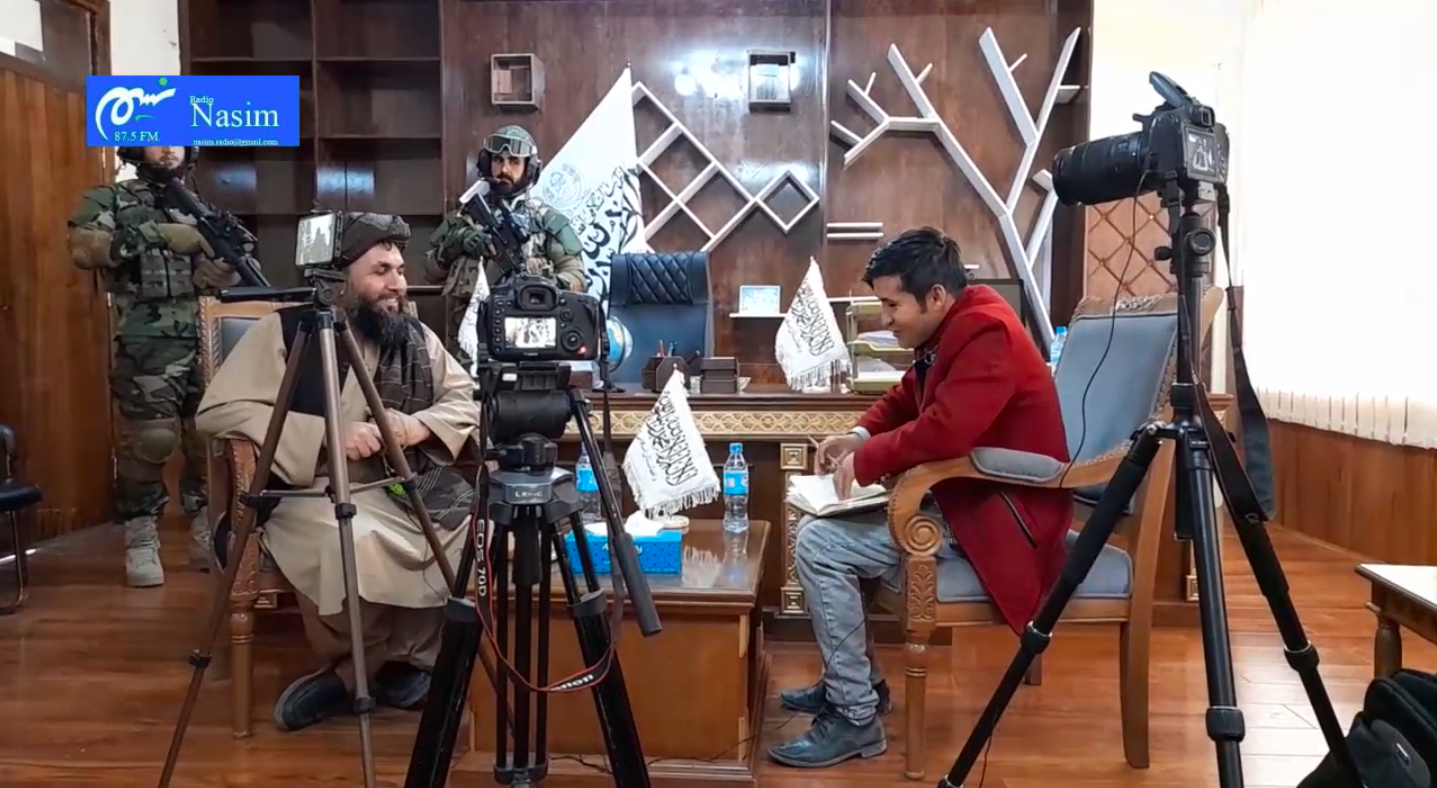
An interview with Aminullah Obaid by Ali Jawadi in December 2021 for Radio Nasim. Upon coming to power, Obaid appeared friendly toward journalists.
“He wanted to have a good relationship with the media, so that we would report on his successes in the province,” said a journalist from the region. Several members of civil society who met Obaid describe him as “sociable” and “affable.”
“In his presence, I dared to criticize certain policies of the regime, particularly regarding girls’ access to education, but was imprisoned shortly after,” said a teacher. Through such accounts, a different image of Obaid emerges: one of an unforgiving man.
Allegations of "propaganda" and "espionage"
“The Taliban may listen to you, and even nod in agreement, but at the end of the day, they will always do what their supreme authority tells them to do. And that is exactly what they did during the negotiations with the United States in Doha,” said Javid Ahmad, Afghanistan’s former ambassador to the United Arab Emirates. Since the fall of Kabul, he has been compiling information on the regime’s new rulers in his Taliban Leadership Tracker.
Jawadi is accused of having “reported that people in the region are poor” — one of his “crimes,” according to the complaint filed against him by the Daykundi intelligence directorate and confirmed by the “fatwa,” or court order, that followed. Jawadi has endured interrogations, torture and detention for alleged “espionage” and “propaganda” against the regime.
In December 2023, he was sentenced to one year in prison. At that time, trials against journalists were rare. A document Forbidden Stories obtained from the Supreme Court of the Islamic Emirate of Afghanistan — the name the Taliban give to their regime — lists his eight other “crimes.” The court accuses Jawadi of providing information to foreign institutions and media outlets about the closure of girls’ schools, journalists being “threatened and beaten,” and cronyism within the administration. But the primary charge against Jawadi, which he denies, is that he told them about local authorities’ extortion of NGOs.
When publishing criticism of the government, the Radio Nasim team took the precaution of not naming the authors of their articles. But Jawadi’s sentence was left to the judge’s discretion: no evidence or witnesses needed. “In matters concerning the rights of Allah Almighty, the report of two individuals or one just person — even if the two are concealed witnesses — is sufficient to establish Ta’zir,” the fatwa says in reference to Jawadi’s punishment.
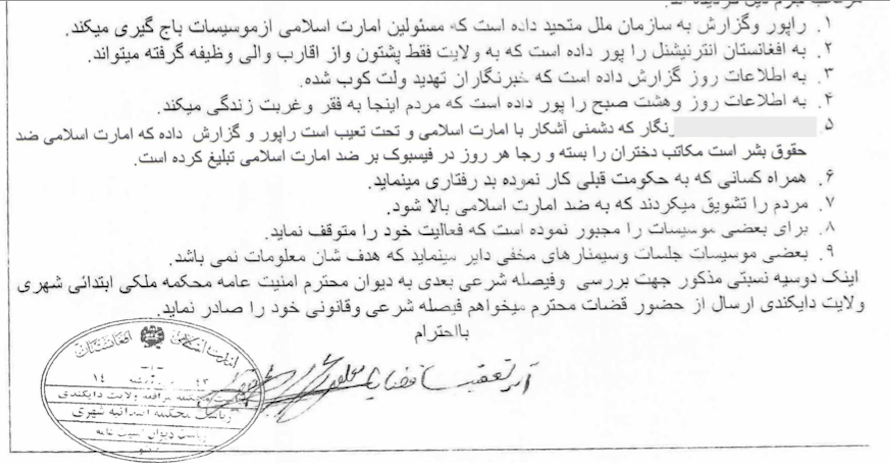
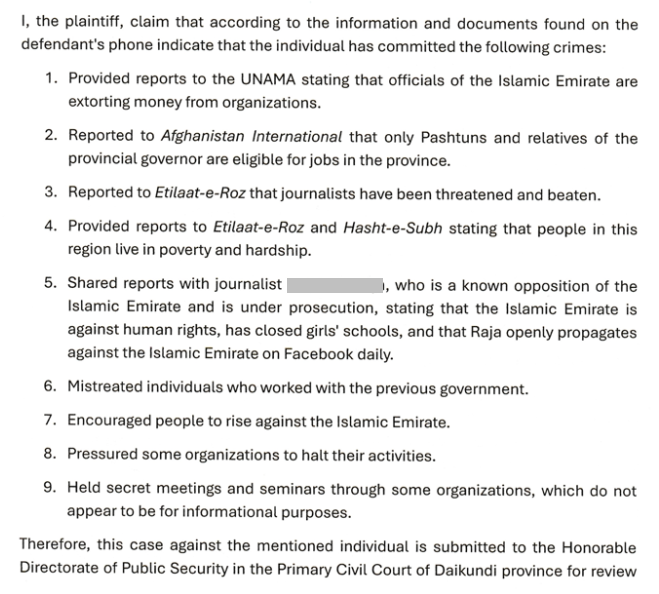
Excerpts from the charges against Jawadi, drawn up by the Daikundi intelligence services and submitted to the court
Across the province, the outspoken figures who Radio Nasim regularly had on their platform now fear for their lives. “We were on the radio very often. We spoke about freedom, women’s education, and we fought against religious extremism,” said a human rights defender, described by the Taliban as “a reporter, spy and collaborator with international organizations, who has led the youth astray.”
Amid death threats, the human rights defender has seen his name appear on a “list compiled by the Taliban” of people to be killed, according to an email Forbidden Stories reviewed from the United Nations Assistance Mission in Afghanistan, or UNAMA. The message is clear: he must be eliminated. “Authorities in the Central Highlands are responsible for increasing their activities based on Islamic principles against spies and hypocrites, whose names are below. They are to be suppressed, eliminated and their benefits destroyed,” the document states — evidence of kill lists and central directives that local governors are tasked with enforcing. According to testimonies from five sources gathered by Etilaatroz in Daykundi, Obaid set up a small group of collaborators assigned to target, interrogate and torture human rights activists.
No record of Obaid’s activities before 2021
When he was appointed to Daykundi, Obaid was a new face in the Taliban leadership. Nothing is publicly known about his background or his service to the movement. Nevertheless, he is highly active on his X account, created in 2022. In his posts, Obaid inaugurates a bus terminal, inspects checkpoints, visits a camp for returnees from Pakistan and Iran, and holds numerous press conferences — where, unsurprisingly, he defends the regime. “We must preserve this system,” he said before an audience of governors in December 2025. But there is no trace of his past prior to the Taliban seizing back power.
Since 2021, the Taliban have appointed hundreds of individuals to strategic positions. “It is crucial to know their past — which may be violent — their supporters and their technical skills. And sometimes, simply to know who we’re dealing with,” said former ambassador Ahmad.
Many governors are former Taliban commanders. Their identities are sometimes concealed, explained Shahmahmood Miakhel, who served as defense minister under Ashraf Ghani, president of Afghanistan from 2014 to 2021. “Even the regime’s spokesperson, Zabihullah Mujahid — we don’t know his real name. These people are used to seizing power and losing it, concealing their identities and pasts, and evading sanctions,” he said.
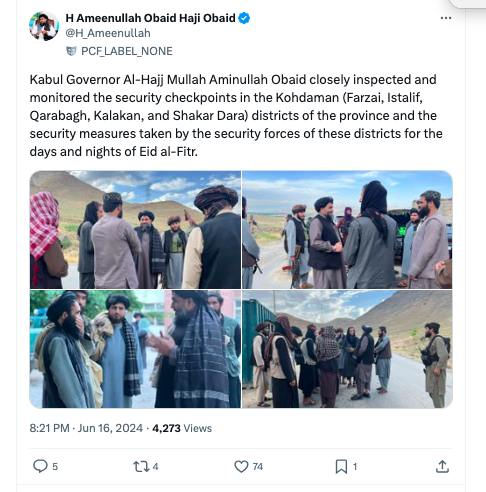
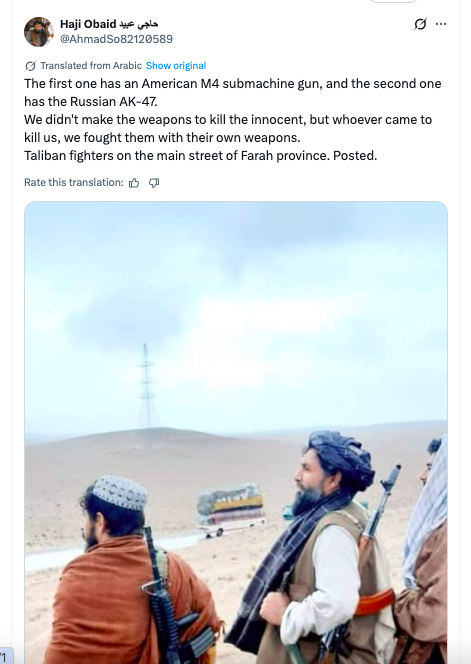
Left: Aminullah Obaid’s X account (Credit: X).
Right: A photo of Aminullah Obaid during the war with the caption, “The first has an American M4, the second a Russian AK-47. We did not make weapons to kill innocents, but those who come to kill us, we will fight with their own weapons. Taliban fighters on a main road in Farah Province.”
Forbidden Stories and Etilaatroz have uncovered rare photos of Obaid, posted on X by a pro-Taliban account in 2020, before he came to power. In one of them, wearing a blue turban and an AK-47 slung over his shoulder, he is surrounded by two other fighters. The post’s caption: “Those who come to kill us, we will fight with their own weapons. ”
A security source explained that Obaid reportedly led a Taliban “front” in the Hazarajat region — which includes Daykundi Province — during the Taliban insurgency, and that he was one of their shadow governors during the Republic in 2007. “He was a shadow governor of Daykundi, but also of Baghlan Province. He commanded a large number of fighters,” another intelligence source added.
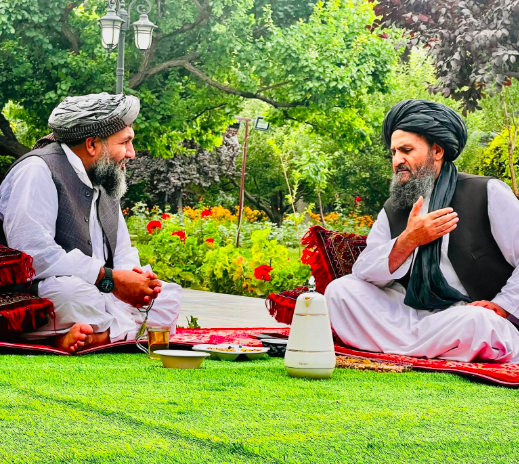
Aminullah Obaid and Mullah Brother, co-founder of the Taliban and the regime’s second-in-command.
About 20 testimonies, collected by Etilaatroz in the Farah, Herat and Nimroz provinces of Afghanistan from people who crossed paths with Obaid, have shed light on the regime’s new strongman. All testimonies have been anonymized for security reasons.
Aminullah Obaid — official records confirm his name — is reportedly from the village of Gajgin, in the Pusht Rod district of Farah Province in the western part of the country, near the Iranian border. He is the “son of a man who had no ties to the Taliban and was known for his good character,” said one of the interviewees.
During the war, after the fall of the first Taliban regime in 2001, Taliban co-founder Mullah Abdul Ghani Baradar took refuge at Obaid’s home, according to a source. On the run, the man nicknamed “Mullah Brother” reportedly stayed with Obaid for six months. In addition to his tribal affiliation — Obaid belongs to the Pashtun Noorzai tribe, just like Emir Haibatullah Akhundzada, the supreme leader of the Taliban — this personal connection may explain Obaid’s rise, according to two accounts. In June 2025, he was photographed having tea with Baradar, now deputy prime minister of the Islamic Emirate of Afghanistan, sitting on a well-manicured lawn in front of beds of poppies.
Humanitarian aid: A crucial issue for Afghanistan
When questioned, residents of Farah Province recalled that Obaid had been accused of “extorting money from merchants, investors and greenhouse owners” along with his brother, nicknamed “Mullah Masoom.”
“Because they were armed and had Taliban forces with them, they were able to make money during the war, keeping some for themselves and giving another portion to the Taliban,” said an interviewee.
For the regime, Radio Nasim ventured too far into the taboo territories of corruption and embezzlement. The Taliban’s seizure of power was accompanied by a promise to practice integrity and fight corruption, which was rampant under the Republic’s governments. The first charge against journalist Jawadi is that he “provided reports to the United Nations stating that the authorities of the Islamic Emirate are extorting money from (humanitarian) organizations,” which Jawadi denies. In Daykundi, the misappropriation of humanitarian aid is a real concern for UNAMA, which oversees humanitarian activities in the country — so much so that in 2022, aid was temporarily suspended. Fifteen NGOs have also halted their operations.
“There are provinces where the governor is more reasonable.”
The sticking point is Obaid. “Daykundi is a region where we’ve had a lot of problems with a certain governor. There are provinces where it’s simpler, where the governor is more … reasonable, I’d say,” said a UNAMA employee, speaking on condition of anonymity.
“There was a clash between Obaid and the United Nations,” said a western expert. “In Daykundi, there was an issue of aid diversion, with lists of beneficiaries imposed by the governor … and, among them, people close to the Taliban.”
Billions have been spent in the country, which has long been dependent on humanitarian aid. During the Republic era, 75% of the government’s budget was funded by international aid, which accounted for 45% of Afghanistan’s GDP. Nearly $5 billion a year was injected into the country between 2002 and 2021.
“We must keep in mind that in recent years, even though embezzlement exists, it has nothing to do with the corruption of the previous government (under the Republic), which reached unimaginable proportions, especially given the enormous amounts of aid involved. … The flow of money today is incomparable,” said Jean-François Cautain, former European Union ambassador, who was based in Kabul for many years.
In early 2025, the United States halted its humanitarian aid to Afghanistan, which made up 36% of total aid. The impact of the cuts has been devastating for the population. “Think of the World Health Organization, which had to close 364 primary health centers in Afghanistan,” Cautain said. The country, facing a resurgence of hunger, is now sinking into poverty. And the Taliban regime, despite its pledges of integrity, is looking to profit from the situation.
Unprecedented and damning testimonies
Since 2008, the U.S. Special Inspector General for Afghanistan Reconstruction, or SIGAR, has been auditing the international community’s expenditures. Even after U.S. troops withdrew from the country in 2021, this government agency continued to publish its financial audit reports until it was dissolved on Jan. 31, 2026. One of these reports, “A Broken Aid System,” released in August 2025, examines the new regime’s misappropriation of aid. It proposes drawing lessons from this, “in the event that U.S. aid were to resume in Afghanistan.”
Forbidden Stories gained exclusive access to internal documents related to this report that have never been published: a collection of 85 interviews, conducted primarily with actors on the ground. Giving these testimonies was extremely risky for the sources. Speaking to Americans could cost them their lives. The Taliban killed “Interviewee Y” (see below) for exposing the situation in his province and for having been in contact with U.S. institutions. “Everyone is afraid of them. So we hide the truth,” said one SIGAR source.
Forbidden Stories is revealing excerpts from these interviews for the first time:
These accounts suggest humanitarian aid is being diverted to benefit the fighters, with the active complicity of local authorities. Governors themselves are reportedly involved in certain provinces:
And, while the security situation in the country has improved, at least five sources report that some agencies are now paying the Taliban to protect them:
The distribution of humanitarian aid also takes place against a backdrop of ethnic discrimination:
Forbidden Stories viewed these videos and photos. Indeed, they show bags of flour infested with worms. In other images, bags labelled “WFP” and “Not for sale” are displayed in stalls — clearly purchasable — representing evidence of humanitarian aid smuggling. Worse still, two sources in two different regions, including Daykundi, indicated that the aid was diverted to military bases. “Food is money,” concluded one of the interviewees.
In Kabul, Obaid continues his career. Surrounded by Taliban flags in his office, he still smilingly receives Afghan journalists, who have little choice but to fall in line. In May 2025, he also met with representatives of UNAMA, whom he asked to “coordinate” with the emirate and to base their efforts on the “real needs of the population.” Well-established in the Afghan capital, Obaid cultivates his relationships, meeting with business leaders and ministers.
The governor has also treated himself to a few getaways — including a visit to Istanbul documented in images posted on Facebook in January 2026 — despite the international community not recognizing the regime. At that time, the United Nations had just expanded the list of sanctioned Taliban members barred from travel. Obaid was not among them.
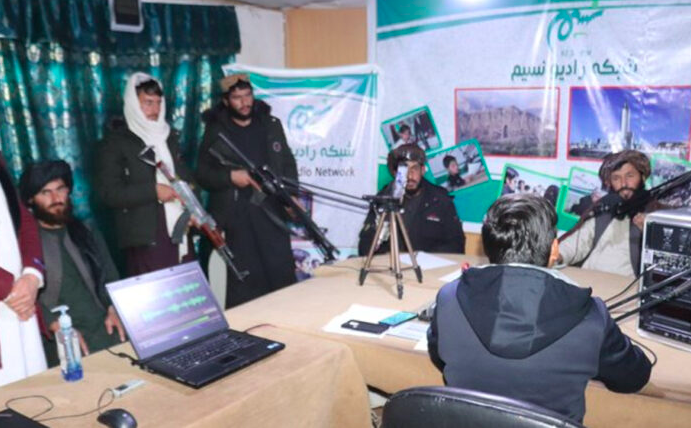
Radio Nasim’s offices in October 2021, during an interview with a Taliban official.
In April 2026, in Daykundi, Radio Nasim’s airwaves remain silent. The station has resumed broadcasting in the neighboring province of Bamiyan, but the staff has changed. New journalists produce cultural reports and broadcast speeches by Taliban authorities, without critique.
Jawadi, for his part, is trying to leave Pakistan. He hopes to be welcomed in Europe. “The situation is very difficult for me and my family; we were forced to leave the country,” he said. “But I did my job. I did what a journalist must do: document cases of human rights violations by the Taliban, highlight social and economic issues and people’s hardships, amplify the voices of victims and women, and raise public awareness. These are our responsibilities.”
He refuses to remain silent, until the very end.
Read also