- Reading time: 10 min.
Sixty Russian agents identified: Prigozhin’s influence network taken over by the Foreign Intelligence Service
Since Yevgeny Prigozhin died in August 2023, his sprawling network of propaganda agents has come under the control of Russia’s Foreign Intelligence Service. A data leak has allowed Forbidden Stories to identify more than 60 of its agents tasked with expanding Moscow’s disinformation efforts across three continents. This is the second article in the Propaganda Machine series.
Credit: Sofía Álvarez Jurado / Forbidden Stories
- In 2024, over 60 Russian agents were deployed to spread disinformation across three continents. At least 17 of them are former members of Yevgeny Prigozhin’s network.
- The Russian Foreign Intelligence Service now oversees their activities and provides financing through two front companies. This investigation reveals the identities of two Foreign Intelligence Service agents in charge of operations.
- The network, internally known as the “Company,” has established five offices abroad, including in Bolivia in 2024.
- With the help of “counter-agents” recruited in the field, the network also carries out intelligence missions.
By Eloïse Layan, Léa Peruchon, Sofía Álvarez Jurado
Lou Osborn (All Eyes on Wagner/Inpact), Dossier Center and Irinia Dolinina (IStories) contributed to this article.
February 20th, 2026
July 16, 2024, La Paz. A group of seven “Russian specialists” was dispatched to the Bolivian capital, coming to the aid of President Luis Arce. Part of the population was accusing him of having orchestrated a coup attempt to remobilize his electorate three weeks earlier.
Within a few days, the agents had organized an “anti-crisis headquarters,” followed by a working group within the Ministry of Communication. They set about rethinking the presidency’s “ineffective” communication strategy.
With opinion polls, “positive” language fed to the press and a “program to correct the public statements of Luis Arce and his vice president,” the unit rolled out its action plan. It even devised a series of smear campaigns against former president and current opposition member Evo Morales. But the “specialists” didn’t stop there. In order to “expand the network,” they decided to set up “an office … in country ‘B’” fit for 15 to 20 people — including potential local hires — and purchased 40 phones, 20 computers and 80 SIM cards.
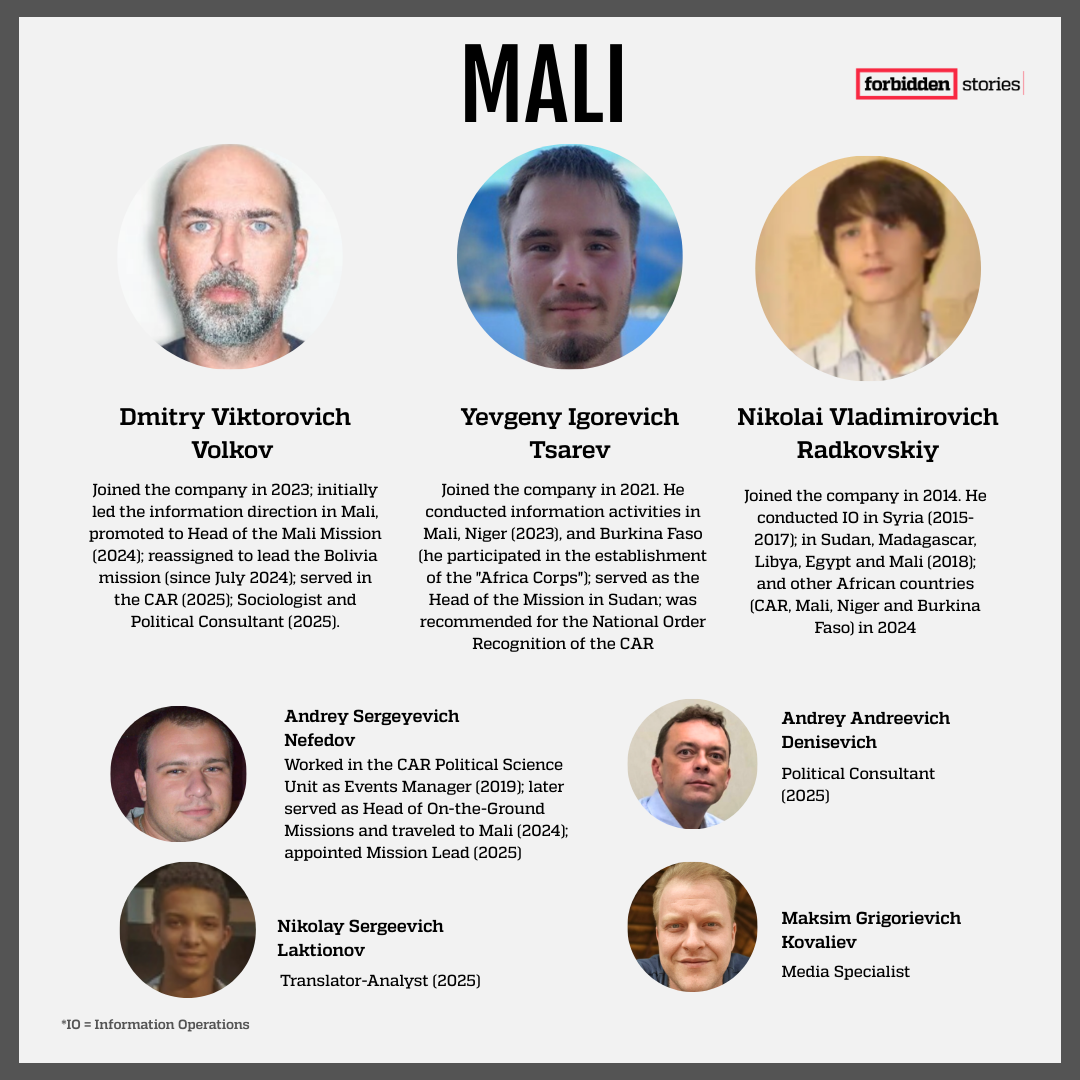
With its new agents in Bolivia, the Russian propaganda network grew. Until now, the “experts” had concentrated on Africa. In November 2024, Central African journalist Ephrem Yalike told Forbidden Stories about his two and a half years working for Russian agents, whom he knew only by their nicknames. Among them was Micha, a “young Russian” Yalike met several times in Bangui. A Forbidden Stories investigation revealed his true identity: Mikhail Mikhailovich Prudnikov, an information warfare specialist.
More than two years after the death of Yevgeny Prigozhin, founder of the Wagner Group and a key player in Russian disinformation circles, the Kremlin’s propaganda machine has not slowed down. Rather, it has accelerated under the control of the Russian Foreign Intelligence Service, or SVR, and spread across three continents.
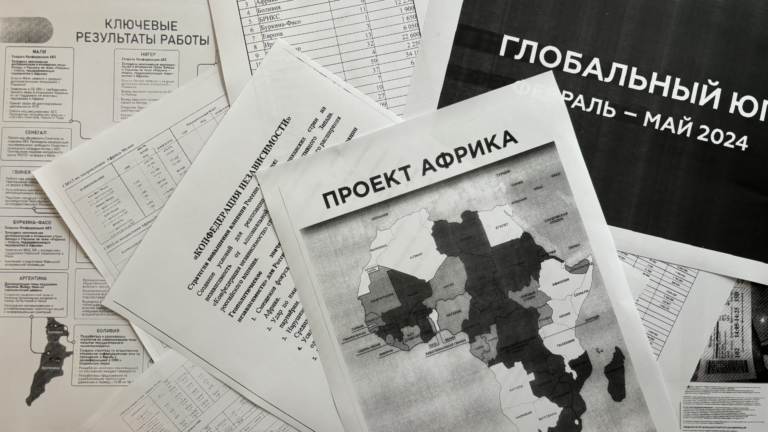
Thanks to a leak of 1,431 pages of internal documents, received by colleagues at the pan-African media outlet The Continent and shared with Forbidden Stories, this investigation will reveal for the first time the names of 60 of these agents, scattered between Saint Petersburg, Africa and Latin America. Airline tickets, collaborator biographies, campaign plans and budgets all provide evidence of their deployment and subsequent activities.
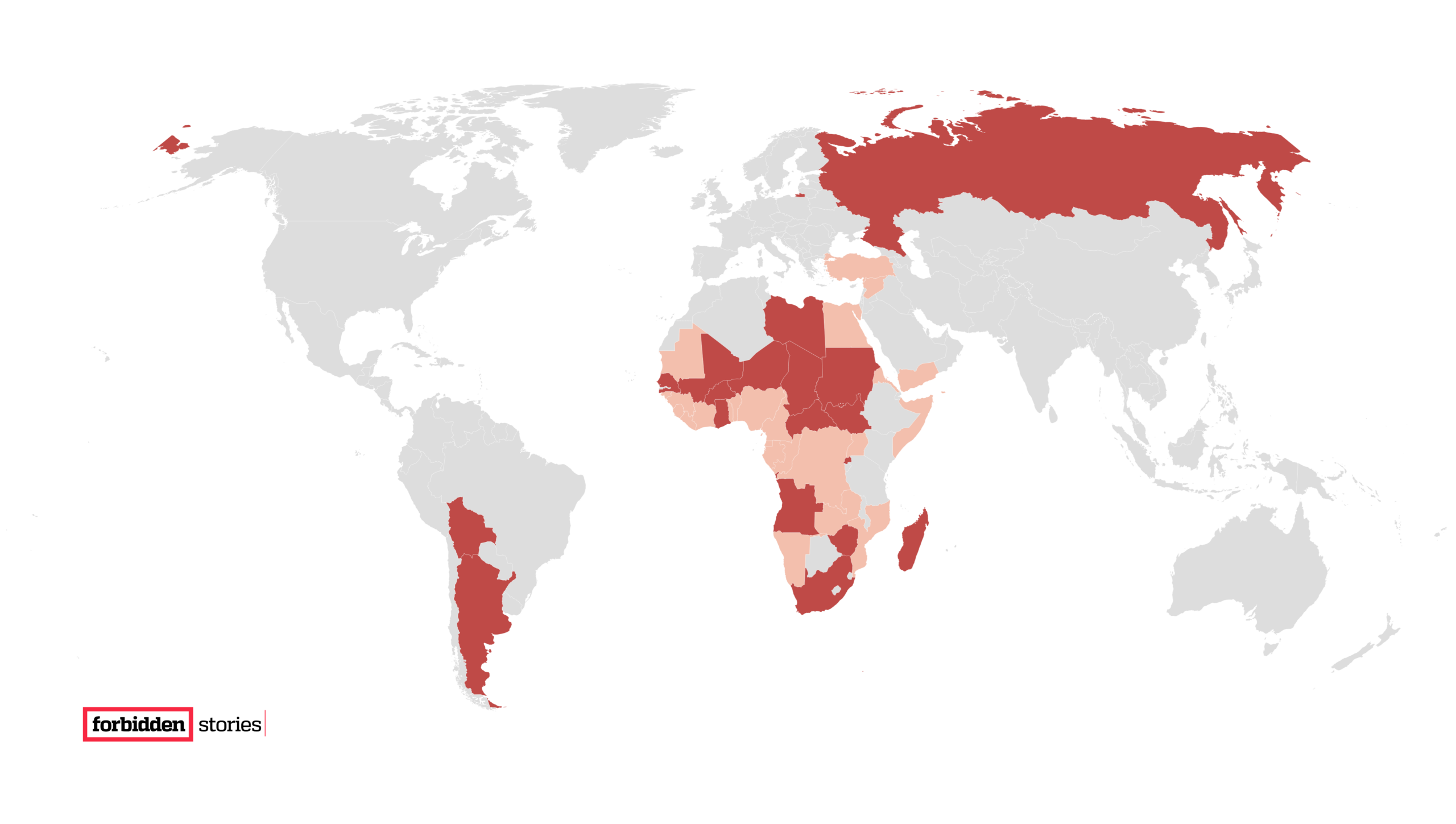
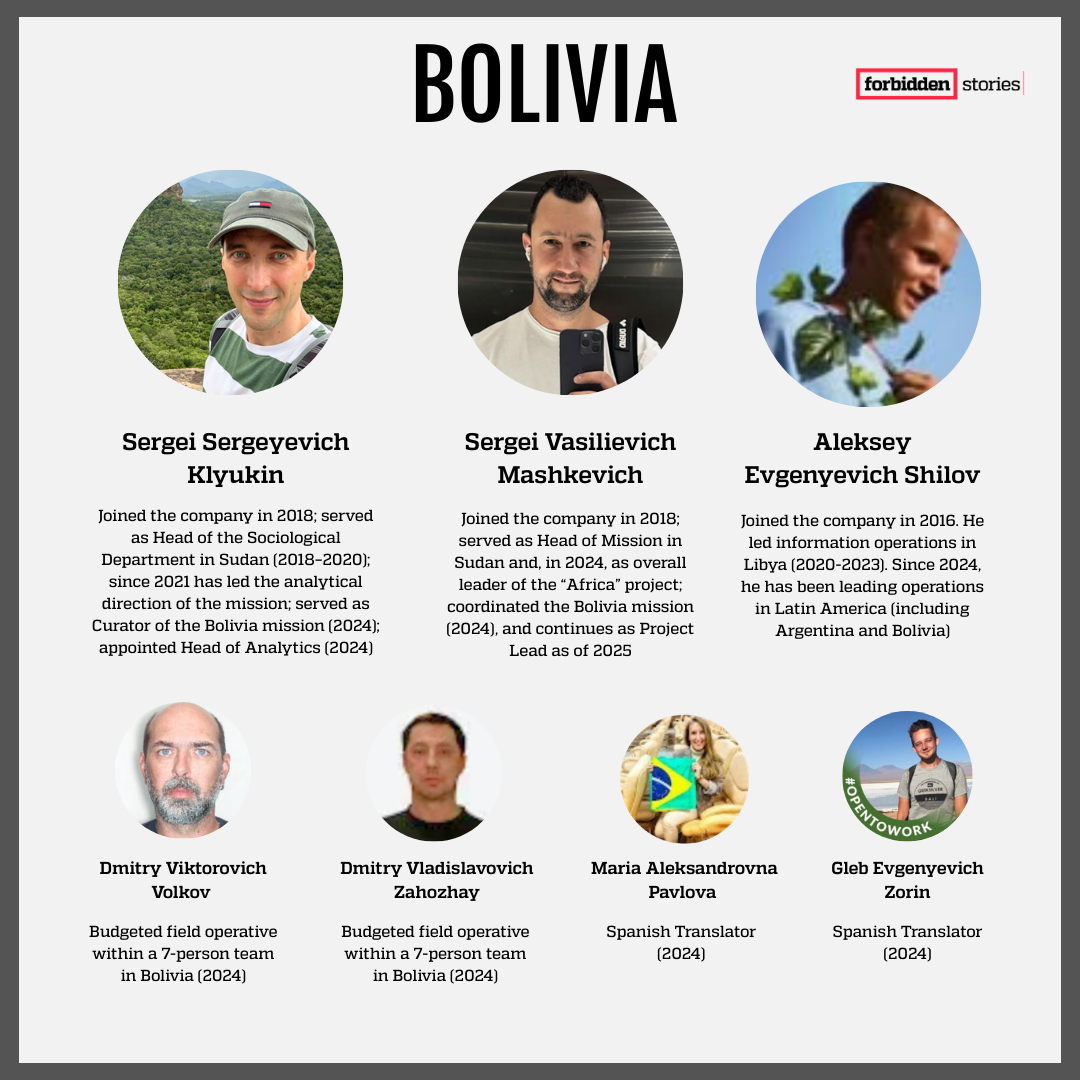
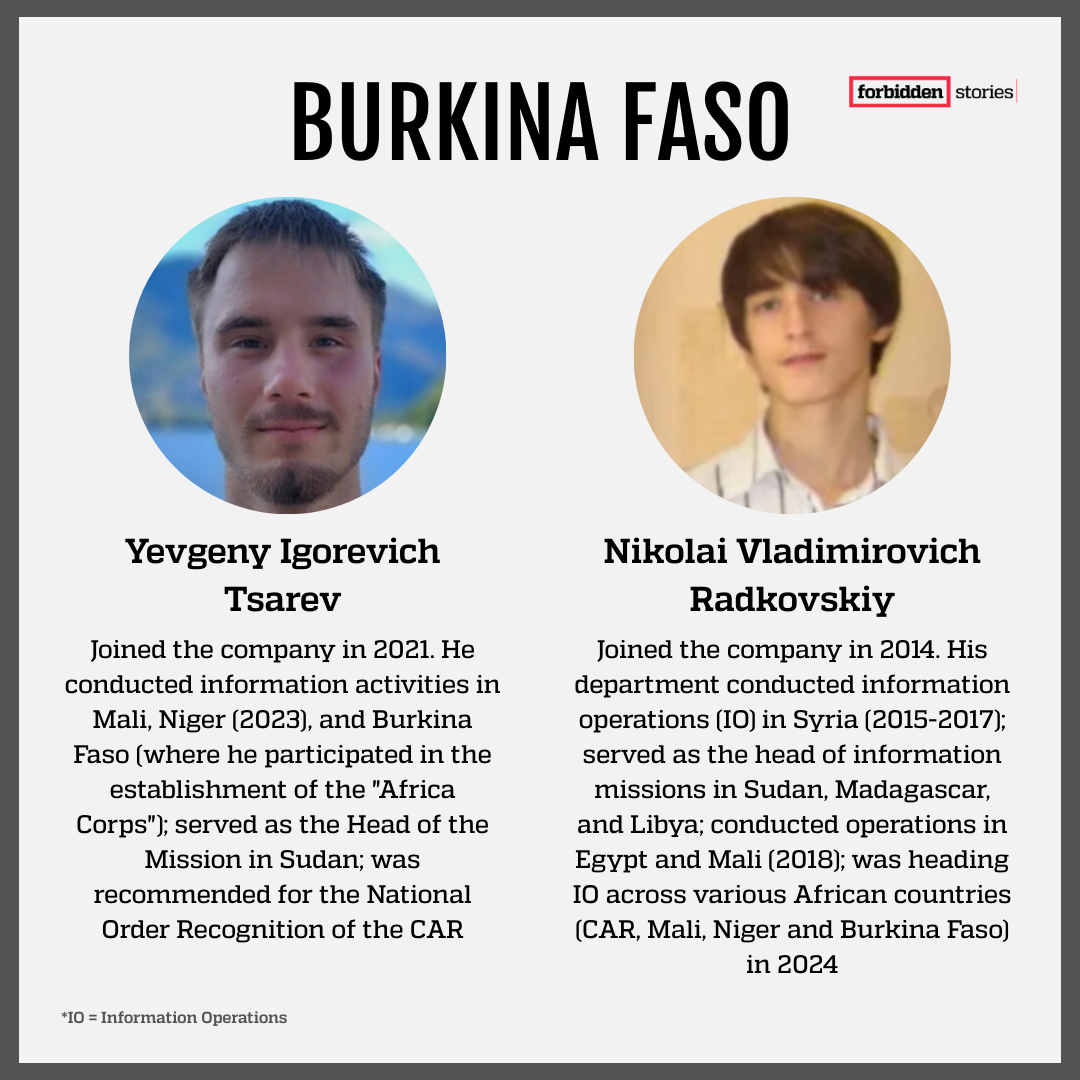
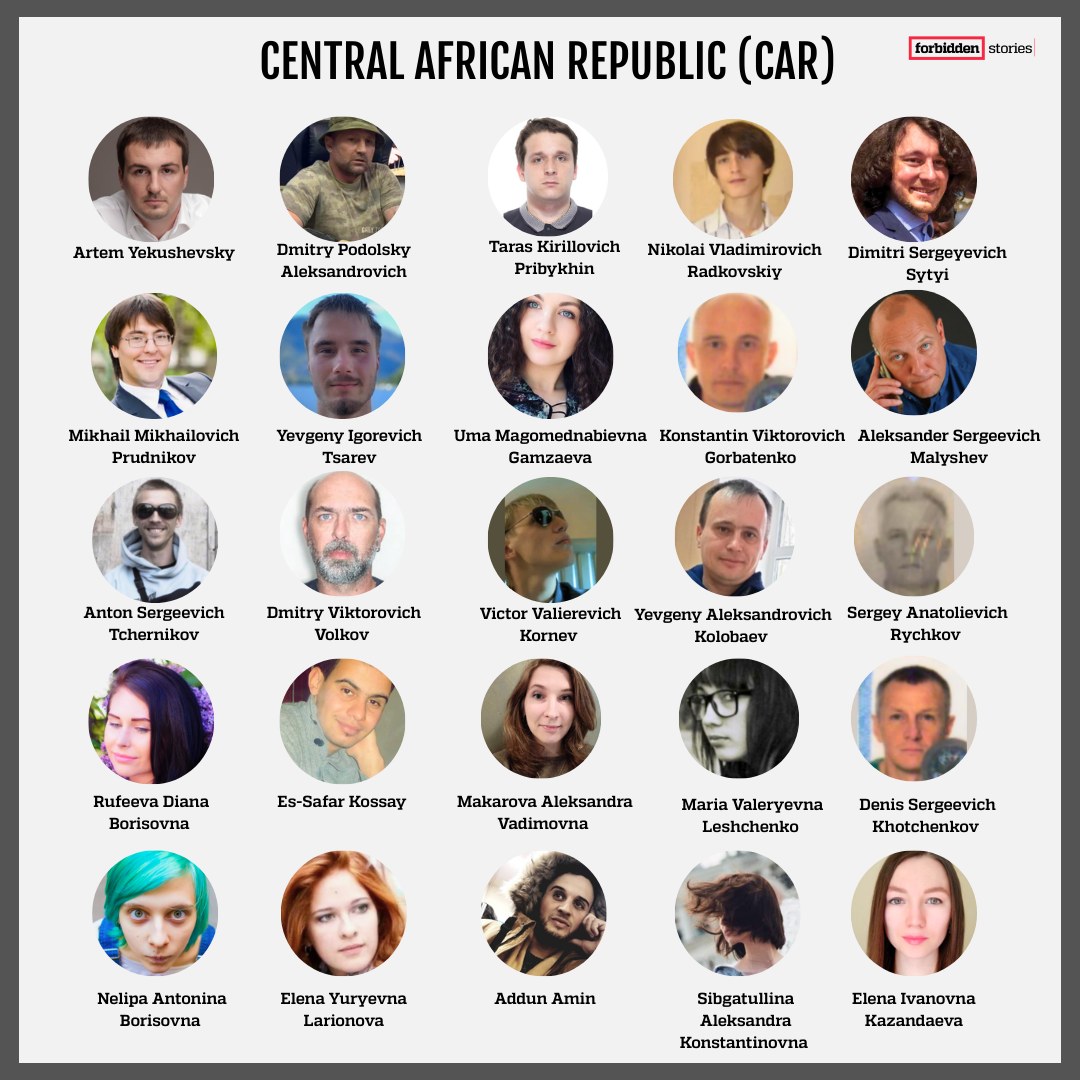
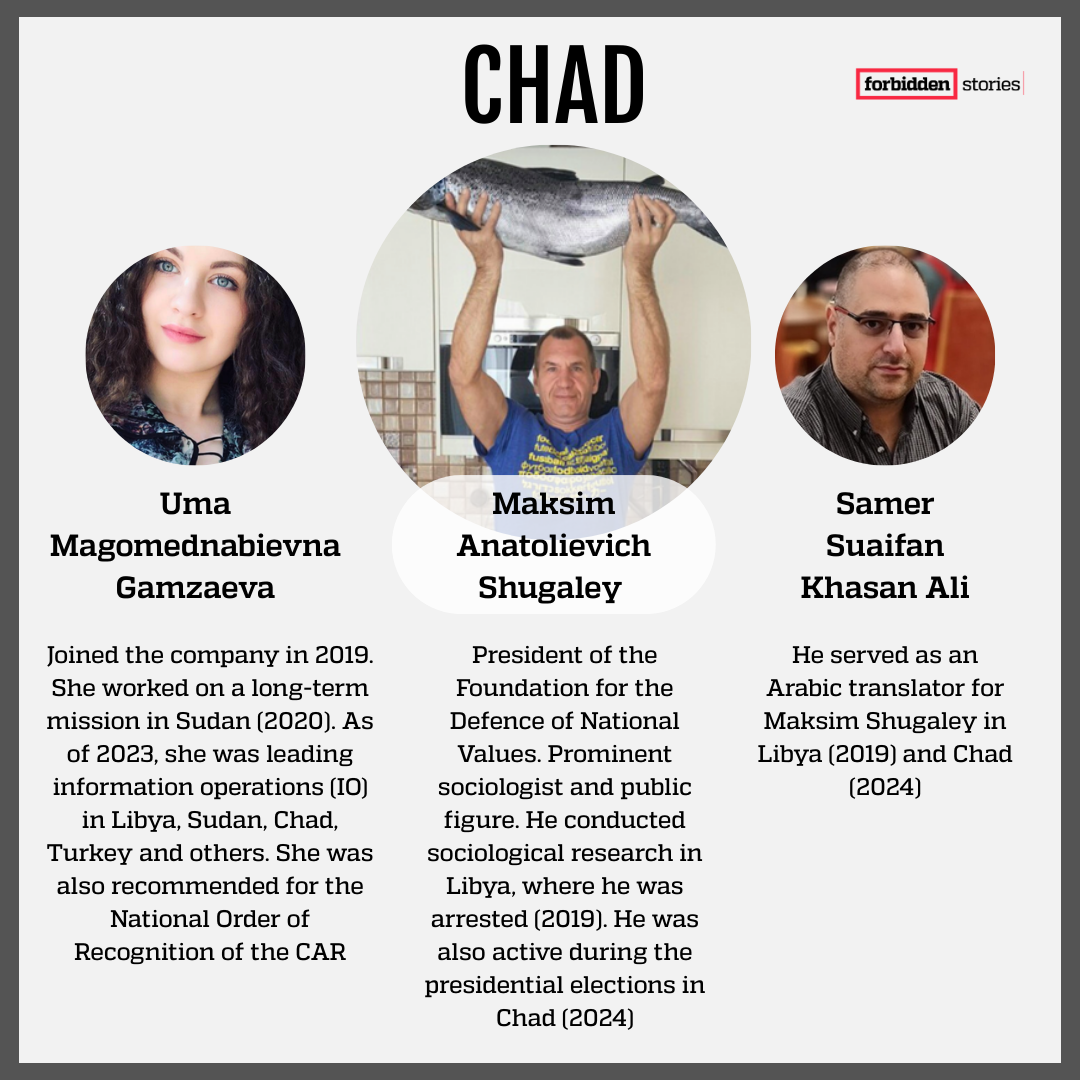
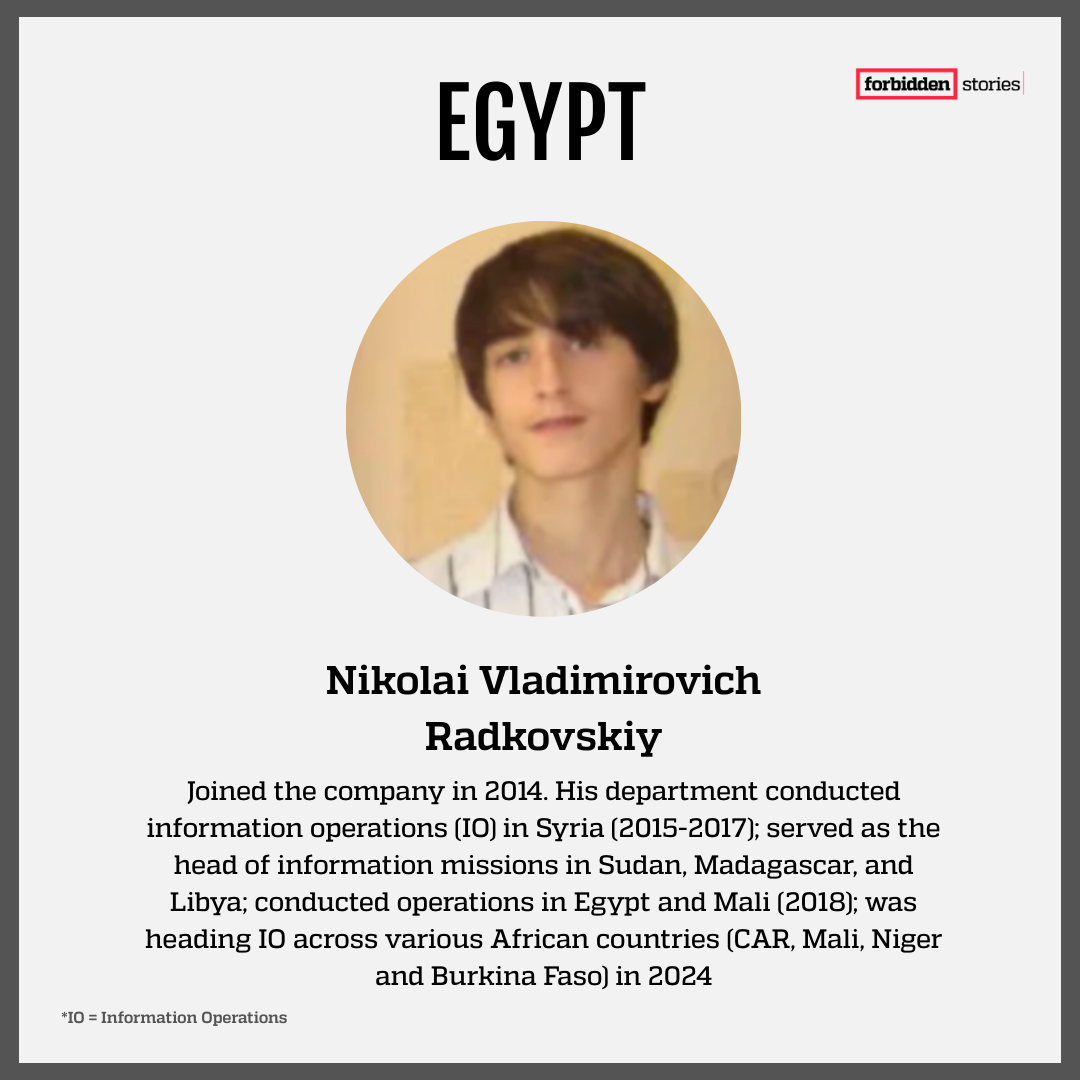
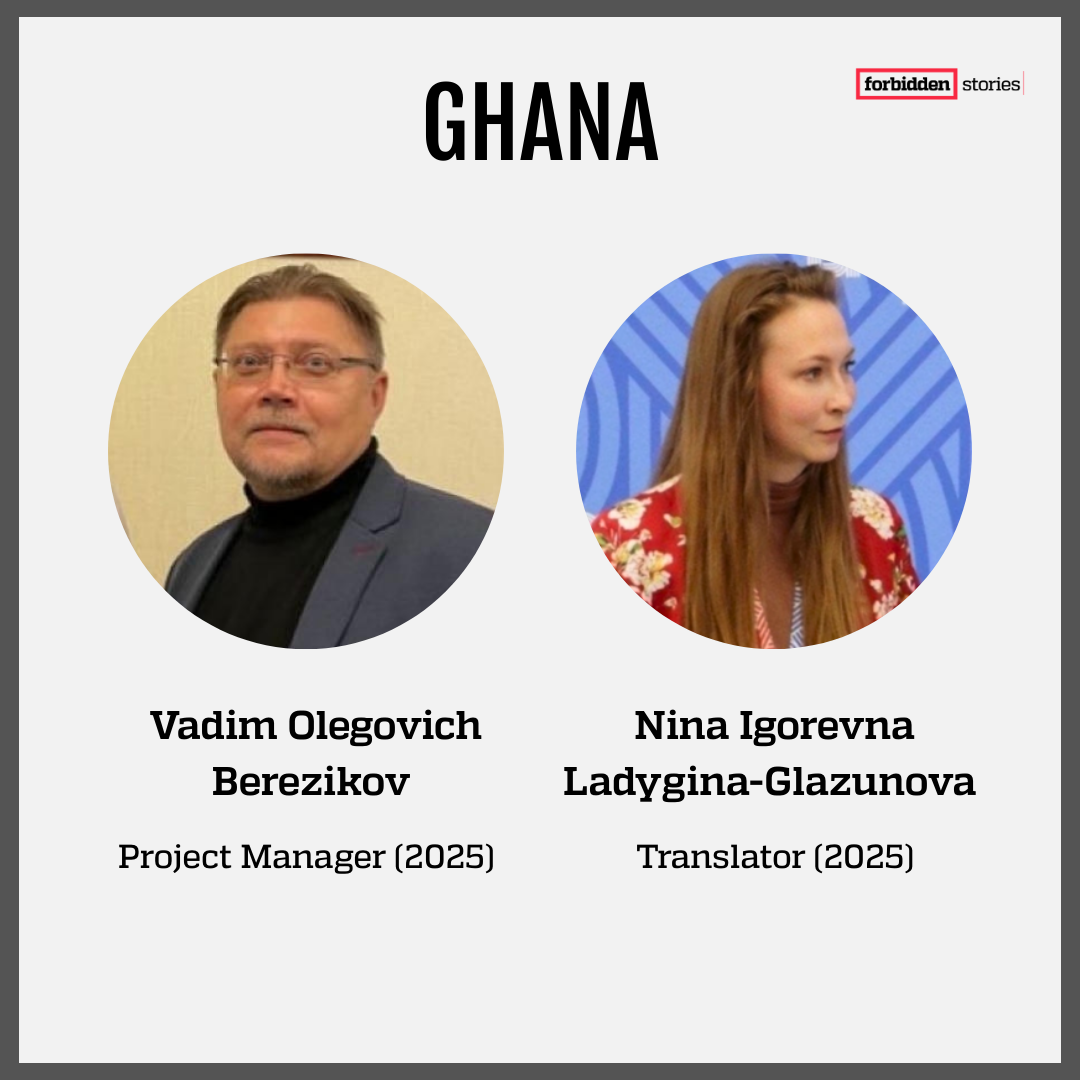
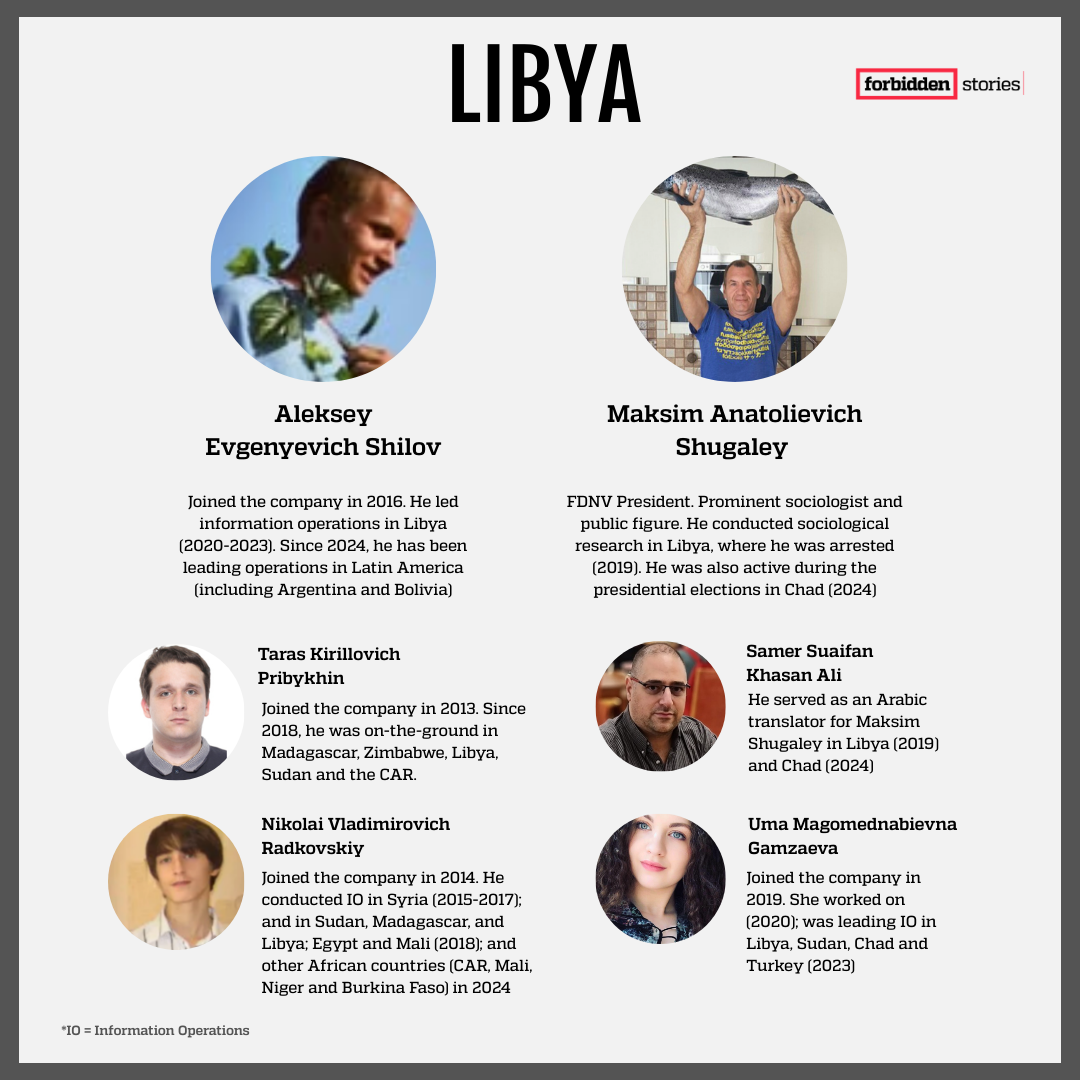
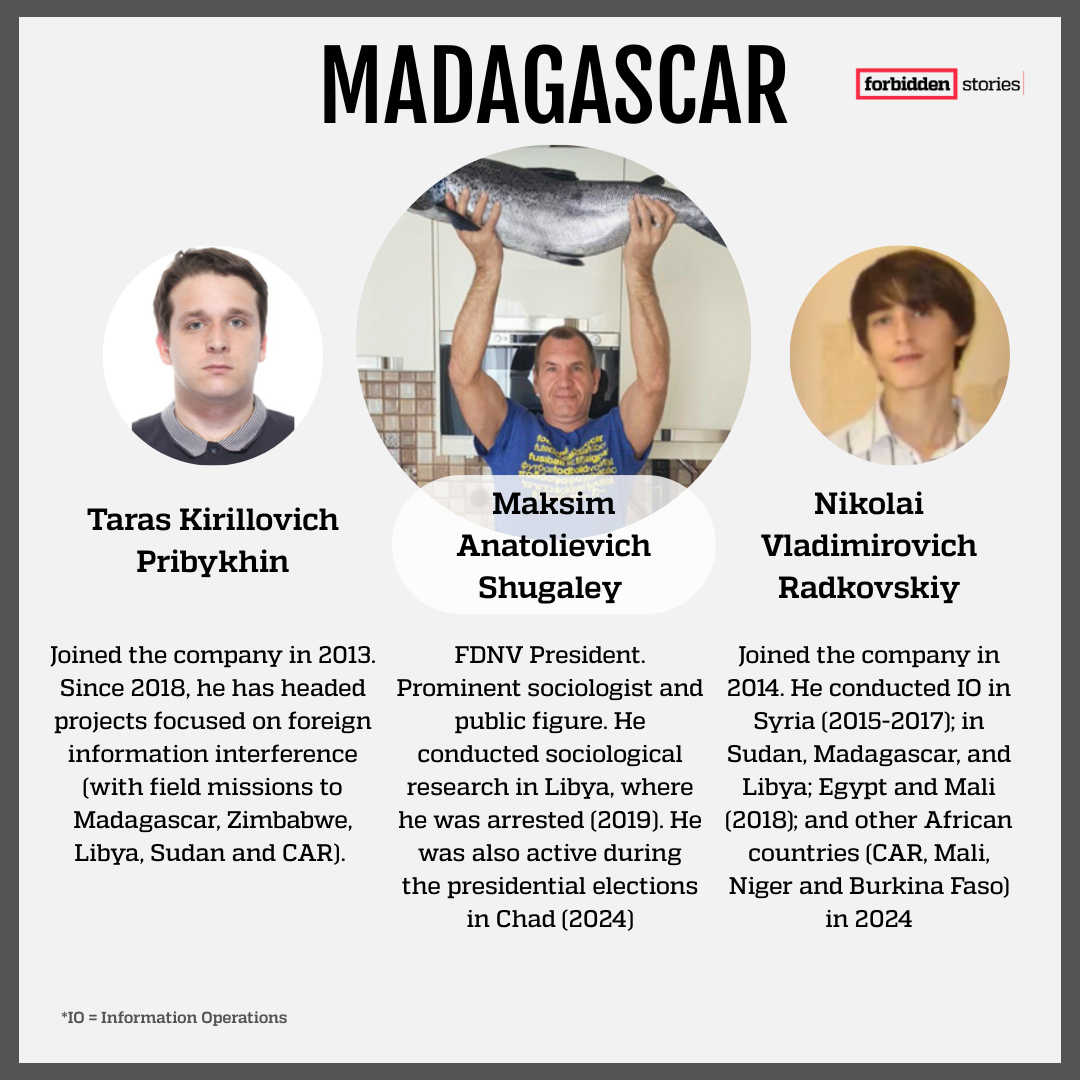
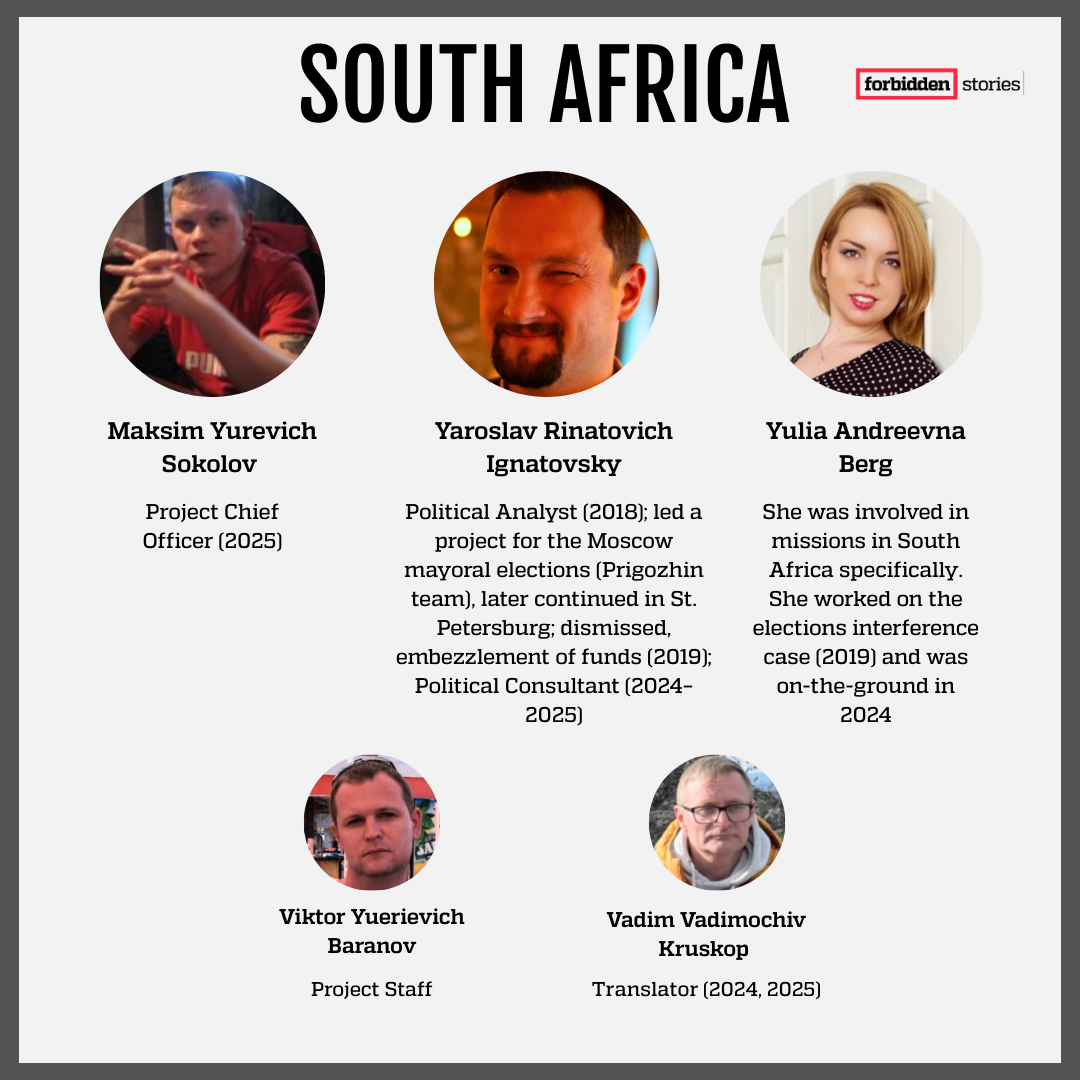
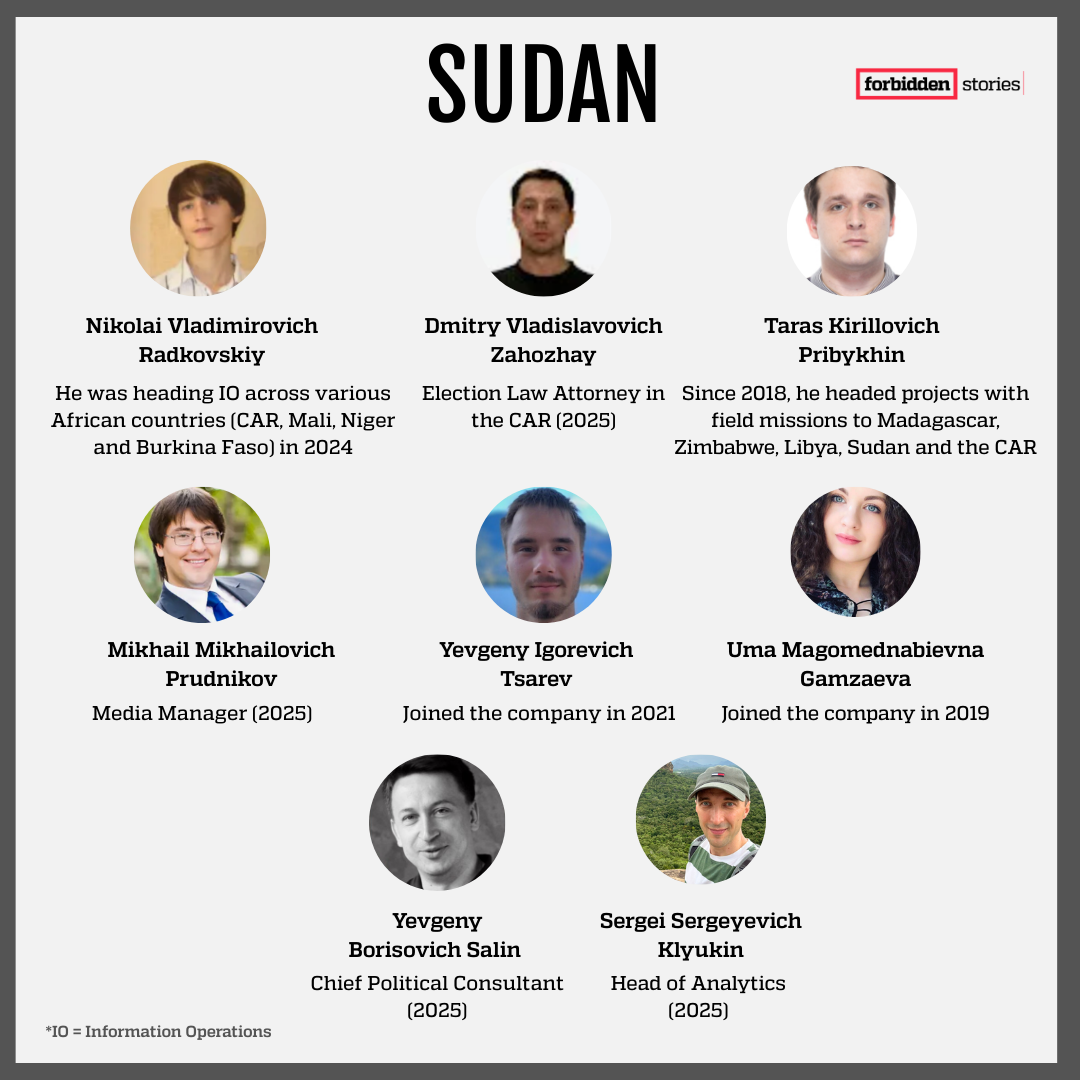
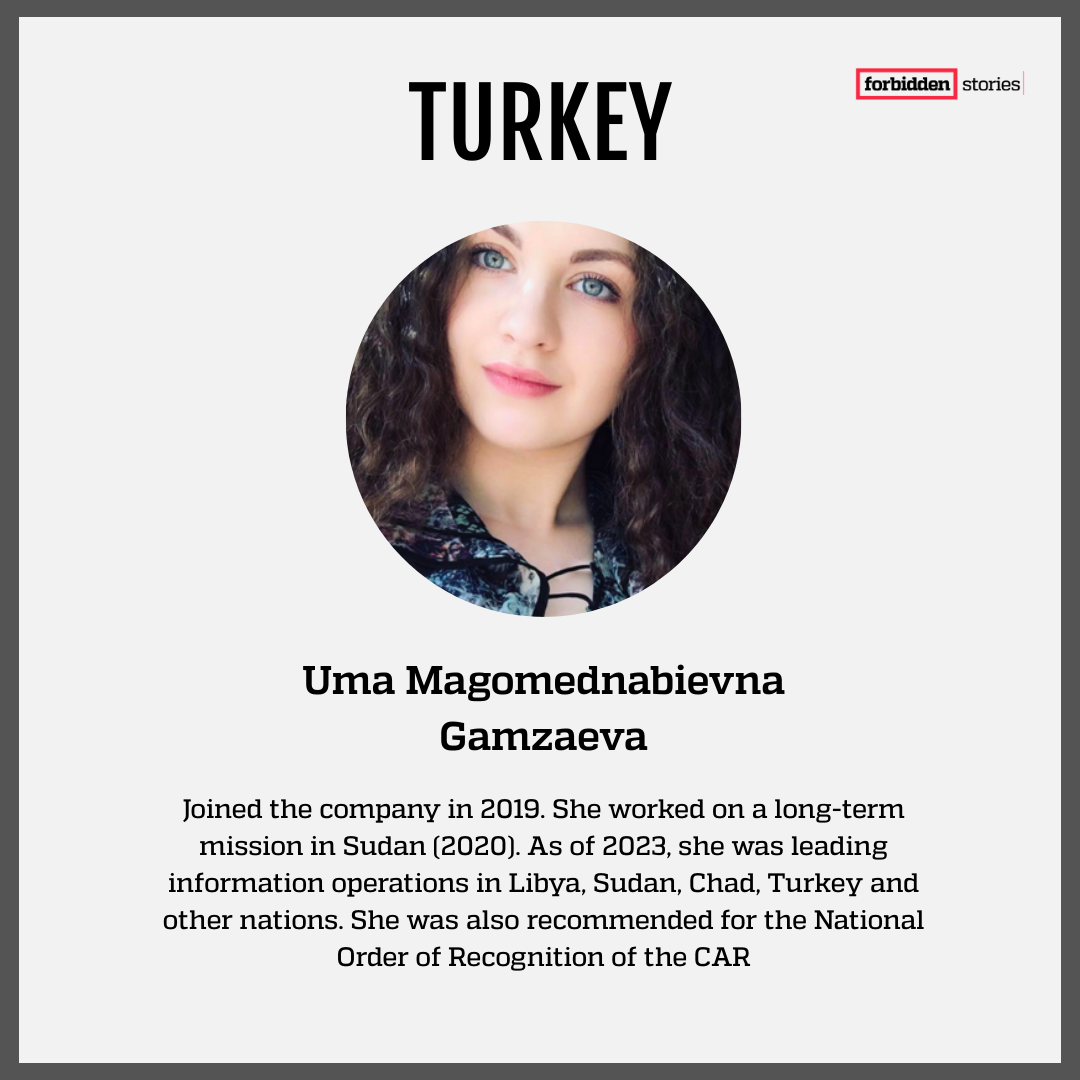
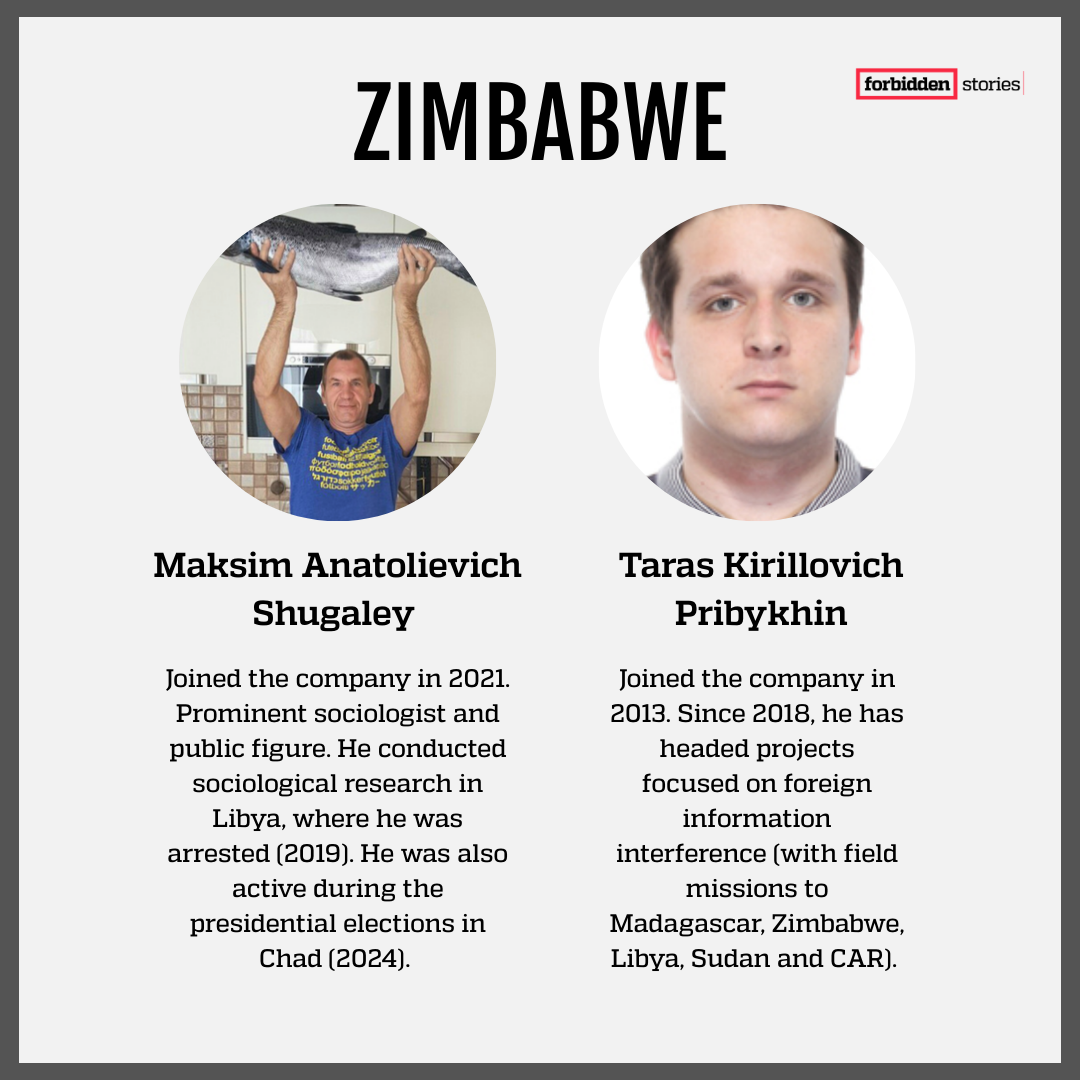
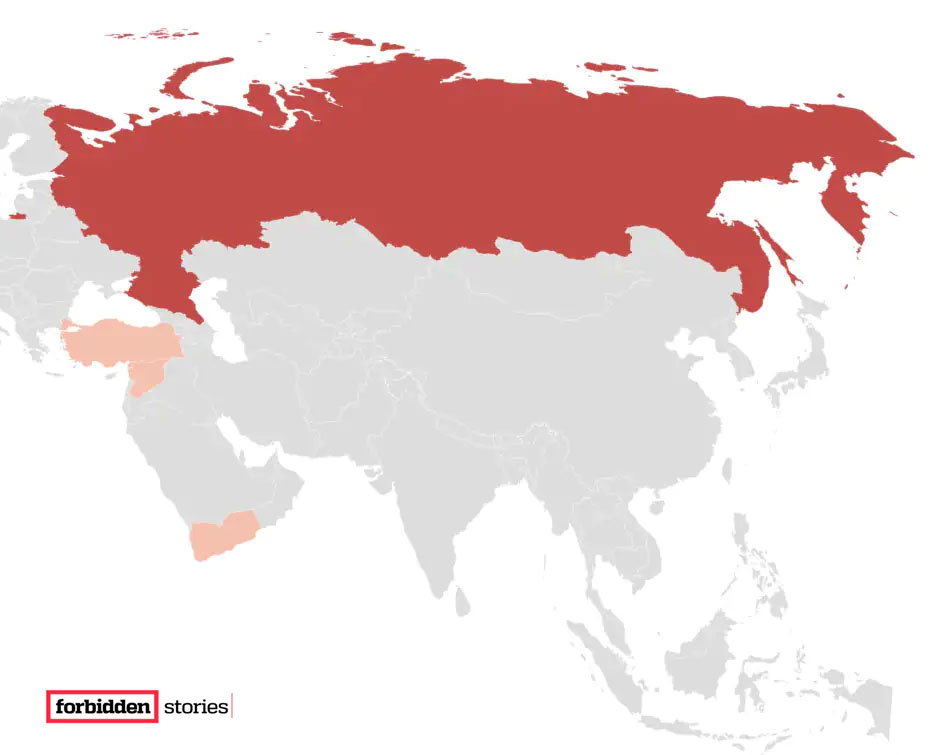
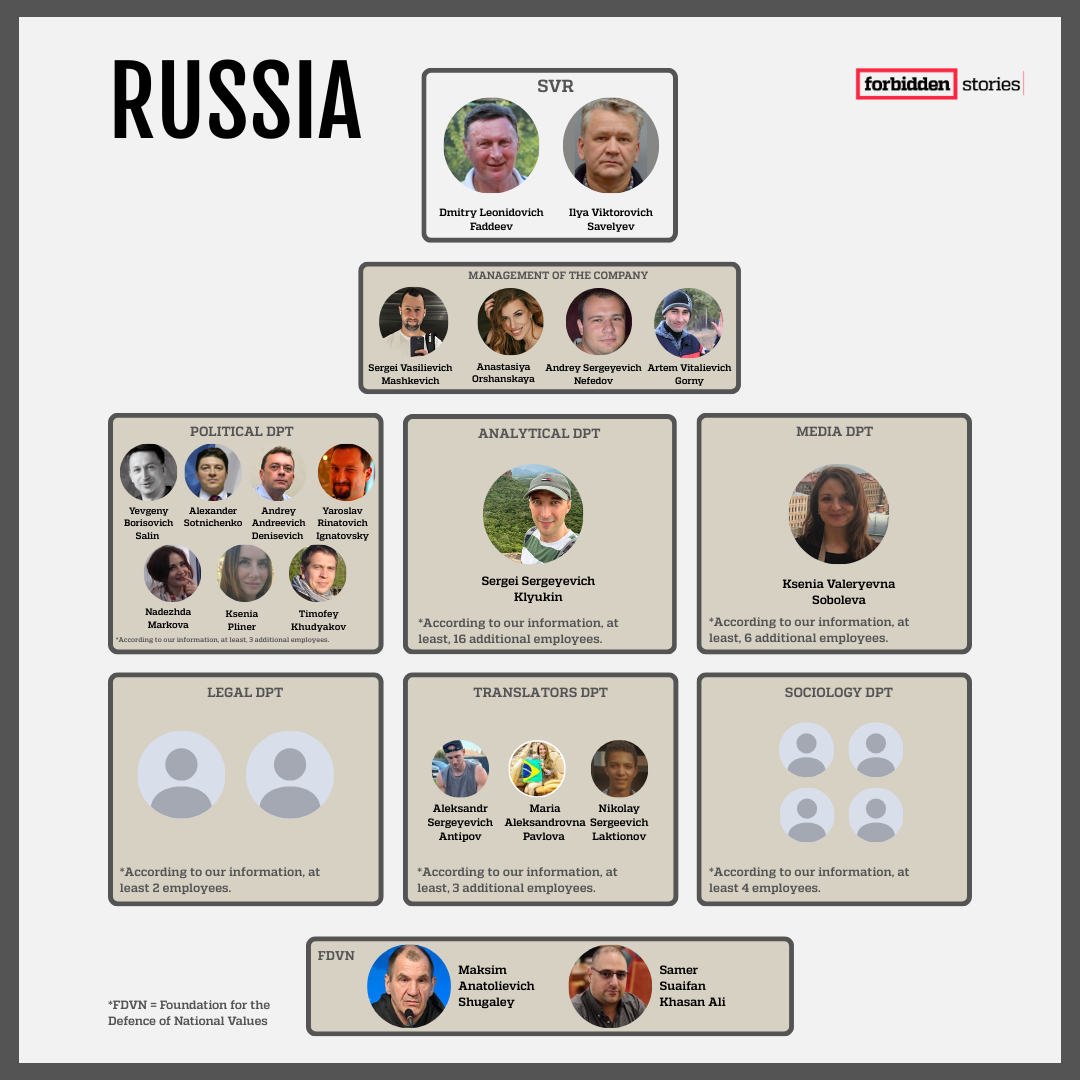
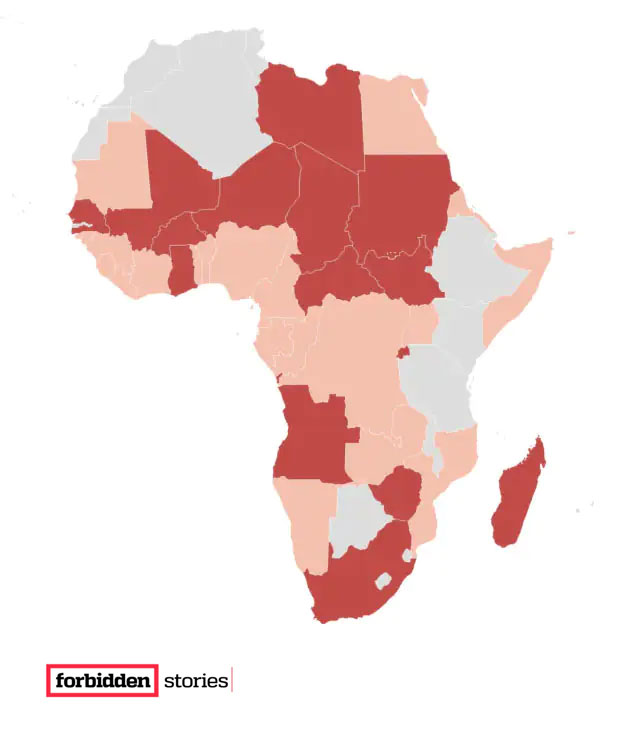
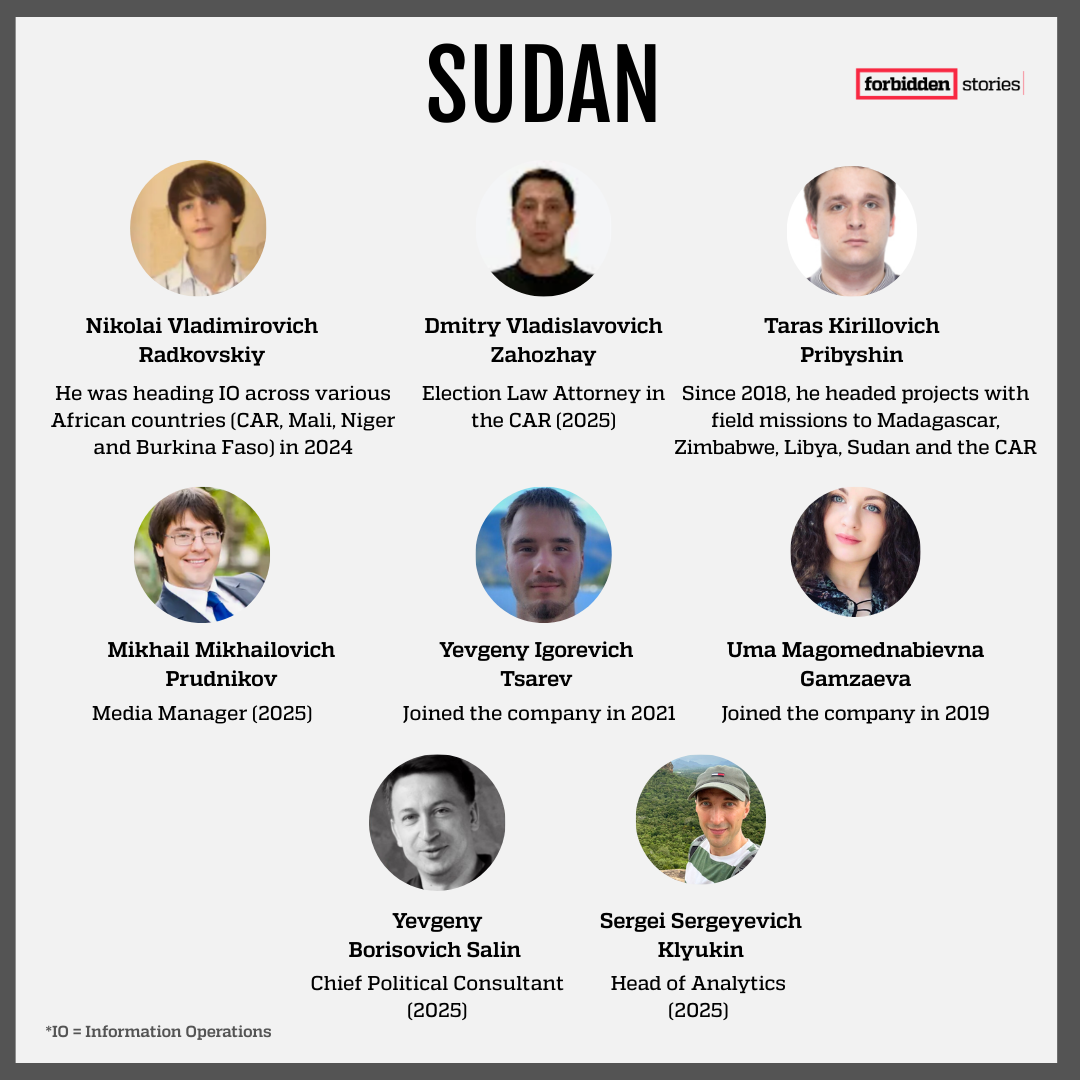
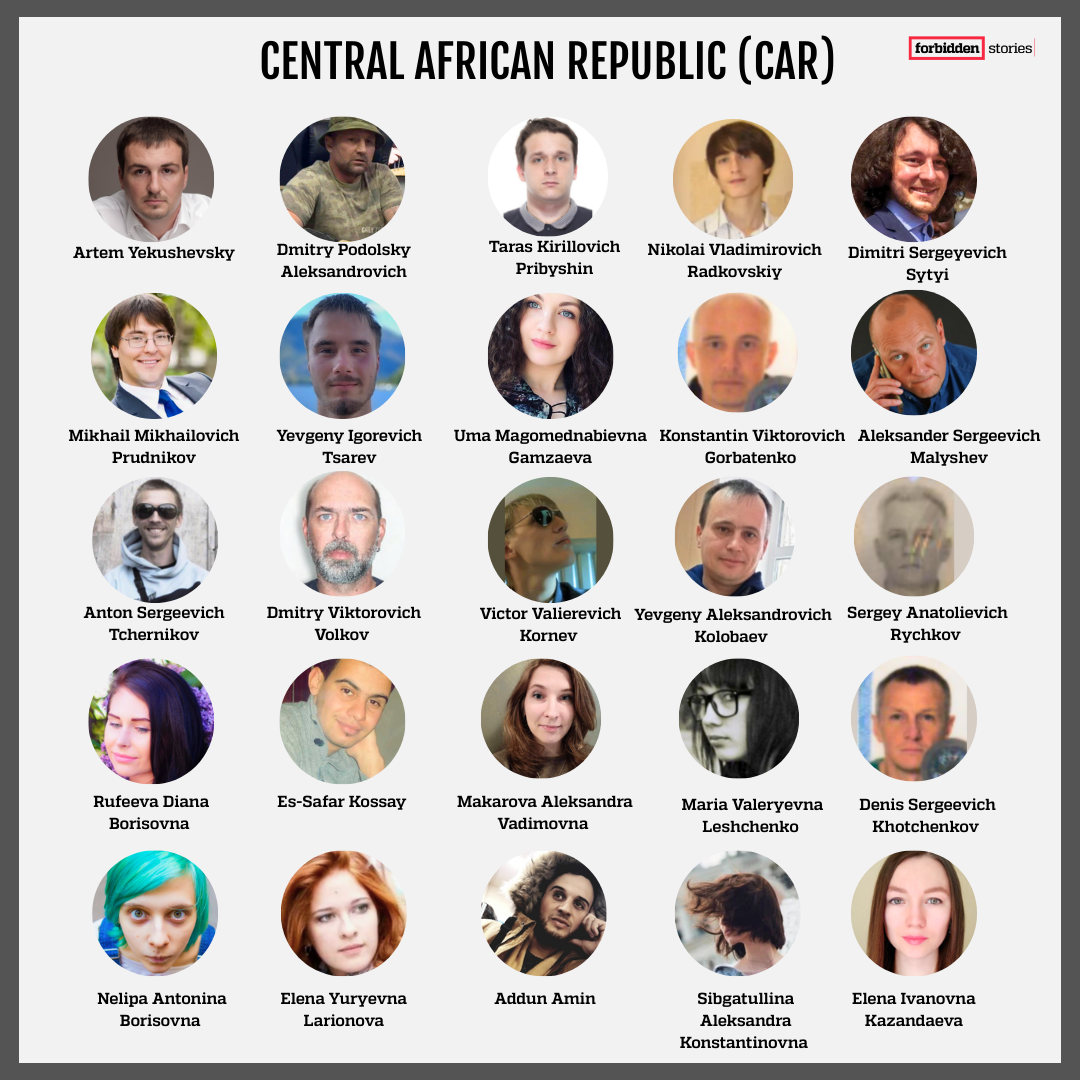
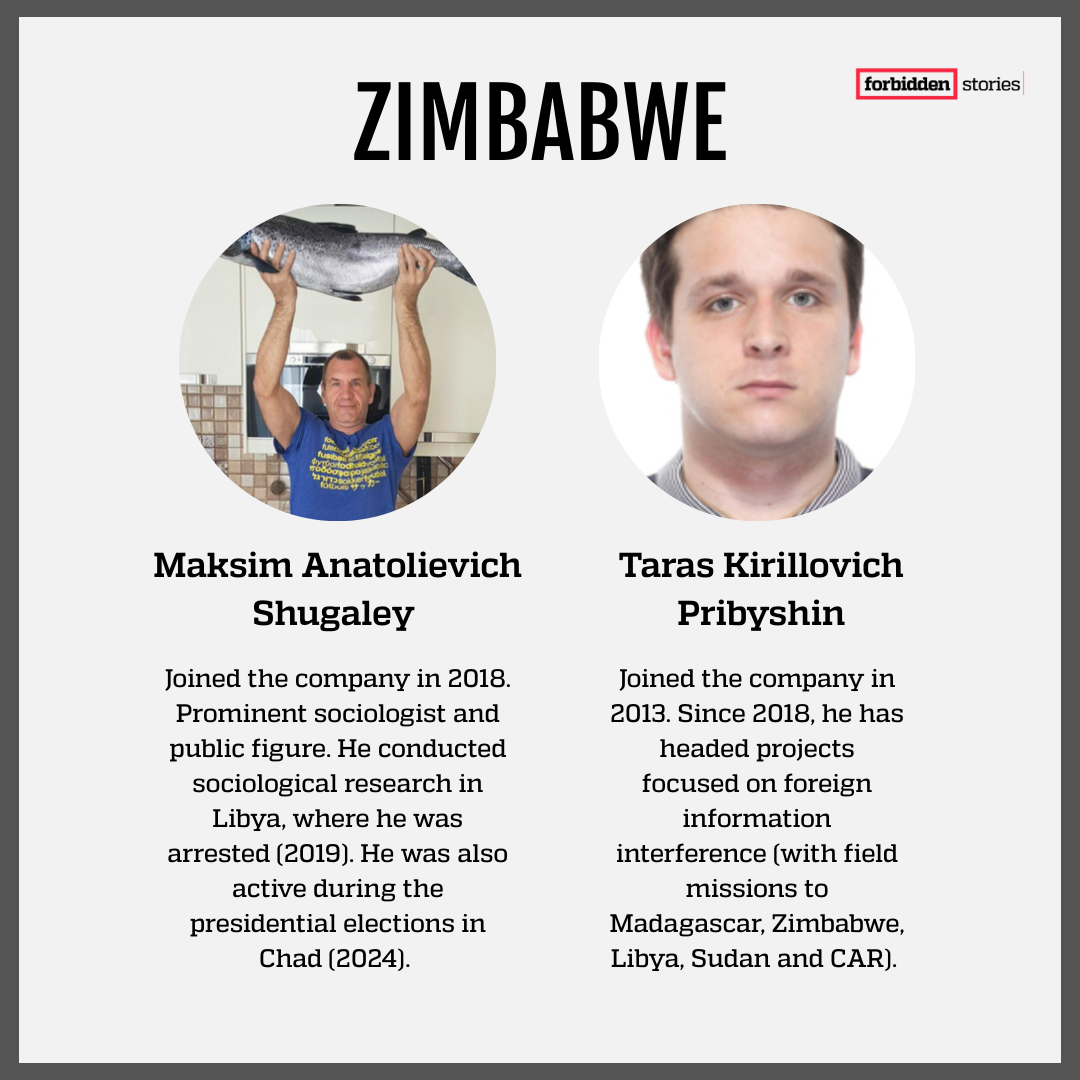
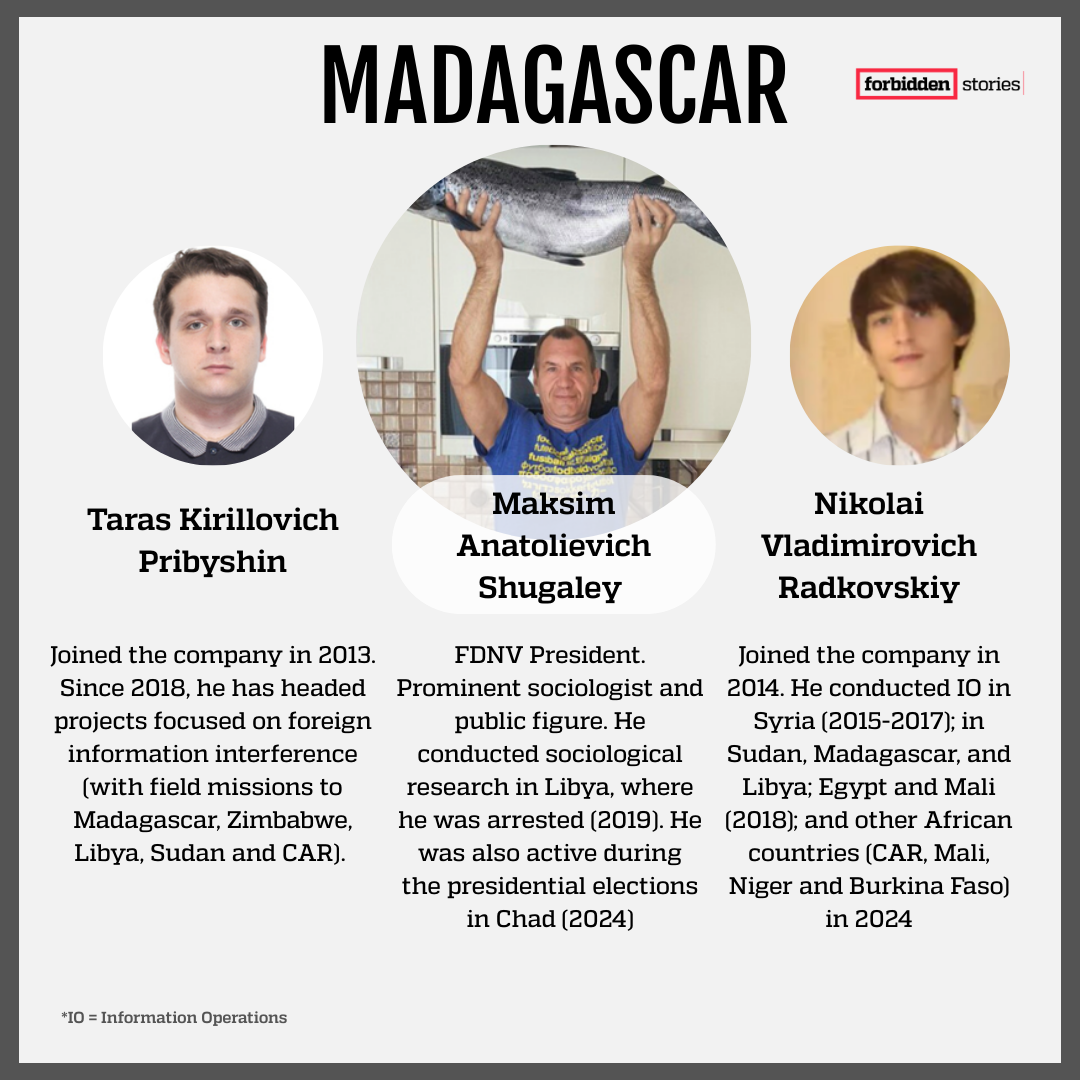
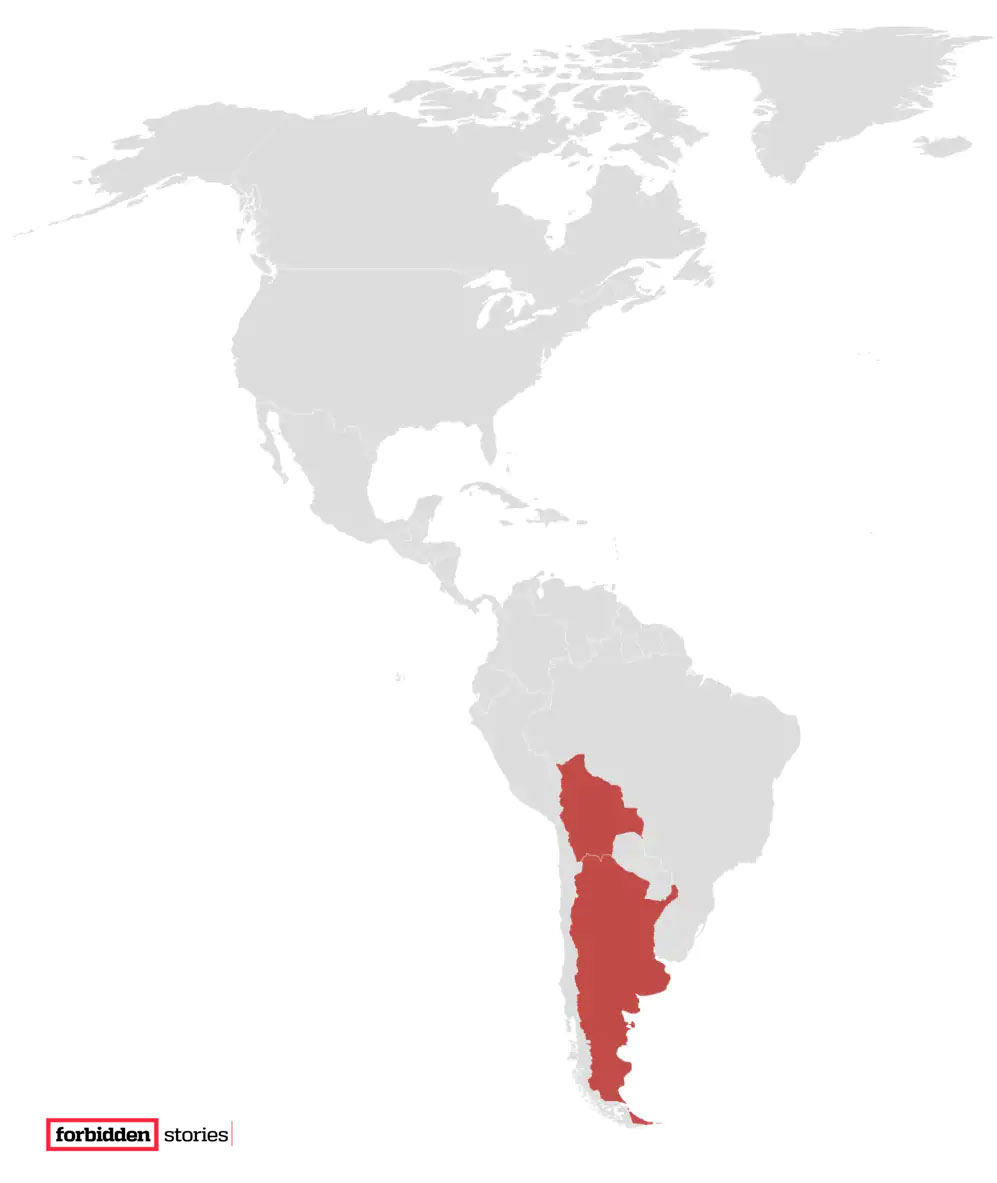
Worldwide presence of The Company agents, 2024–2025. Dark red indicates countries with confirmed on-the-ground units; light red shows countries targeted by influence campaigns, where current presence is unconfirmed. Created with DataWrapper. By: Sofía Álvarez Jurado (Forbidden Stories), Debussac Multimedia.
Change of address
Dmitry Viktorovich Volkov, 54, is at the head of the Bolivian mission. Previously unknown to experts on Russian disinformation, this is the first time he has been linked to propaganda operations. As a former political and media advisor, Volkov once worked for Russian public television and was hired in February 2023 by the disinformation network — internally referred to as the “Company,” but better known as Politology.
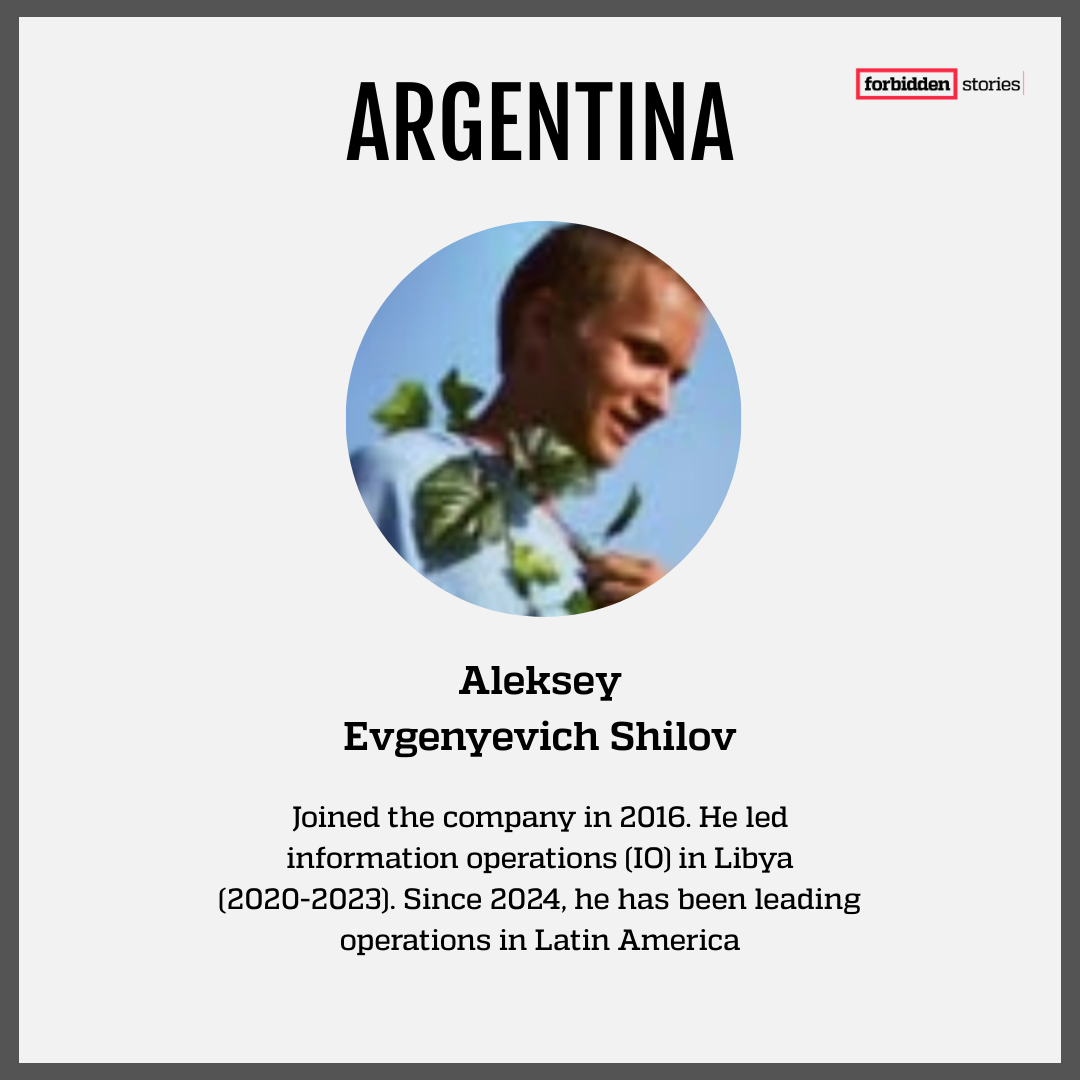
After serving as the head of information in Mali, Volkov became the mission lead in Bolivia in July 2024. Described as a “hard worker” and “proactive” in a laudatory internal document, the “Company” recommended him for an official decoration. According to internal employee biographies, Russia has honored several agents for their services. Among them is 33-year-old Aleksey Evgenyevich Shilov, who was stationed in both Bolivia and Argentina and was decorated with the Order for Merit to the Fatherland. There’s also Uma Magomednabievna Gamzaeva, who has worked in Turkey, Libya, Sudan and Chad. Fifteen other agents are being considered for honors abroad, including the Central African Republic’s Order of Recognition.
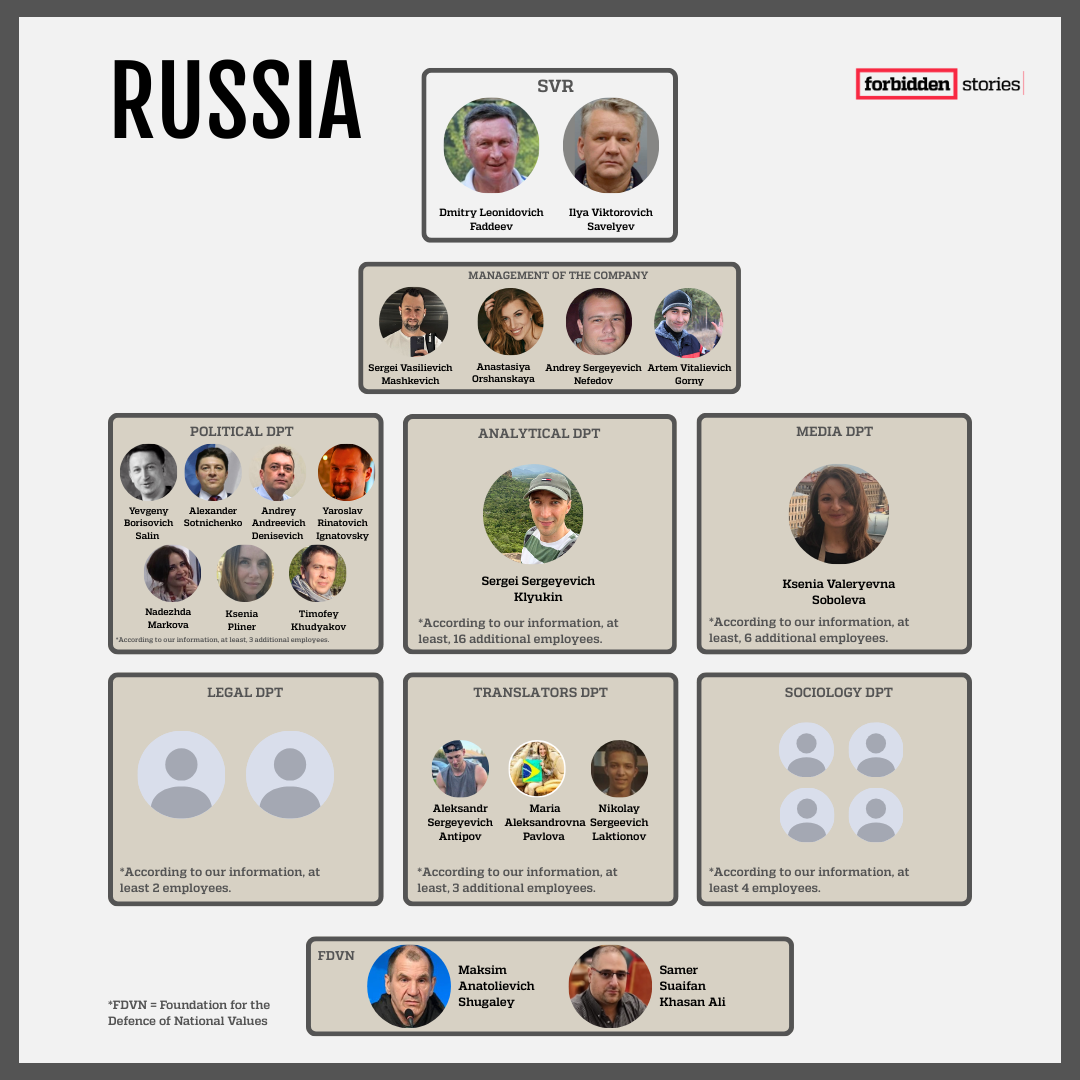
From Russia, two men oversee all operations: Sergei Sergeevich Klyukin, the head of the analysis department, and Sergei Vasilievich Mashkevich, described as the global project manager, “responsible for ensuring the expansion of the ‘Company’ in Africa and Latin America.”
From left to right, Volkov, Klyukin and Mashkevich with their biographies from the data leak.
In February 2024, Artem Vitalievich Gorny, a key member of the organization, ordered a moving truck to unload furniture at 8A Pirogova Lane, Saint Petersburg. It’s at that address, in a stately stone building a few hundred meters from St. Isaac’s Cathedral, that the “Russian back office” appears to be headquartered. Dozens of Yandex taxi trips mention this location, and Klyukin registered a company called “LLC StratConsult” at the same address.
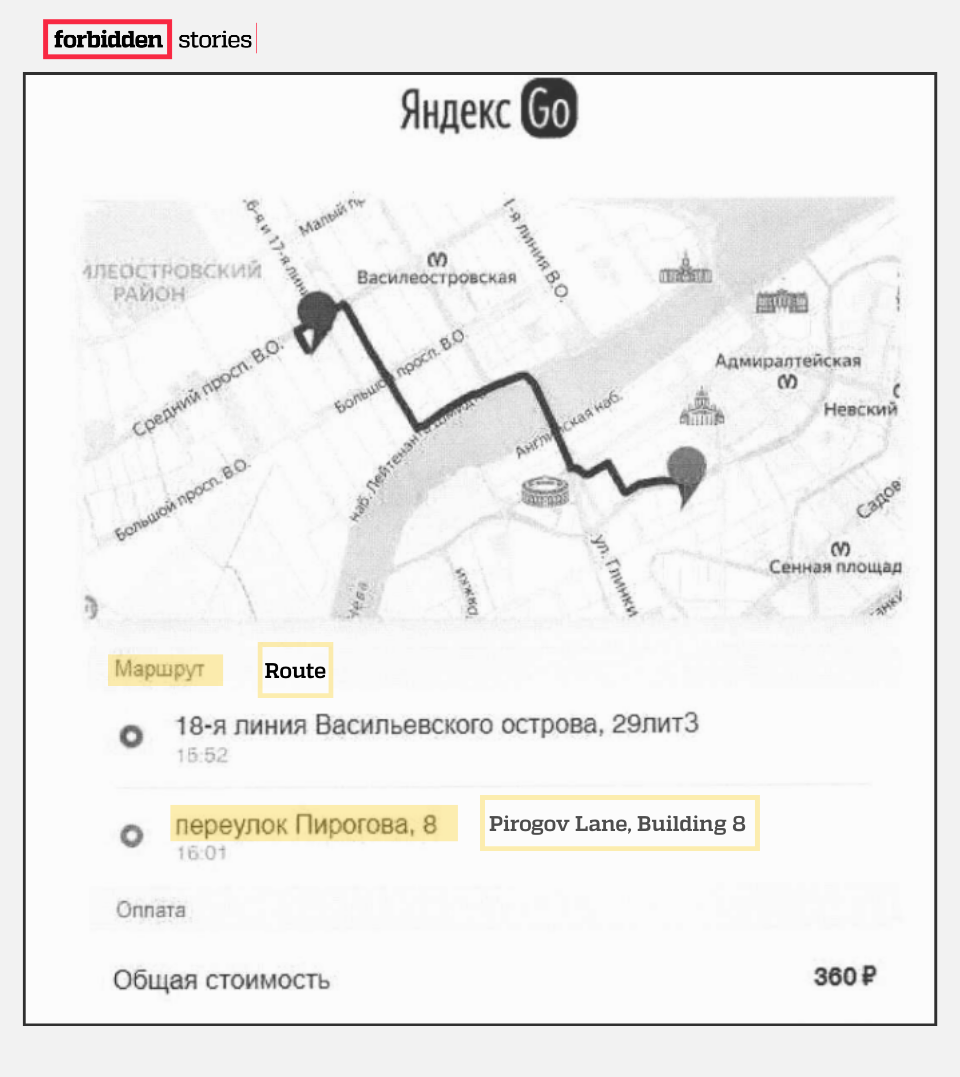
A taxi ride taken by a “Company” employee to 8A Pirogova Lane.
Until now, Gorny rented the “Company”’s premises on the other side of the Neva River, on Bolshoy Prospekt V.O. Avenue. That address was known to the U.S. authorities for its association with Africa Politology, “a propaganda organization linked to Wagner” that aims “to induce countries that promote human rights and good governance to withdraw their presence in Africa and is involved in a series of Russian influence tasks in the CAR.” In January 2023, the U.S. sanctioned the group for acting “for or on behalf of, directly or indirectly, Prigozhin.”
Under the SVR’s control
Barely four months after Prigozhin’s death on Dec. 15, 2023, the SVR arranged a meeting with Sergey Mashkevich, the head of Politology. The goal: to create a secret financing channel between the SVR and the “Company”, thereby placing it under its control.
Forbidden Stories was able to consult a preparatory document for this meeting, which did not appear in the initial data leak. It contains a series of questions asked by an agent affiliated with the SVR, followed by answers from the “Company” — altogether, an illuminating exchange about the SVR’s strategies for staying under the radar.
“How will the “Company” spend the money it receives via bank transfer … so that it looks normal to the (Russian) regulatory authorities?” asks the SVR. Similar logistical questions follow to root out any vulnerabilities that could expose the Service’s link to the “Company”, starting with which bank the finances will pass through. “Which bank will the money from the Moscow account be transferred to? What are the relations with this bank?”
The “Company” responds by saying the selected bank will be “systemically important,” and measures will be taken to “avoid the freezing of funds.” In the final remark in the document, it explicitly requests the SVR’s help: “A contact from the Service is needed to assist with the opening of the current account.”
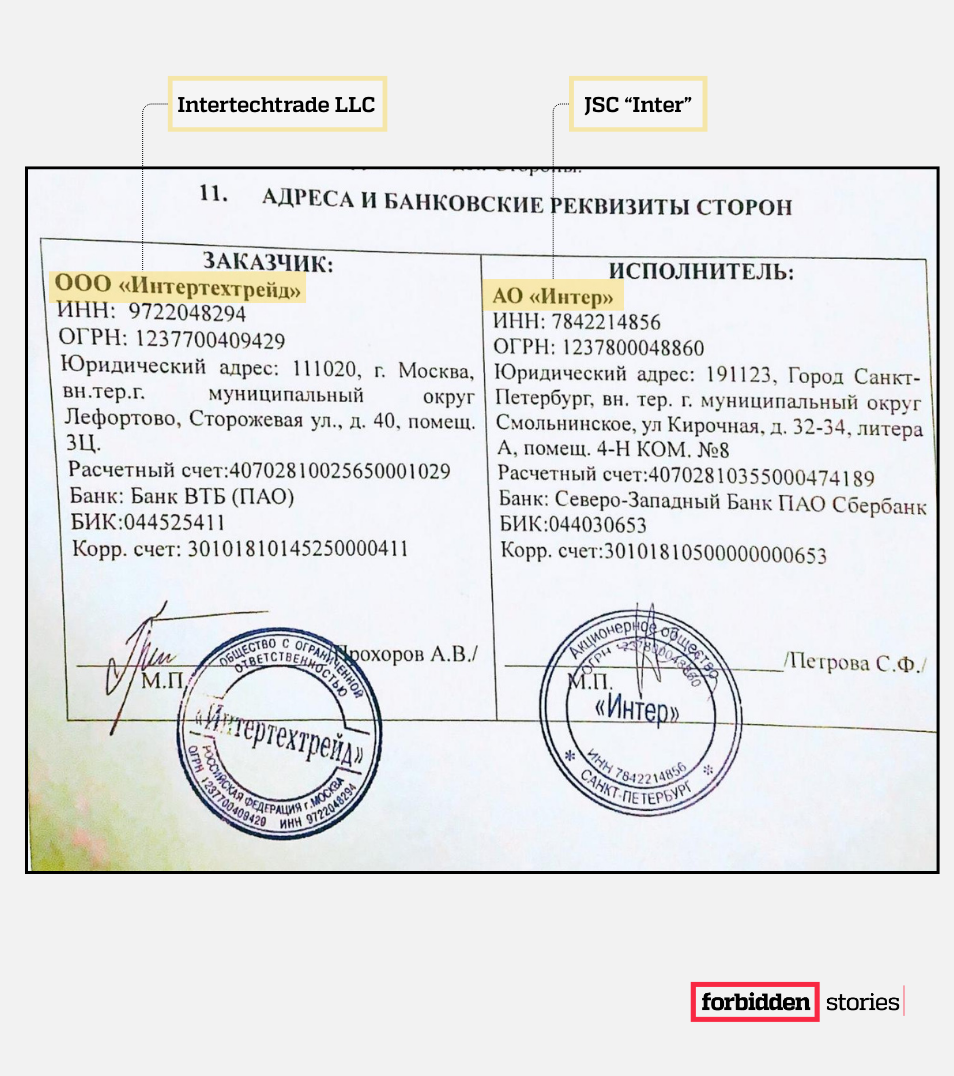
A signed contract between Intertechtrade LLC and JSC Inter.
The plan is put into action on Dec. 20, 2023, when the companies Intertechtrade LLC and JSC Inter sign a contract. Implicitly, the SVR will send money to Intertechtrade LLC, which will then redistribute its funds to JSC Inter via cash deposits and transfers, deliberately capped to avoid detection, particularly by the Russian tax authorities.
To further cover their tracks, the identity of Intertechtrade’s director was likely fabricated. The only information in the Russian administration’s databases about Alexander Prokhorov, a man believed to be 64 years old, is a passport issued in 2020 and a telephone number registered in 2023. At first glance, no one would suspect that the SVR was behind the whole arrangement. Its methods are untraceable.
The unveiling of a statue of Felix Dzerzhinsky, the founder of the Soviet secret police, at the SVR’s Moscow headquarters on Sept. 11, 2023. A montage featuring SVR Director Sergey Naryshkin (in red) and Dmitry Faddeev (in white).
Dmitry Leonidovich Faddeev, a 74-year-old general and former first deputy to SVR Director Sergey Naryshkin, was directly involved in the takeover of the “Company”, according to information obtained by Forbidden Stories. He now defines the “Company”’s major strategic priorities, particularly for the African continent.
His career may explain his current place vis-à-vis the disinformation network. Faddeev himself operated undercover abroad, at the Russian Embassy in Berlin between 2006 and 2008, officially as a political advisor. From 1997 to 1999, he was also part of the currency and finance department of the Russian Ministry of Foreign Affairs, a structure inherited from the Soviet Union, historically used to host SVR and military intelligence officers engaged in clandestine operations abroad.
As a symbol of his importance within the intelligence community, Faddeev appears next to Naryshkin in the center of an SVR group photo, taken in 2023 during an official ceremony. In his operations with the “Company”, Fadeev works with another SVR officer, Ilya Savelyev, who served as Russia’s consul in Mumbai in 2015 and is currently the director of the Centre for the Study of Socio-Political Problems of African and BRICS Countries. Savelyev is believed to have provided an operational link between the SVR and the “Company”, continuing to maintain regular contact with the latter’s management today.
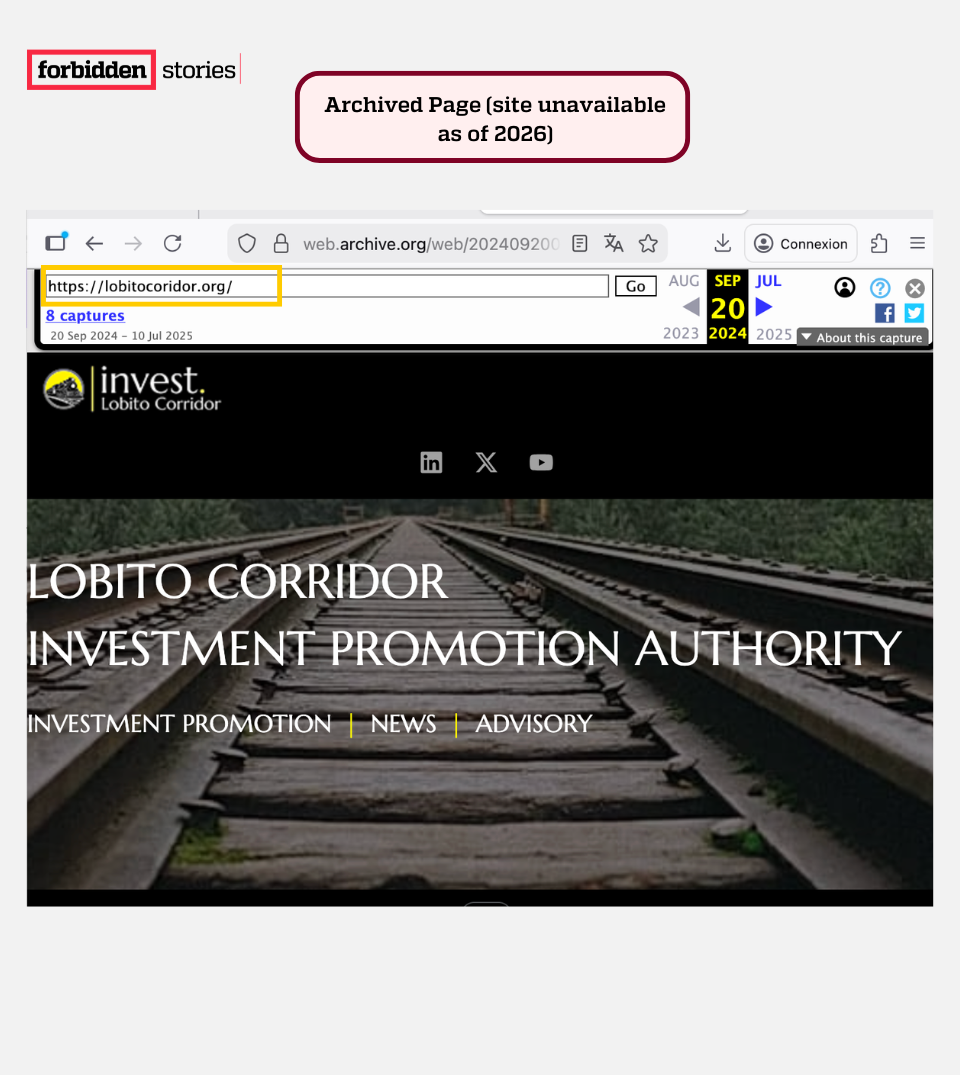
The “Company”’s mirror site of the Lobito Corridor project in Angola.
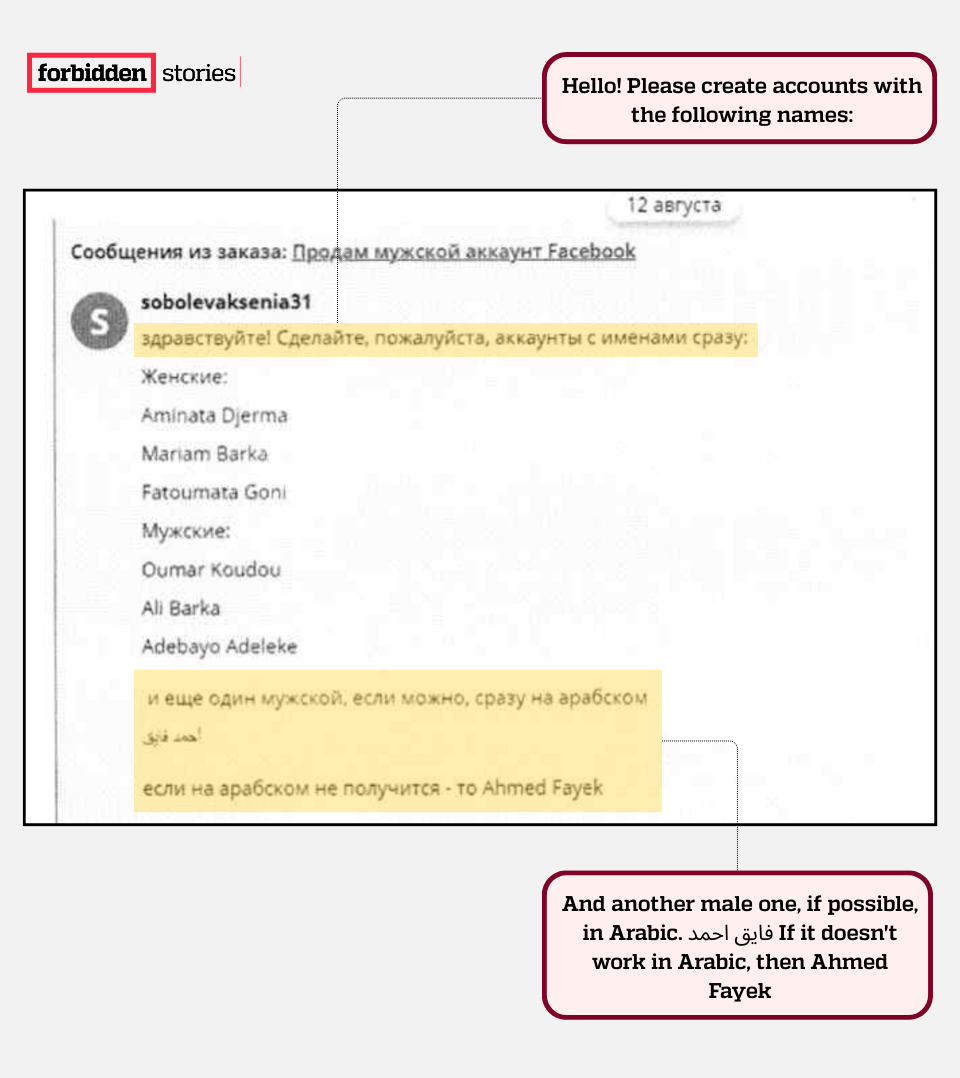
A “Company” employee places an order for fake Facebook accounts.
At the “Company”, a group of “34 specialists,” sometimes referred to as “sociologists” or “political technologists,” work under Klyukin’s supervision. Responsible for monitoring and analyzing the political situation in 15 countries, they write briefing notes and conduct telephone surveys with thousands of respondents — 1,133 in the Democratic Republic of the Congo in June 2024, another 1,024 in Mali in August, and so on.
Additional teams carry out online manipulation campaigns, in line with the Lakhta Project troll factory, which the “Company” partly initiated. In August 2024, according to internal invoices, someone named Ksenia Valeryevna Soboleva placed an order for fake Facebook accounts under the pseudonym “sobolevaksenia31.” She wrote, “Please create accounts with these names. Profiles of women: Aminata Djerma, Mariam Barka … and men: Oumar Koudou, Ali Barka … And for another man, if possible, (write the name) directly in Arabic.”
Soboleva, along with a woman named Dina Trumm, also made payments to pro-Russian Telegram accounts like the one run by journalist Abbas Djuma, who had 61,175 followers in August 2024 and was sanctioned by the United States. Since then, Soboleva has risen through the ranks and now heads the “Company”’s media department, according to Forbidden Stories’ information.
Fake websites are another tool in the “Company”’s arsenal. Aside from a missing “R,” the link to the site https://www.lobitocoridor.org/ is identical in appearance to that of the official Lobito Corridor website, https://www.lobitocorridor.org/. This strategic railway linking the port of Lobito in Angola to the Democratic Republic of Congo is crucial for the transport of minerals and for European and American investments. But with its false URL, the “Company” intends to spread increasing disinformation against Western interests.
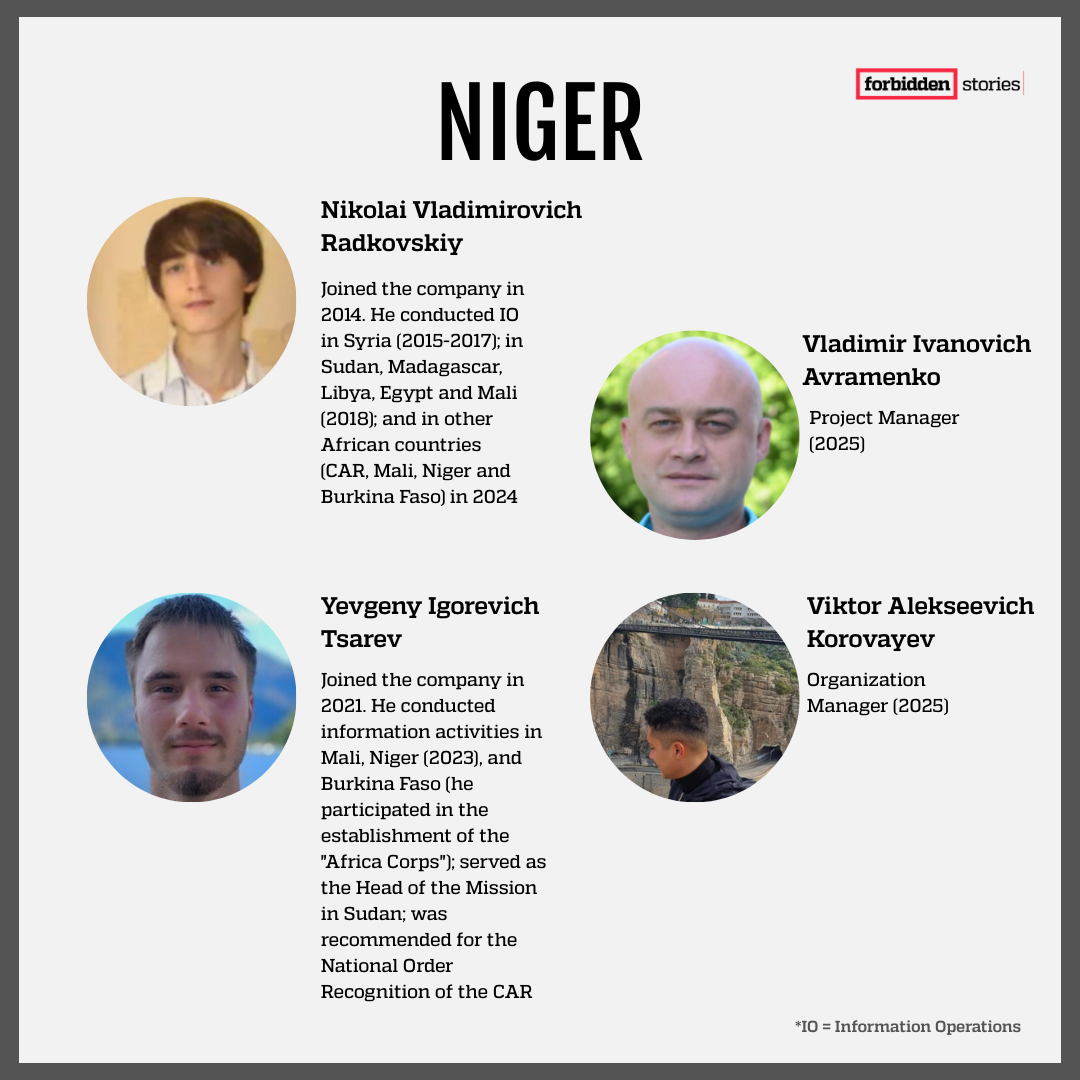
Thousands of miles away from headquarters, Russian agents take charge in the field. In light of the data leak, Forbidden Stories can reveal that in addition to the Bolivian premises, offices were rented in Mali, Libya, South Africa and Rwanda in 2024. Sometimes, non-governmental “Russian Houses” — supposed cultural centers, unlike the Russian Houses attached to the Ministry of Foreign Affairs — serve as a rear base for Russian agents. Internal documents from the “Company” mention the opening of four new structures of this type in 2024, notably in Niger, Angola, Chad and Guinea.
Counter-agents, graffiti and cash
The “Company” now operates in support of the SVR’s intelligence activities. Thus, in Angola, according to internal documents, the organization seeks to “update its network and obtain first-hand information.” In the various target countries, it recruits “контрагентов,” literally “counter-agents” in English. Opposition leaders, ruling party officials, military personnel and even local intelligence agents — such as a certain “Yousef” in Libya, advisor to the head of intelligence, and “Hatim Idris, former employee of the Sudanese General Security Service” — are tasked with providing information, conducting negotiations and opening up access. Such is the case in Kigali, Rwanda, where eight agents were recruited “to safely gather information in Sudan.”
“'Counter-agents’ are tasked with providing information, conducting negotiations and opening up access."
At the same time, the “Company” continues its “traditional” activities by recruiting journalists to help disseminate its propaganda. As internal documents reveal, Ephrem Yalike, the Central African journalist who shared his experience with Forbidden Stories, was far from an isolated case. In August 2024, for example, 516 articles were placed by agents of influence in various media outlets for a total of $340,000, according to an internal statement. Beyond journalists, the “Company” even hired graffiti artists to illustrate the organization’s campaigns on walls. In Angola, for example, $3,400 was spent in September 2024 on graffiti and a demonstration against President Joe Biden’s visit to the country.
In total, internal accounts show that the “Company” spent more than $7.3 million between January and September 2024, divided between two major items: “political science,” which accounted for about two-thirds of the budget, and “media placements.” In May 2024, 98 agents were working for the organization. Each month, almost the entire projected monthly budget was received in cash, as evidenced by the “cash” line in the account tables.
Prigozhin’s successors
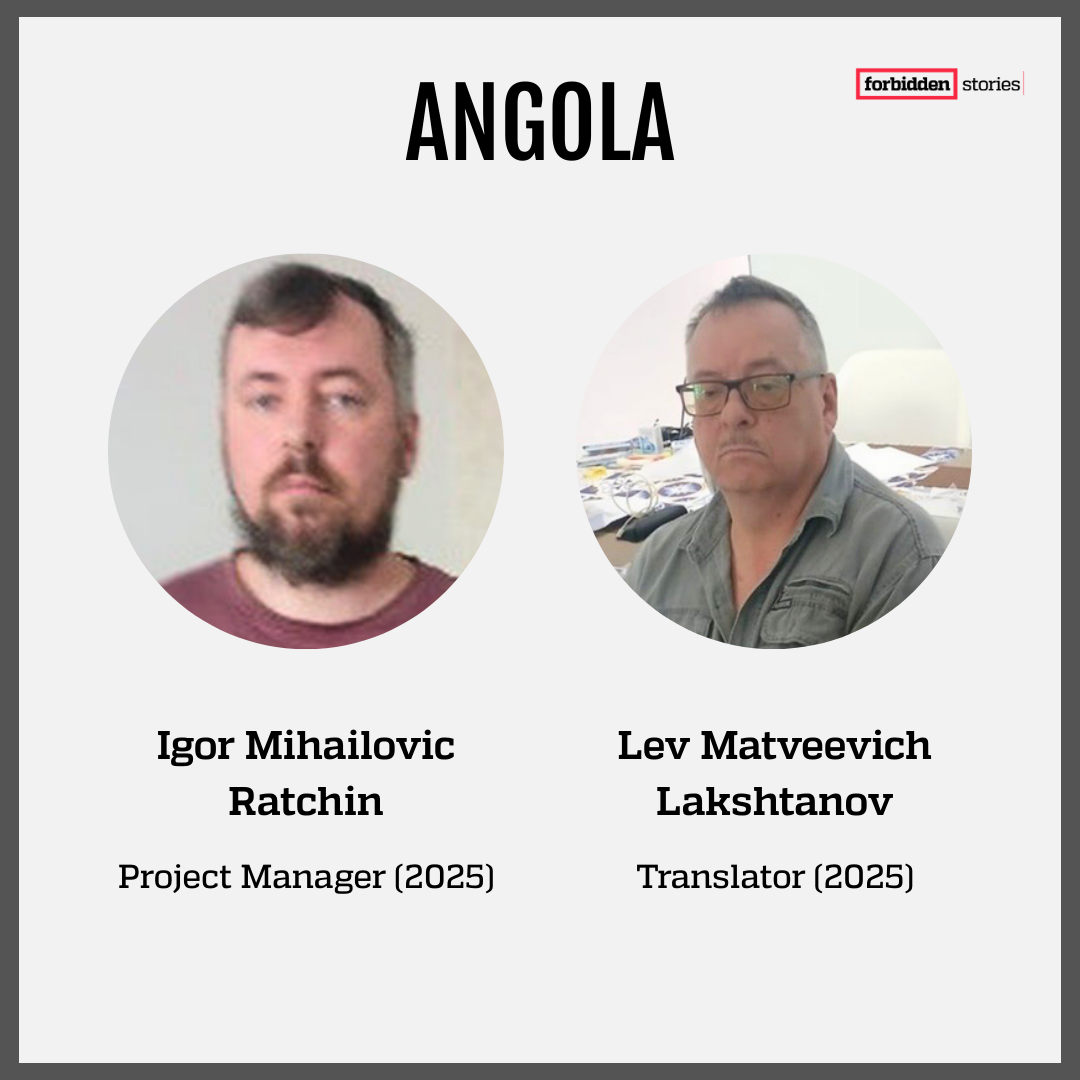
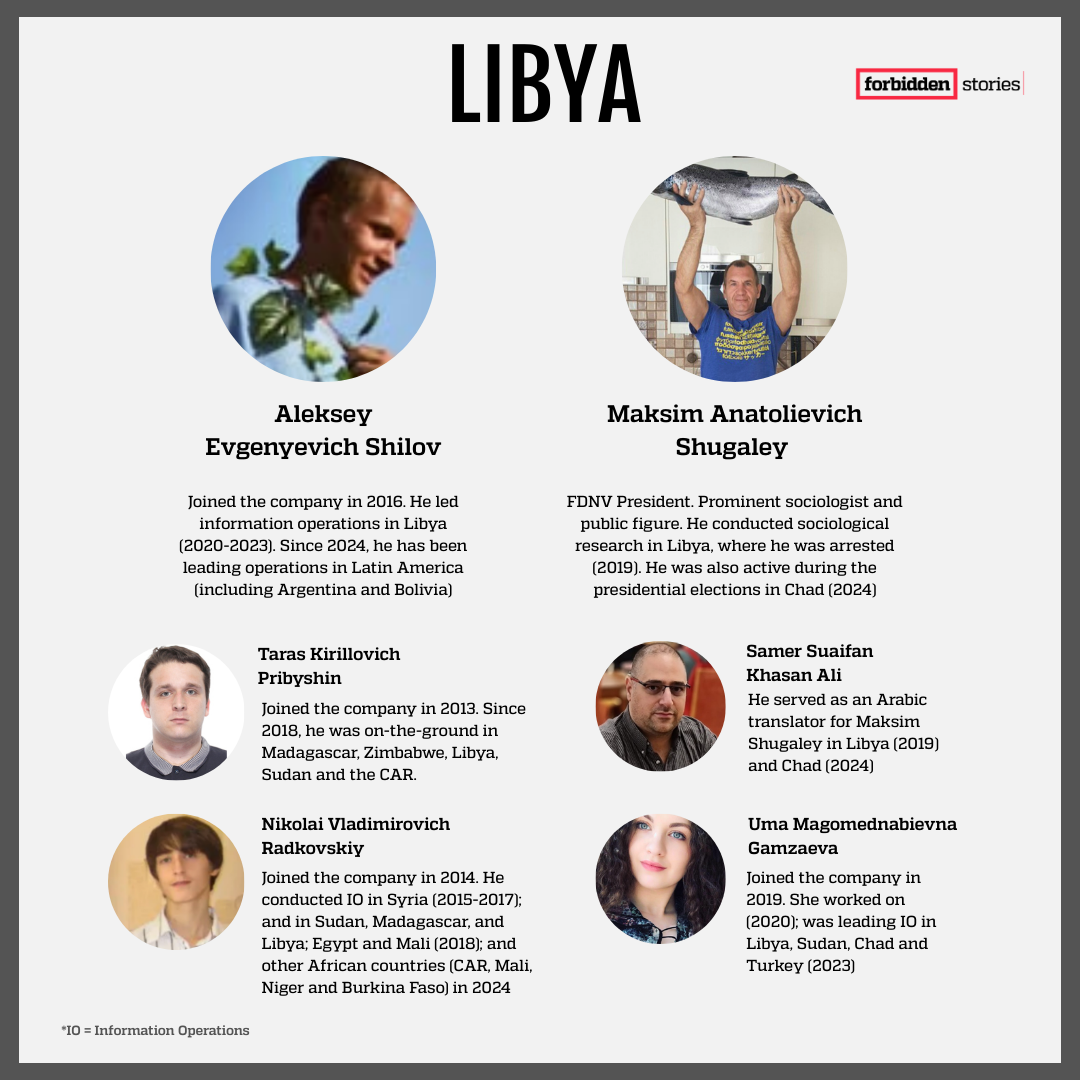
Of the 60 Russian influence agents identified, at least 17 were already working for Prigozhin. The most senior agents joined the “Company” in 2013 or 2014, according to the documents. Among them: Taras Kirillovich Pribyshin and Nikolai Vladimirovich Radkovskiy, who had earned their stripes in Syria during a campaign “for the victory against the Islamic State.” Pribyshin, in particular, went on to carry out missions in Madagascar, Zimbabwe and the Central African Republic.
Mashkevich and Klyukin have both been working for the “Company” since 2018 and, like Gorny, have worked in Sudan, where the organization attempted to keep President Omar al-Bashir in power before he was overthrown in 2019. A leaked internal document from 2023 notes: “to this day, the ‘Company’ is making judicial, diplomatic and political efforts to secure (his) release.”
In South Africa, Yulia Andreevna Afanasyeva Berg, whose plane ticket from Johannesburg dated March 14, 2024 appears in the leaked data, is also no stranger to Prigozhin’s circle. In 2021, the U.S. sanctioned her, notably for interfering in foreign elections.
On the left, a poster for the film Shugaley, financed by Prigozhin and released in 2020. On the right, disinformation agent Shugaley.
Sometimes, agents of disinformation are exposed. In 2019, Maxim Shugaley and his interpreter, Samer Sueifa, were imprisoned in Libya after they too were accused of attempting to interfere in elections. While they were still in prison, the first installment of a testosterone-fueled trilogy called “Shugaley” was released in Russia. Financed by Prigozhin, it turned Shugaley from a self-proclaimed simple “scientist” into a national hero. Shugaley and Sueifa, released from detention in December 2020, would be imprisoned again on Sept. 19, 2024, this time in Chad.
Officially, Shugaley and Sueifa had spent part of 2024 supporting outgoing president Mahamat Déby. The leaked documents reveal that, in May of that year, they were operating “at the election headquarters of Chad’s transitional president, Mahamat Déby,” and suggest that their involvement was driven by ulterior motives. Their goal was to “exacerbate the political rivalry between the two candidates and pit outgoing president Déby against his ‘co-pilot’ (Masra),” ultimately “destroying the Déby-Masra tandem and causing them to lose control of the political situation in the country.” This would then bring Déby and Chad into Russia’s sphere of influence. The SVR allegedly mobilized one of its agents to secure Shugaley’s release from prison in November 2024.
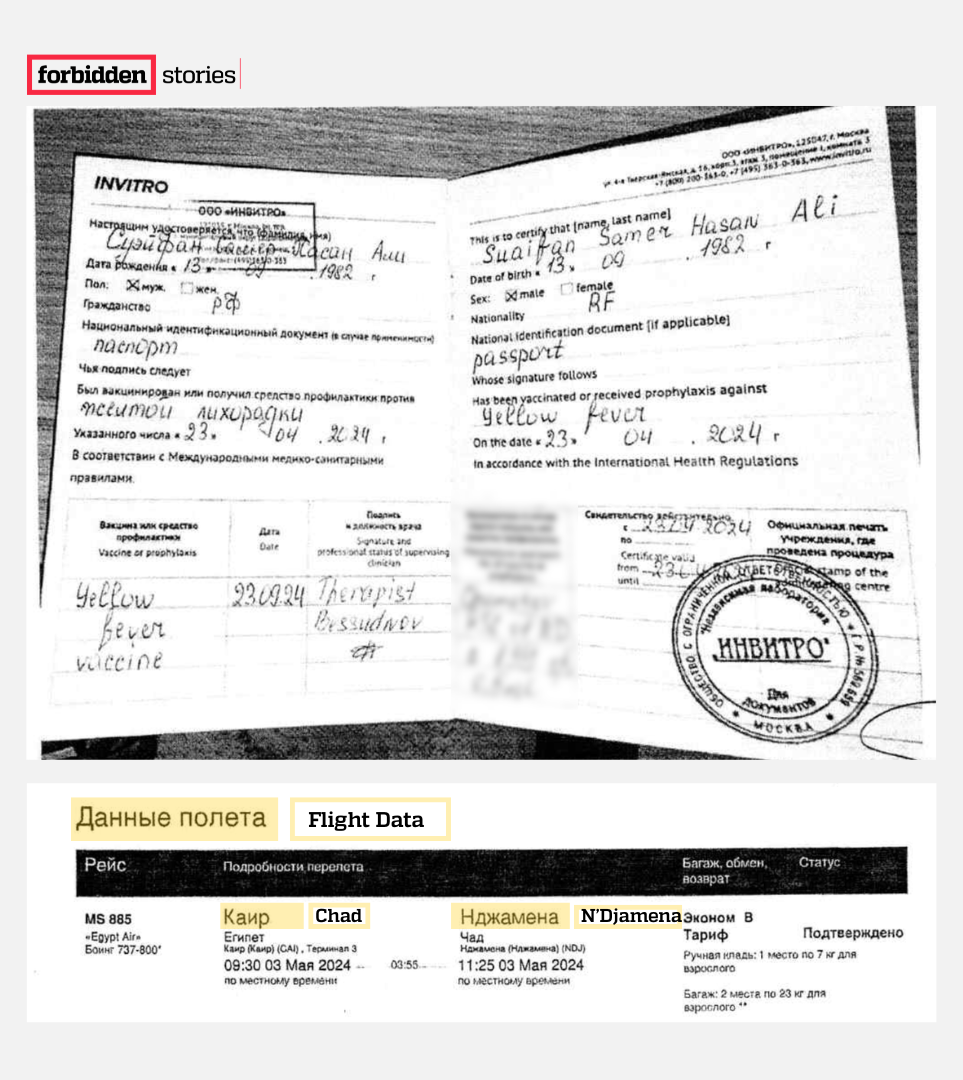
Samer Sueifa’s yellow fever vaccination certificate and a plane ticket for one of his trips to Chad with Shugaley
The most recent document from the data leak dates back to Nov. 6, 2024. Since then, the “Company” has had to rein in its ambitions in Bolivia. Their operation there failed, and President Arce has been in prison on corruption charges since December 2025. The seven Russian agents from the Bolivian office have been redeployed elsewhere, according to Forbidden Stories’ information.
When contacted, none of the individuals in this network, nor the Russian Foreign Intelligence Service, responded to Forbidden Stories’ questions.
In Saint Petersburg, however, the “Company’s headquarters continues to hire. Not counting field agents, there were at least 52 project managers, political consultants, analysts and media managers working there in December 2025, according to new internal “Company” documents Forbidden Stories consulted — a sign of the flexibility of this formidable propaganda machine, which, despite setbacks, continues to expand.
Protect your stories
Are you a journalist under threat because of your reporting? Secure your information with Forbidden Stories’ SafeBox Network.
Read also