- Reading time: 8 min.
Maintaining friendly powers at all costs
The maneuvers of Russian influence agents in South Africa, Namibia and Madagascar
In these three countries, Russian influence agents engaged in covert operations during election campaigns between 2019 and 2025, according to a data leak reviewed by Forbidden Stories and its partners. In Johannesburg, secret meetings were held between specialists from “The Company,” a network run by Russia’s Foreign Intelligence Service, and leaders of the ANC. In Madagascar, the operatives supported and then attempted to isolate President Rajoelina. Through smear campaigns against the opposition and fabricated documents, they actively supported candidates deemed pro-Russian. This is the fourth article in the Propaganda Machine series.
Credit: Forbidden Stories
- In South Africa, according to documents obtained by Forbidden Stories, secret meetings took place between Russian agent “9477” and Fikile Mbalula, secretary general of the African National Congress. Mbalula’s advisor, Bongani Mbindwane, allegedly received $3,000 per month in early 2025 in exchange for his services. “The Company” is behind several smear campaigns against the opposing political party.
- In Namibia, “The Company” produced fake letters and videos to discredit the rival IPC party.
- In 2023, “The Company” planned disinformation campaigns to “force” Madagascar President Rajoelina to “seek Russia’s help again.”
By Eloïse Layan, with Léa Peruchon
March 13th, 2026
Secret meetings in Johannesburg
On Dec. 23, 2024, in the private lounge at the African Pride Hotel in Johannesburg, a Russian influence agent — code name “9477” — and his translator met with one of the most influential men in South Africa.
Fikile Mbalula is the secretary general of the African National Congress, or ANC, historically Nelson Mandela’s party, and is a potential candidate for the 2029 presidential election.
The meeting was secret, but Forbidden Stories consulted Agent 9477’s written account. “I briefly reported on the results of the 2024 mission,” he says. He details how Mbalula, who had been joined by his advisor Bongani Mbindwane, thanked the Russians “for their assistance before the elections” in May and June 2024 and “stated that he would like the mission to continue to help the party, particularly in the run-up to the 2026 elections” at the municipal level. Agent 9477 also describes Mbalula requesting “support for the shooting of a film to coincide with the party’s anniversary … and $300,000 to finance the organization of the party congress.” The meeting ended with “gifts offered to Mbalula, Mbindwane and their families” for Christmas, according to the memo.
The links between Russia and the ANC, an anti-apartheid movement and member of the Socialist International, date back to the days of the Soviet Union. But this meeting, along with more than 1,400 pages of leaked data initially received by the pan-African newspaper The Continent and shared with Forbidden Stories, reveals much more direct support delivered outside diplomatic channels.
In 76 internal documents from an entity called “The Company” — better known as Politology and led by Russia’s Foreign Intelligence Service, the SVR — Russian influence agents formerly employed by Wagner founder Yevgeny Prigozhin report their activities in Africa and Latin America: carrying out disinformation operations, smear campaigns and election interference. This new article in the Propaganda Machine series deciphers the political maneuvers developed by Russian agents to keep “friendly” regimes in power, particularly in South Africa, Namibia and Madagascar. These campaigns have remained secret until now.
A red nose, a young lover and accusations of racism
The signature is identical, as is the logo. But “it is so badly written that it is actually an insult, and bears no resemblance to the DA’s position,” posted Helen Zille, president of the liberal Democratic Alliance party, in June 2024, referring to a letter signed in her name. This document, purportedly internal to the DA, describes the party’s alleged political schemes to remove the ANC from power once a coalition had been formed. The data leak reveals it’s a forgery: “a document fabricated” by Russian agents.
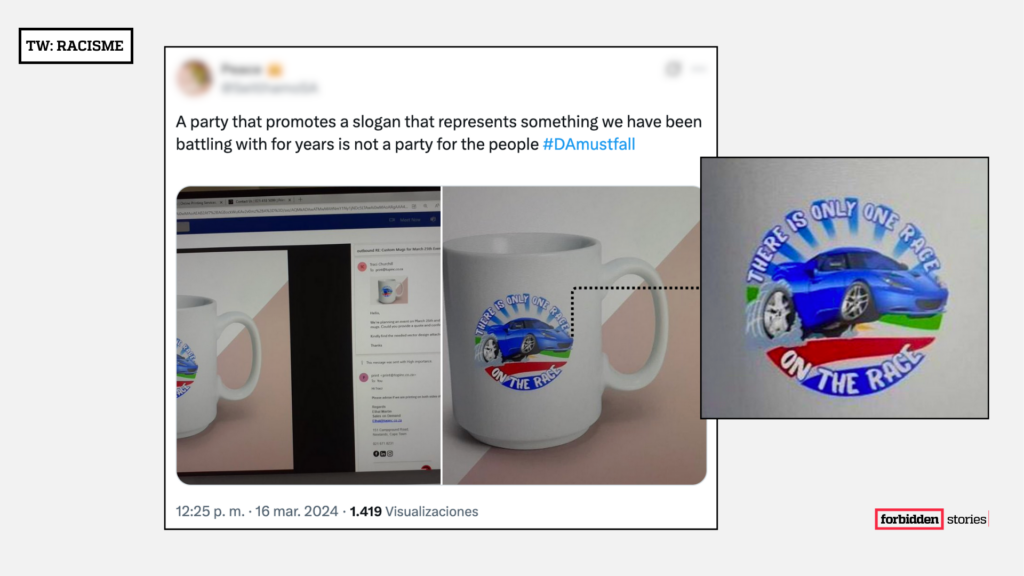
Screenshot from social media showing racist mugs reading “There is only one race on the race,” reportedly linked to John Steenhuisen’s birthday, during South Africa’s 2024 presidential campaign. An example of fake news and disinformation at the time. (Credit: Forbidden Stories)
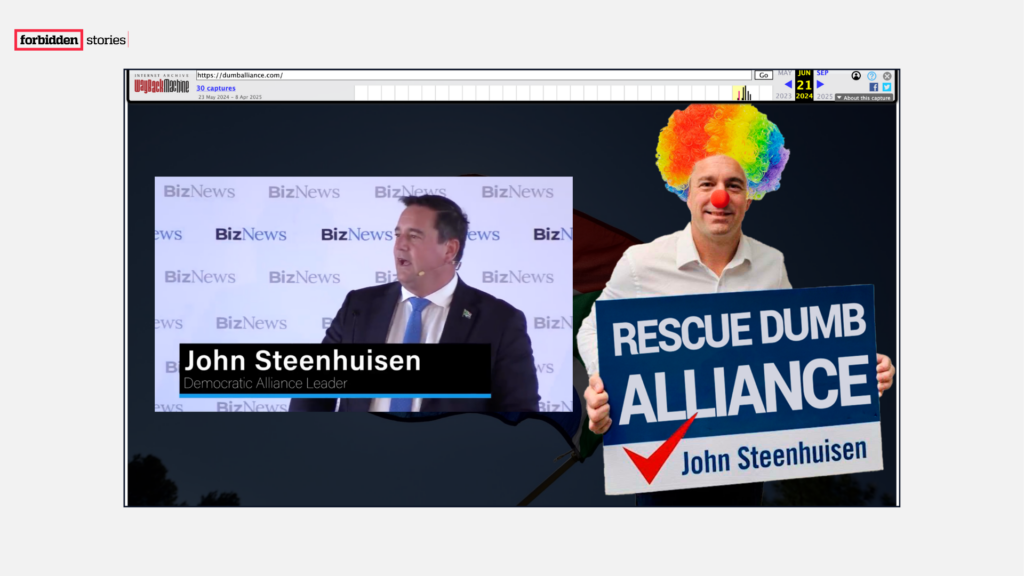
Screenshot from the Wayback Machine showing the now-defunct website [dumballiance.com], reportedly created by Russian agents during South Africa’s 2024 presidential campaign, depicting John Steenhuisen in a clown costume alongside other scandals involving Democratic Alliance members. (Credit: Forbidden Stories)
That same year, with South Africa in the midst of a presidential race, fake news and disinformation operations against the DA multiplied. An order for racist mugs bearing the phrase “There is only one race on the race” was placed for the birthday of John Steenhuisen, then leader of the DA, a party that many opponents, observers and citizens have labelled the “white party.”
Russian agents also launched the website “dumballiance.com,” branded with the DA logo. It features an image of Steenhuisen wearing a wig and a red nose and lists scandals involving DA members. “The Company” is also behind another deception: a bill for a reservation for a room at the luxurious Marina Bay Sands hotel in Singapore for Zille and her young subordinate, Tim Harris, framed as her lover.
“It’s ridiculous. Tim Harris is old enough to be my son,” said Zille, who recently celebrated her 75th birthday. “We thought campaigns were orchestrated, but we never suspected foreign interference. It’s outrageous,” continues the ex-former journalist, anti-apartheid activist, former mayor of Cape Town and now candidate for the mayoralty of Johannesburg.
In 2024, one month before the elections, Politology allocated a budget of $118,000 for “the development and implementation of special projects,” including online campaigns such as “DA Racists,” “Burning the DA Flag” and “Corrupt DA Activists.”
Among the leaked documents, account tables show that nearly a dozen South African influencers were paid an average of $150 for every post they made on X against the DA. One of them, Ntate Williams, confirmed the rates to Forbidden Stories, about $180 today for a sponsored tweet. However, he denies having worked for Russian agents, saying that the “rare” political content he publishes reflects “his own opinion.” “I think they would have approached us through a local intermediary,” he said.
Another document that Forbidden Stories consulted indeed mentions the presence of an intermediary. Paid $1,200 per month in December 2024 and in January, February and March 2025, Phuti Mosomane (@phutism on X) is responsible for contacts with online newspapers and “influencers with more than 100,000 followers,” according to “The Company.” Reached by phone and text message, Mosomane did not respond to Forbidden Stories’ requests for comment. The involvement of intermediaries makes it impossible to know whether the influencers are aware of who their real employer is.
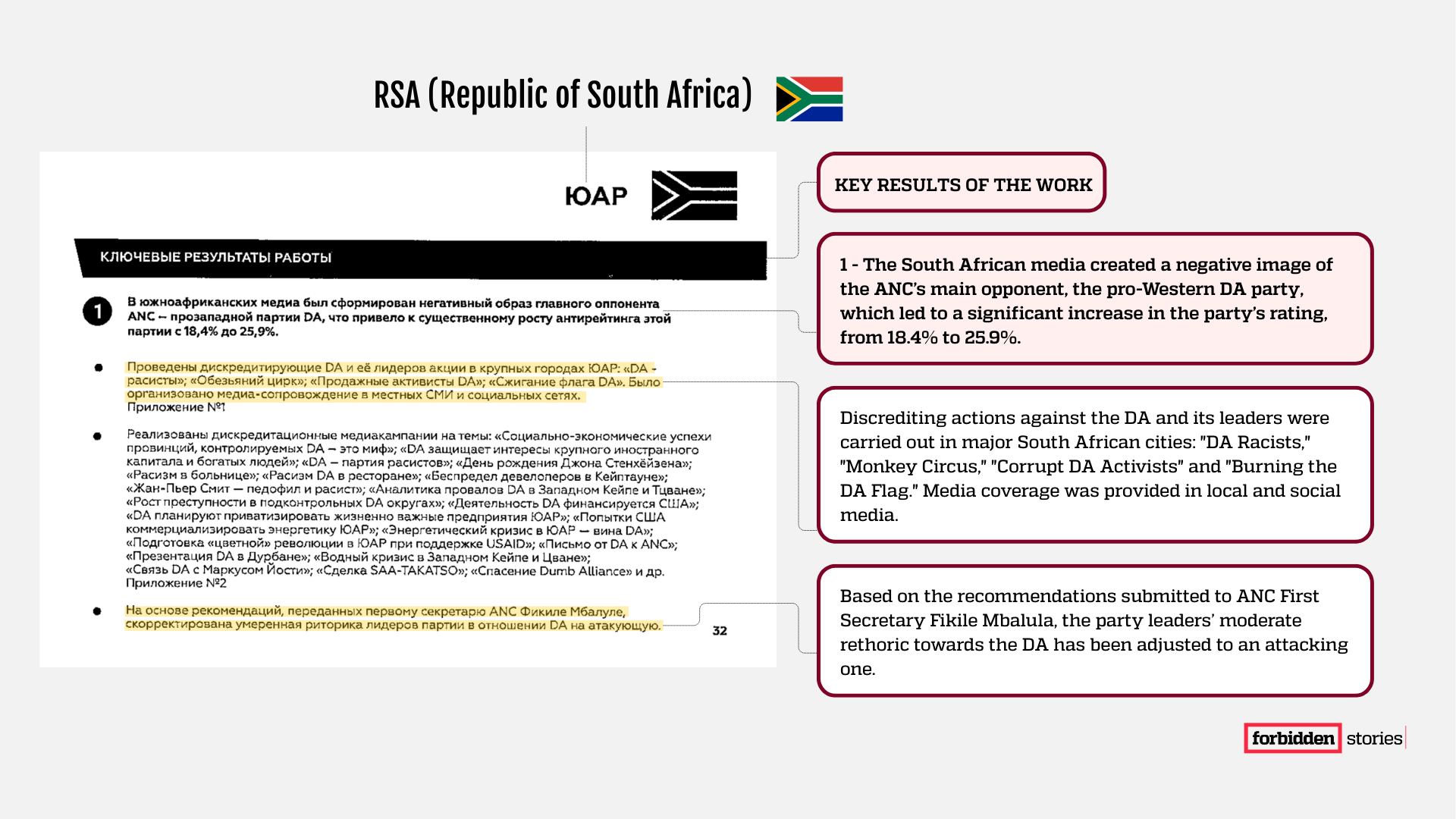
Extract from internal “Company” documents outlining the alleged “key results” of its work in South Africa in 2024. (Credit: Forbidden Stories)
In May 2024, “The Company” invested more in South Africa than in any other African country, followed by the Central African Republic and Mali. Internally, it assessed the impact of its campaigns: 3.6 million people reached for one entitled “South Africa’s energy crisis is the DA’s fault,” and 1.2 million for the operation against Zille and her alleged lover.
“I hadn’t heard about that one. It’s absurd,” Zille told Forbidden Stories through laughter.
The 1,400 pages of documents are filled with “The Company” highlighting only “its successes.” But its triumphant figures and claims should be put into perspective. Murmur Intelligence, a social intelligence lab collaborating with The Continent, analyzed several of the campaigns retrospectively. Its findings suggest the impact was far smaller than the internal reports claimed. One example was the so-called “DA Racists” campaign, which “was poorly spread,” according to Murmur Intelligence. In total, analysts identified only 214 posts linked to the effort.
Sokolov: Agent 9477, a famous political technologist
In Johannesburg, a team of at least six “specialists” rented their offices. An invoice also shows an address in one of the most upscale neighborhoods of South Africa’s largest city. Specifically, in a private residence on Khyber Court. At the head of the mission there: Maksim Sokolov. According to information obtained by Forbidden Stories, he is Agent 9477.
A 2022 survey of experts conducted by the daily newspaper Novye Izvestia found Sokolov to be one of the “best Russian political technologists,” the Russian term for an agent of influence. He is under Ukrainian sanctions.
In a rare interview with a Russian regional media outlet in 2025, entitled “Election Campaigns: The Secrets of a Pro,” Sokolov admits to having been based in Africa “a long time ago.” In reality, he was there just a year earlier. He goes on to say his team “helped and provided consultancy.” When asked about the value of deploying Russian specialists to Africa, he explains, “They needed to speed up all the processes. … They’re literally in first gear. Compared to them, we —” The interviewer interrupts him: “You’re flying like a rocket.”
Sokolov did answer Forbidden Stories’ calls.
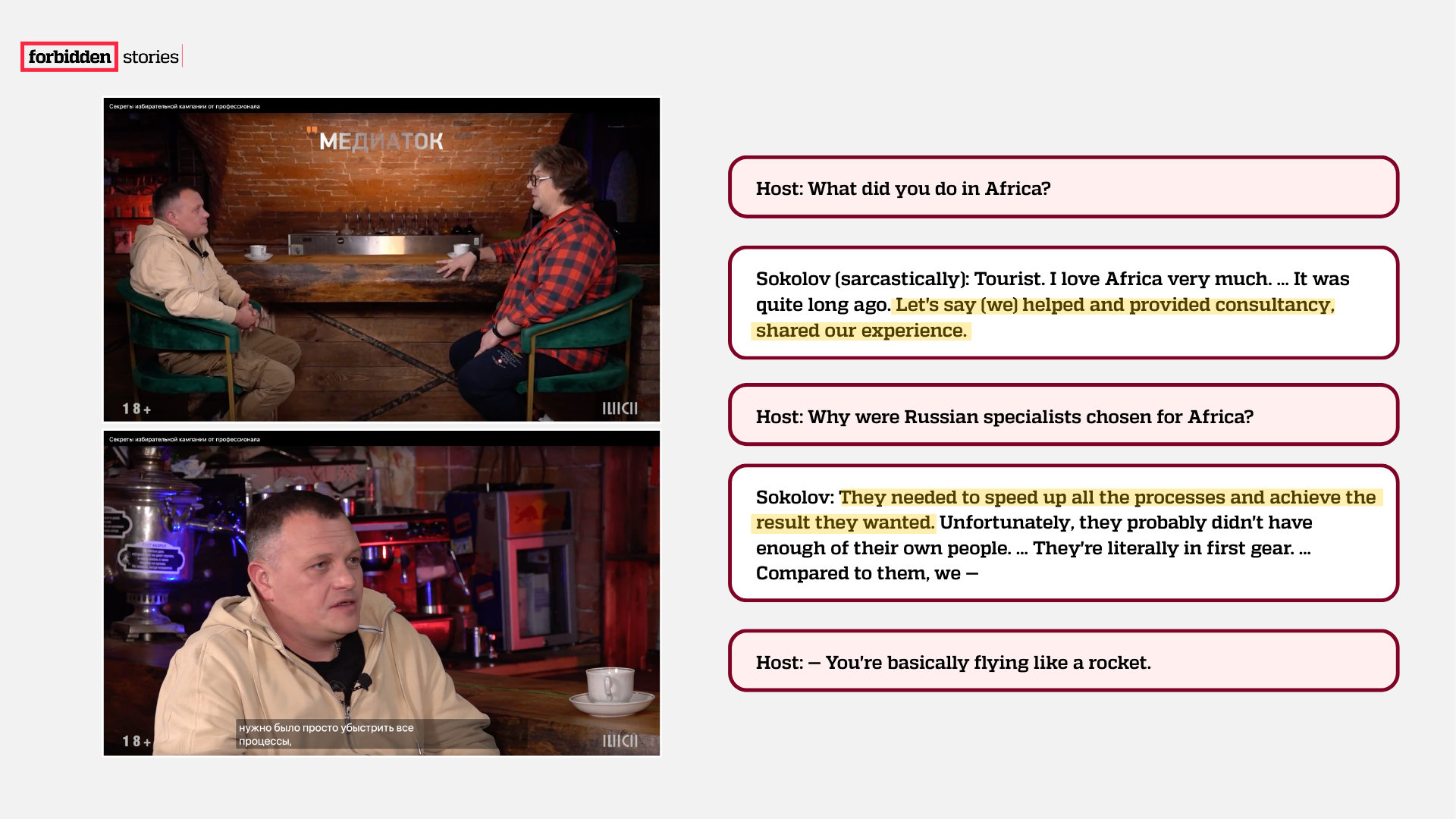
Screenshot from an interview Maksim Sokolov gave to a regional Russian media outlet in 2025, in which he admits to having been based in “Africa” in the past. (Credit: Forbidden Stories)
“Friendly” versus “pro-Western” parties
Russia has the same objectives in South Africa as it does in all the countries “The Company” targets: to keep a friendly party in power against “pro-Western” political opposition. Although still ruling South Africa, the ANC is seeing its popularity decline. As early as 2018, Secretary General Mbalula reportedly “turned to The Company’s specialists for support in the 2019 elections” during a visit to Moscow. “The Company” claims to have conducted “sociological surveys and exit polls,” made “recommendations to counter the opposition” and worked on “managing the party’s social media accounts.”
One term later, in 2024, “The Company” was doing similar work, while also advising Mbalula that the “moderate rhetoric of party leaders against the DA be adjusted and made more aggressive.” According to internal documents, support for campaign activities was provided “at the request of the party leadership.”
“We have never asked for Moscow’s support, and we have never received any support whatsoever. That has never happened,” Mbalula said when reached by telephone. He acknowledged having met with “groups of researchers,” but “from all over the world … even Scandinavians.” When asked about Sokolov and other former employees of Prigozhin, he said, “It’s possible that we met them, but I don’t remember the names of all the people we see.” Funding, polls, recommendations: “It’s all nonsense,” Mbalula said.
$3,000 a month for Moscow’s counterpart in South Africa
Mbindwane, Mbalula’s assistant and “confidant,” as the leaked materials describe him, also categorically denies having met with Russian agents in December 2024 or at “any other time.” Nicknamed “Bongs” by “The Company,” he was previously implicated in South Africa in an attempt to eavesdrop on an ANC congress in 2017. Nevertheless, the internal documents reveal he is the gateway to the ANC for Russian agents, providing confidential party information during several meetings. A document obtained by Forbidden Stories also mentions payments of $3,000 per month in December 2024, January and February 2025 for “communication with the ANC and analysis” services.
“I was not in South Africa in 2024,” Mbindwane states in a letter sent to Forbidden Stories, questioning the authenticity of the documents from the data leak. “The ANC maintains its relations with Russia directly and through established inter-party channels, without intermediaries or unidentified third parties,” he writes. Mbindwane adds that during his trips to Russia, his engagements “took place exclusively with representatives of the Russian government, through official diplomatic channels.”
However, a copy of a hotel reservation obtained by the investigative organization Dossier Center shows that in 2018, the booking fees for Mbindwane and Mbalula were paid by two employees of Prigozhin. As for the data leak, European security sources and researchers specializing in Russia have authenticated the materials, which concern more than 33 countries. Some of the information in the documents — notably the names of Russian agents — has already been corroborated in previous articles from the Propaganda Machine project, published by the consortium.
Mbindwane also denies the existence of a film that would coincide with the party’s anniversary, contradicting the claim in Sokolov’s memo that Mbindwane requested funding from “The Company.” In reality, the film “Legacy of Hope: Freedom Through Solidarity” was made “to mark the anniversary of the ANC,” according to the accompanying caption, and later released in April 2025. Available on YouTube, it celebrates the historic friendship between Russia and South Africa and praises “Russia’s resistance to European imperialism through its proxy, Ukraine, which is trying to invade Russian territories” — a formulation consistent with Kremlin propaganda. The film was co-produced by Mbindwane through his production company Zoetic Management. According to director Harry Hofmyer, Mbindwane was primarily responsible for financing.
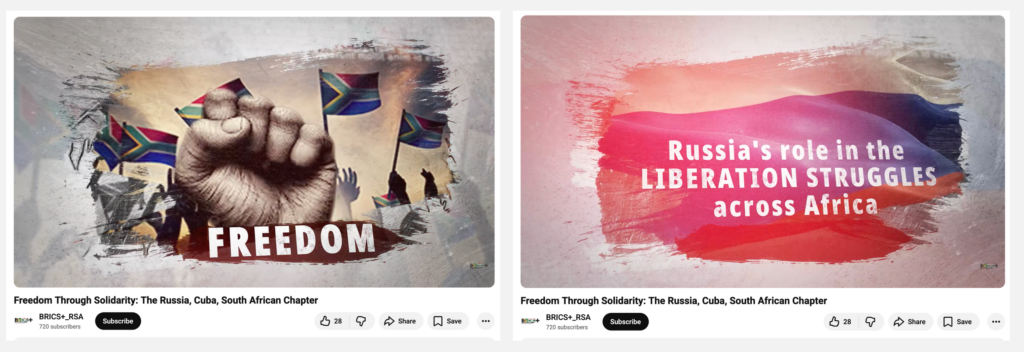
Screenshot from the 2025 film “Legacy of Hope: Freedom Through Solidarity,” available on YouTube. (Credit: Forbidden Stories)
The “key man” in the project, according to Hofmyer, is Marius Fransman, the film’s other co-producer, a former ANC MP and former deputy minister of international relations under Jacob Zuma in the 2010s. Fransman regularly travels to Moscow and promotes Russian language courses. His name also appears on a document reviewed by the consortium. He allegedly received $900 per month, from December 2024 to March 2025, for analysis and event organization activities, which he denies in a response to the consortium. Fransman also states that he is unfamiliar with Politology and did not receive any funding from “The Company” for the film: “It was a project we financed ourselves.” When questioned about a meeting between Mbalula, Mbindwane and Russian influence agents, he says, “I know nothing about Mbalula’s activities.”
It is unclear whether the ANC leadership was aware of the secret meetings and arrangements between Mbindwane and Mbalula with Russian agents of influence.
· The Namibian president elected as fake news circulates
Throughout 2024, ahead of the November elections in Namibia, Russian agents stepped up their fake news campaign against the opposition party Independent Patriots for Change, or IPC. At the same time, they conducted operations to promote the ruling party, the South West Africa People’s Organization — also known as SWAPO, a former Namibian independence movement and member of the Socialist International.
Internal Russian documents describe a letter “fabricated” by “The Company” claiming that the UK was financing the IPC in exchange for benefits related to oil extraction. This forgery forced the British ambassador to Namibia to deny the information in an interview with the Namibian Sun on July 28, 2024. “Under no circumstances would we have provided £750,000 … to a party, whether in Namibia or anywhere else,” he said.
For “The Company,” the diplomat’s intervention was proof of its success. “The news spread so widely that the British Embassy issued an official denial,” an internal document reads.
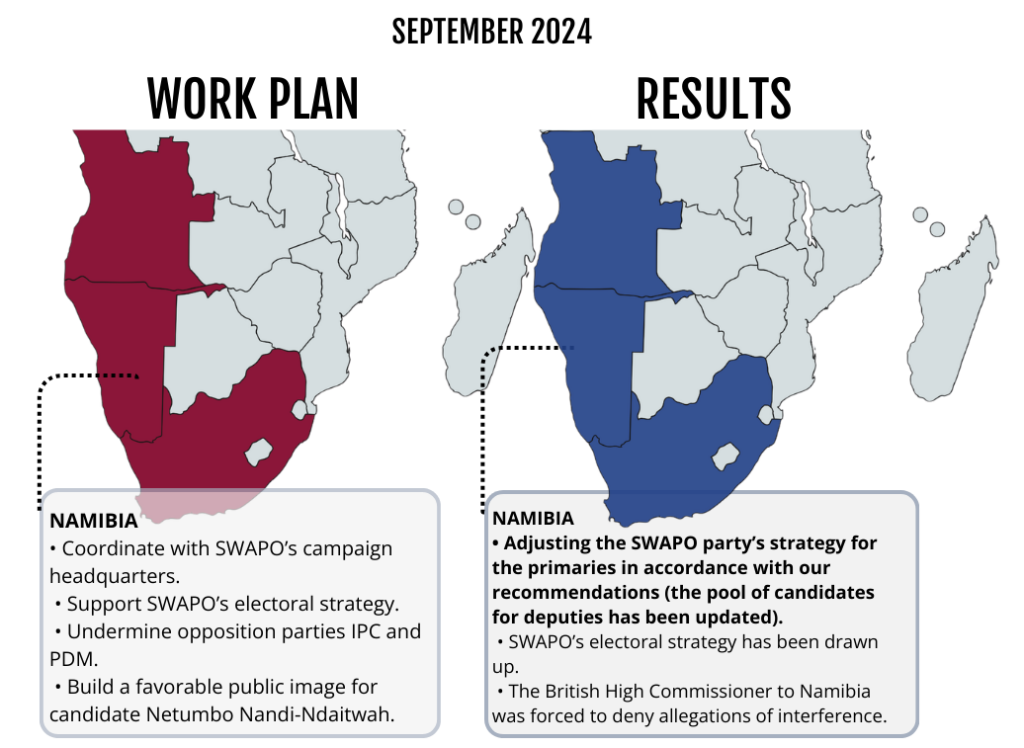
Working plans and results by “The Company” in Namibia, according to documents found in the leak (Credit: Forbidden Stories).
Other campaigns against the IPC create further deception. One targeted the IPC’s alleged mismanagement with “a series of videos created by The Company on the problem of child begging in Windhoek,” the country’s capital. Another circulated a fake press release from the Zimbabwean police stating that one of their patrols had discovered a military training camp for 50 Namibian nationals at the border. The campaign’s goal: to make people believe that “the IPC is training fighters for unrest in Namibia.”
Other files consulted by Forbidden Stories reveal correspondence between SWAPO leaders and Russian agents a few days before the elections. On Oct. 26, 2024, a document states that then-Namibian presidential candidate “Netumbo Nandi-Ndaitwah contacted us. … She wishes to express her gratitude to her ‘Russian friends.’ She also asked for help with the SWAPO campaign, but this must be done ‘cleanly.’”
On Oct. 27, Russian agents reported a request for financial assistance from the party’s deputy secretary general, Uahekua Herunga: $118,000 to pay 10,000 party activists on election day, $17,700 for the production of T-shirts and $23,600 for the transportation of voters and activists. Whether or not “The Company” had agreed to this is left unspecified.
On Nov. 27, 2024, Nandi-Ndaitwah was elected in the first round, with 58.07% of the vote. Reached by phone and text message, the presidential spokesperson did not respond to Forbidden Stories’ requests for comment.
· Making Madagascar’s head of state “as embarrassing and unacceptable as possible”
Gaëlle Borgia chose her words carefully. “We know that the Russians approached him during the second round. … But today, it is difficult to prove that Andry Rajoelina had Russian help to win the presidential election,” said the Franco-Malagasy journalist in 2023 on Radio France Internationale. Four years earlier, she had released her documentary “Madagascar: Did Russia Manipulate the Presidential Election?” in which she identified half a dozen candidates whom Russian intermediaries approached during the 2018 campaign.
In internal materials Forbidden Stories consulted, “Company” agents claim to have played a role in the Madagascar election in 2018. But it appears their initial approach failed. Russian strategists initially bet on the success of the incumbent president, Hery Rajaonarimampianina, before realizing they had backed the wrong horse. The teams analyzed the electoral landscape and sifted through polls. Rajaonarimampianina’s popularity was said to be no higher than 8%, and he was perceived as the most corrupt leader in the country.
The Russians then turned to another candidate: Andry Rajoelina, the former mayor of the Malagasy capital. According to the documents, during his exchanges with Russian agents, Rajoelina “repeatedly confirmed his intention to move closer to the Russian Federation” once elected.
In the wake of this, a political strategy began to take shape. Internal reports describe the formation of a bloc of 11 candidates selected to play a key role: hold out in the first election round, then rally behind Rajoelina in the second to organize a transfer of votes in his favor.
Some questions remain unanswered. Did Russian experts orchestrate the formation of this bloc themselves, or did they simply jump in on a process that was already in motion in the first round? It’s impossible to say with certainty. When asked, Rajoelina’s team did not respond to Forbidden Stories’ requests for comment.
The second round played out to Rajoelina’s advantage. Internally, Russian agents congratulated themselves and took credit for the victory: “Madagascar has become the first African country where the rapid and effective intervention of Russian specialists in the field of political and media consulting has made it possible to change the results of a presidential election.”
The stated objective was to make the head of state “as embarrassing and unacceptable as possible,” to “force him to seek Russia’s help again.”
Rajoelina went on to support positions at the U.N. that were perceived as relatively favorable to Moscow in the context of Russia’s invasion of Ukraine. At the very least, they were not aligned with Western interests. But his stance quickly changed. Under diplomatic pressure from the U.S. and Europe, and “faced with the passivity of the Russian Foreign Ministry and the inaction of the Russian embassy in Madagascar,” according to the same internal documents, Rajoelina began to rebalance his position and ultimately distanced himself from the Kremlin.
The Russian strategists did not receive the shift well. With the 2023 presidential election approaching, a new roadmap was drawn up. The stated objective was to make Rajoelina “as embarrassing and unacceptable as possible to the West” in order to “force him to seek Russia’s help again.” The method envisaged is radical: disinformation campaigns accusing him of “corrupt ties” with Moscow, in the hope of provoking Western “secondary sanctions” against him and increasing his dependence on Russia.
The plan did not produce the desired effects. In October 2025, Rajoelina was overthrown in a coup and forced into exile. Colonel Michael Randrianirina, now at the head of the transition, is multiplying diplomatic partnerships. Received by Vladimir Putin in Moscow last February, he spoke of a “new era of cooperation.” In Paris a few days later, he also formalized a “renewed partnership” with France, following a meeting with Emmanuel Macron.
Read also