- Reading time: 9 min.
In the Sahel, journalists, activists and NGOs in the crosshairs of Russian agents from “The Company”
To build its network of influence and expand its reach in Africa, Russia is targeting civil society actors: recruiting journalists, infiltrating NGOs and activist groups, and mobilizing public figures. Forbidden Stories analyzed new documents obtained by pan-African partner publication The Continent, which reveal the important role these actors play in strengthening and expanding Moscow’s foothold in the Sahel.
- The Russian network known as “The Company,” operating under the Russian Foreign Intelligence Service, has worked to strengthen the Alliance of Sahel States, which it seeks to expand into “an anti-Western belt stretching from Guinea to Sudan.”
- Tournons la Page, a network promoting alternation of power in Africa, is directly targeted in internal documents. The organization appears to have been infiltrated to such an extent that it suspended its Nigerien branch.
- The Russian influence network is exploiting youth movements. The International Conference of African Youth, held in Bamako in 2024, was part of Russia’s plan to push Chad, Guinea and Senegal to join the Alliance of Sahel States — so far, without success.
By Léa Peruchon and Eloïse Layan
March 27, 2026
In August 2024, two white men escaped the sweltering heat of Chad’s capital, N’Djamena, in the lobby of the Hôtel de l’Amitié, a stone’s throw from the National Museum.
They introduced themselves as Belarusian journalists, there for an appointment with a Chadian colleague, Olivier Monodji. The men explained that they had come to help train local reporters and would soon be launching a “media house” in the capital.
“They showed me their press credentials, talked about advertorials, about collaboration,” Monodji said. The journalist, editor-in-chief of the newspaper Le Pays, agreed, unaware that he had just been “marked” by Russian agents. “I didn’t know it was on that level… I was later accused of colluding with the enemy,” Monodji told Forbidden Stories.
A month later, numerous Chadian journalists were invited to the inauguration of the “Russian House” in the Farcha neighborhood. The event was carefully orchestrated. Speeches, hors d’oeuvres and local media coverage: Everything seemed to go off without a hitch. But behind the scenes, the two Russian-speaking men, who had been keeping a low profile until then, seemed nervous. They didn’t know it yet, but from a nearby balcony, agents from the National State Security Agency were discreetly filming them. As soon as the ceremony ended, they were arrested.
Monodji and three other journalists would be arrested in March 2025 for helping the Russians publish propaganda articles, particularly against France and Ukraine. In the referral order, reviewed by Forbidden Stories, some of the journalists admit they agreed to publish “sponsored reports” on various online media outlets. Doing so earned them between 50,000 and 200,000 CFA francs (approximately 75 to 300 euros), equivalent to a month’s salary for a single publication. Ultimately, the journalists had the charges against them dismissed after demonstrating their good faith. “It’s because of the Russians that I spent four months in prison; I was set up,” Monodji said to Forbidden Stories.
“Counter-agents” in the service of an “anti-Western coalition”
Although that operation failed, Russian methods are nonetheless proven. Few people dare to speak out against them. In November 2024, journalist Ephrem Yalike risked his life to expose Russia’s disinformation campaign in the Central African Republic. He told Forbidden Stories about the threats he received after rebelling against his former Russian “employers,” who paid him 45 euros per article he published. His testimony became central to the first investigation in the Propaganda Machine series.
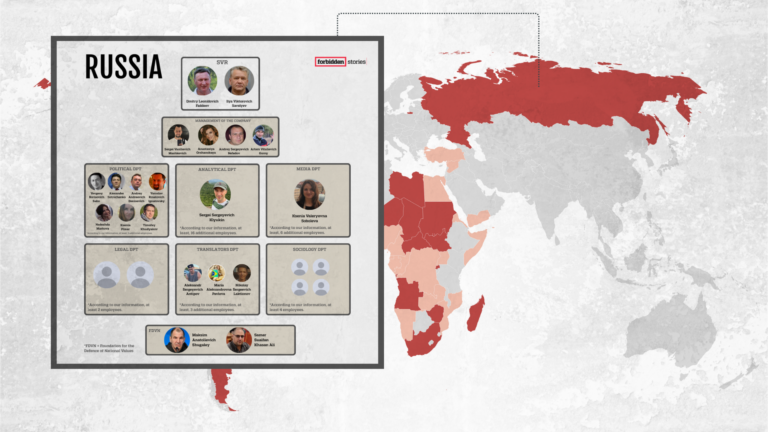
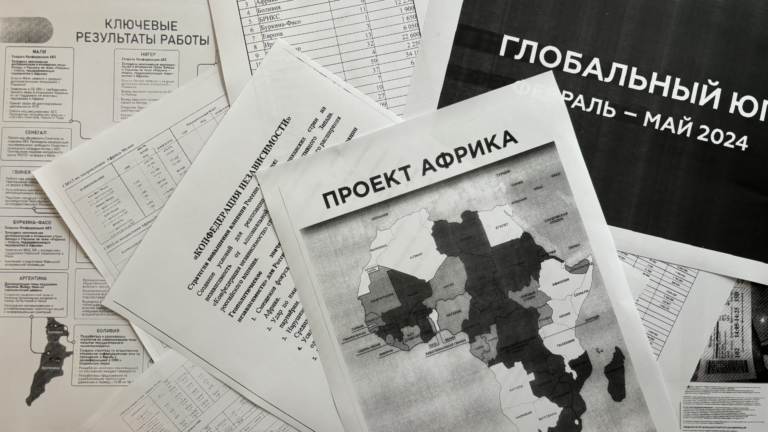
A 1,400-page data leak — obtained by the pan-African media outlet The Continent and shared with Forbidden Stories and several international newsrooms — details the operations of Russia’s influence network, internally referred to as “The Company.” It illuminates how the network identifies, recruits and turns journalists, activists and NGO members. Each of these “counter-agents” is a cog in Russia’s influence machine, targeting multiple countries.
An internal document indicates that as early as August 2023, “The Company” aimed to form a “confederation of independence,” which would be “the largest anti-Western coalition in Africa,” and at the same time, “the center of the future expansion of Russian influence.” One month after this strategic plan was drafted, Mali, Burkina Faso and Niger created the Alliance of Sahel States, or AES, a coalition that appears prominently throughout the documents.
From Mali, considered the “locomotive” of the alliance since Assimi Goïta’s 2020 coup, “The Company” adopted a “ripples on water” strategy, according to a document dated Jan. 31, 2024, obtained by Forbidden Stories. In other words, the network advanced Russian influence in successive circles, relying on the “pro-Russian” AES and its “expansion to five states, with associated states, and the formation of an anti-Western belt stretching from Guinea to Sudan (from the Atlantic Ocean to the Red Sea).” This fifth installment of the Propaganda Machine project sheds light on the methods Russia employed to this end.
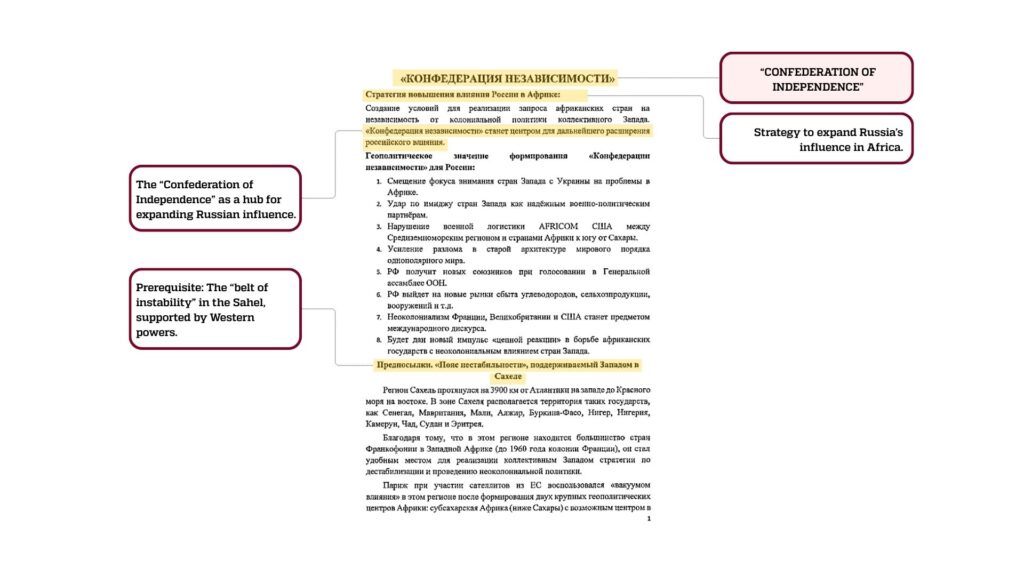
The first page of the internal document “Confederation of Independence” (seemingly dated August 2023), outlining a country-by-country strategy for the coming months (Graphic: Sofía Álvarez Jurado / Forbidden Stories)
The latest country to officially join the AES is Niger, following the coup in July 2023. Military officers led by General Abdourahamane Tiani overthrew the elected president, Mohamed Bazoum, who has since been imprisoned without trial. In the days that followed, the streets of Niamey filled with demonstrators chanting pro-Russian slogans and expressing hostility toward the French presence: “Long live Putin,” “long live Russia,” “down with France,” “long live the Nigerien army!”
In internal documents reviewed by Forbidden Stories, Russian strategists welcomed this development. “Mali and Russia appear as Niger’s natural allies in the current context,” one reads. Behind the scenes, “The Company” was already planning its next move: to control, and even neutralize, critical and independent voices within Nigerien society.
An NGO in the crosshairs of “The Company”
Among the targets of “The Company” is Tournons la Page, or Let’s Turn the Page, a citizen network active in 16 African countries that promotes democratic transitions of power on the continent. Its Niger coordinator, Maikoul Zodi, has publicly spoken out against the coup. Two days after it unfolded, he issued a statement condemning this “seizure of power by force,” explaining that it was not the solution “for the country’s emergence and development.” Zodi warned “certain corrupt and ill-intentioned partners against any interference in Niger’s internal affairs,” indirectly referring to the Russians.
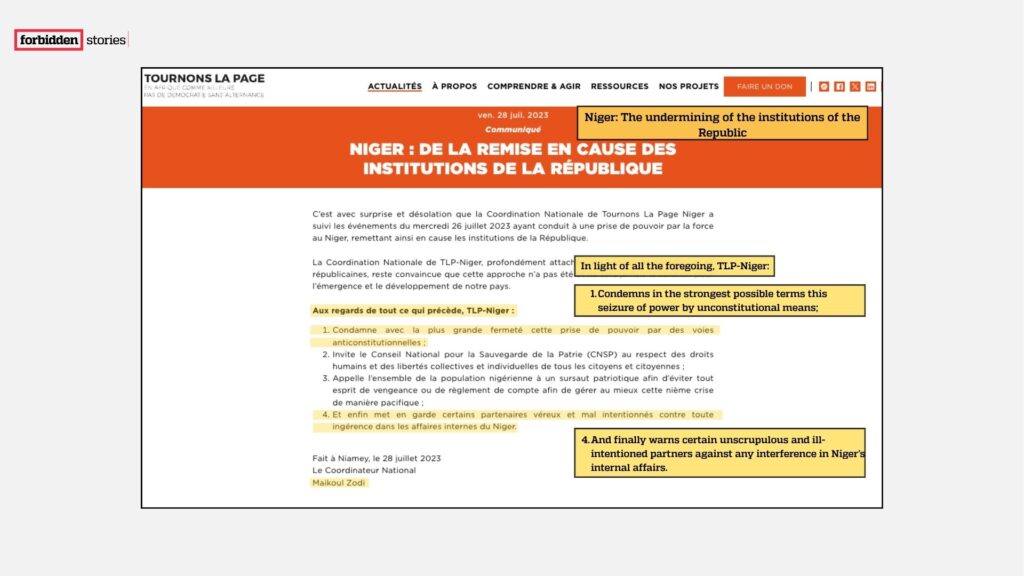
A TLP-Niger statement condemning the coup in Niger, July 28, 2023 (Graphic: Sofía Álvarez Jurado / Forbidden Stories)
This anti-junta, pro-democracy stance puts Tournons la Page at odds with Russia’s interests. The organization is explicitly targeted in several internal documents from “The Company,” with a “briefing note” devoted to TLP-Niger beginning to circulate as early as August 2024. A few months later, in a work plan by the AES, Tournons la Page is listed among the “pro-Western NGOs active in Mali receiving significant media coverage,” which should be “blocked,” notably through the adoption of a “foreign agents law.”
Without waiting for such a law, it appears Russia has already infiltrated TLP-Niger. Barely a week after the coup, Zodi was unexpectedly present in the stands of the Niamey stadium, alongside thousands of people who had come to support the coup leaders.
“This demonstration is a message to the international community preparing to attack Niger,” Zodi told the press. When asked about his sudden reversal, he cited the embargo on Niger and the ECOWAS sanctions. “Access to electricity, medicine and food was a problem,” he said to Forbidden Stories more recently, adding that “TLP-Niger has decided, along with other civil society organizations, to say no to the cynical sanctions against the Nigerien people, as well as to war.”
Zodi now claims to reject any external influence on his stance and maintains that he “fights against all forms of paternalism, whether French or Russian.” But a few months later, his pro-Moscow views were echoed by media outlets known to be close to Russian influence networks, such as Afrique Média.
In 2024, Zodi said he would welcome a rapprochement between Niger and Russia and advocated for an anti-terrorism military partnership between the two countries. “Russian technology will effectively help us achieve this strike capability,” he said. At the same time, “The Company” celebrated the withdrawal of American, French and German troops from Niger, viewing these departures as confirmation of a strategic shift.
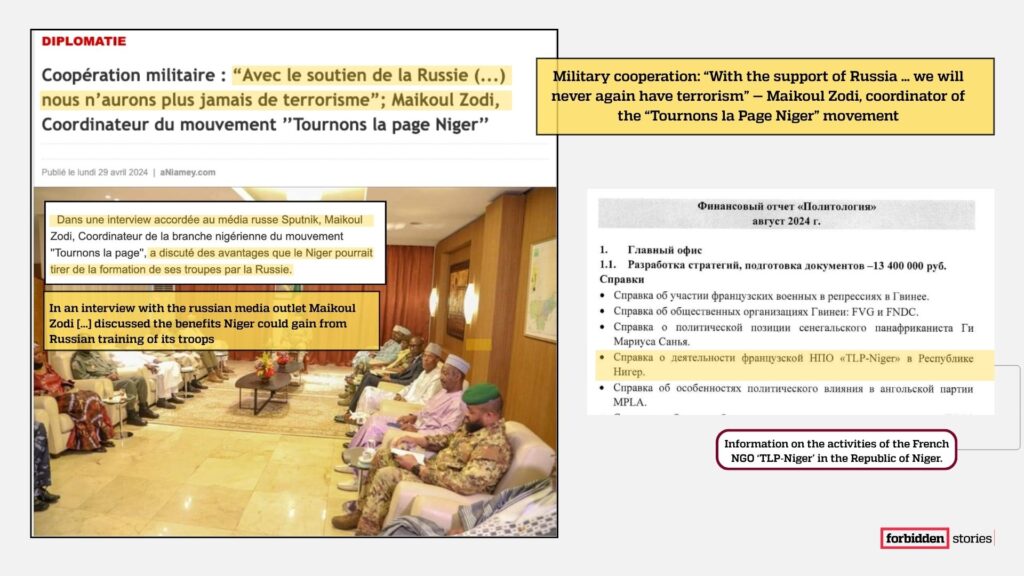
Comments by Maikoul Zodi supporting Russian aid in the fight against terrorism, less than a year after the coup, on the media outlet aNiamey (left); an internal “Company” report from August 2024 mentioning a memo on TLP-Niger’s activities (Graphic: Sofía Álvarez Jurado / Forbidden Stories)
On the media side, certain sites that published Zodi’s remarks, like aNiamey and Mali Actu, appear systematically in internal “Company” tables. Written in Russian, these accounting documents list more than 700 articles published between June and October 2024 in West African media outlets, in exchange for payments ranging from $250 to $700. They aim to promote the AES, support juntas, and criticize international sanctions and Western military presence on the continent.
Within the Tournons la Page network, these operations are causing tensions. The problem is no longer confined to Niger, instead creating ripples within the “parent” organization, TLP International. Several of its members confirm attempts to infiltrate the organization beyond Niger.
According to these members, Zodi and former Tournons la Page President Alexandre Didier Amani promised funding and sought to bring certain activists closer to pro-Russian pan-Africanist circles. Reportedly, the two went so far as to suggest meetings with the Black supremacist activist Kemi Seba, a fervent admirer of Vladimir Putin. “They told me we had to shift toward pan-Africanism, to drive the whites out of the organization. They even offered me funding. I refused,” one member told Forbidden Stories, speaking on condition of anonymity. Maikoul Zodi categorically denies having made these statements; he has since been suspended by Tournons la page, which he also disputes.
Celebrities in service of the AES
During this period, Russian agents were holding an increasing number of meetings in the region. According to the internal documents, 11 were organized in September 2024 with various “counter-agents” — the internal terminology used to describe government officials, public figures and media representatives recruited to gather information.
Another milestone happened around the same time, when a new agreement between Mali, Burkina Faso and Niger transformed the AES into a confederation. Russian agents were already planning the next steps: expanding the alliance to include other countries such as Senegal, Chad and Guinea. To achieve this, they need to expand their “counter-agent” network.
The Russians identified and wrote briefing notes on “opinion leaders,” while also leveraging the influence of celebrities. In Dakar, in early October 2024, Guinean reggae star Eli Kamano appeared at a conference. A figure of pan-Africanism, popular in West Africa and among the diaspora, he is known for his political activism and supports his country’s accession to the Alliance of Sahel States. He also composed an unofficial anthem for the confederation — “let us awaken, the courageous peoples of the Sahel”; “the AES is the stronghold of African peoples who had no home left” — as well as an ode to the leader of the Burkinabe junta, Captain Ibrahim Traoré.
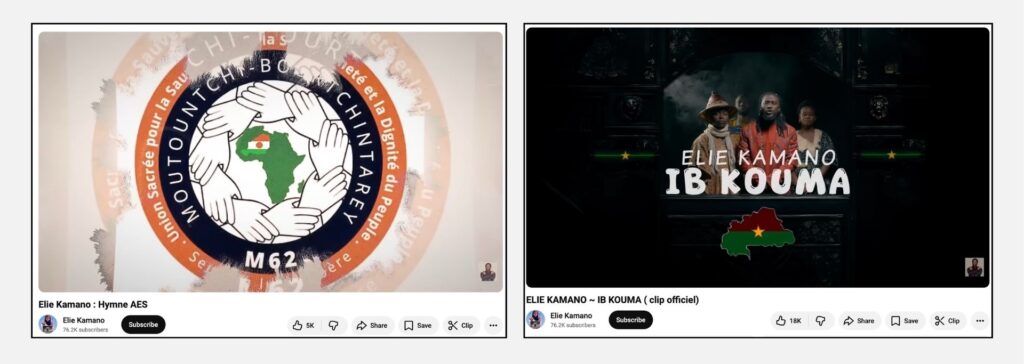
A screenshot of the music video for the AES anthem composed by Eli Kamano (left) and his music video dedicated to Ibrahim Traoré (right) (Credit: Forbidden Stories)
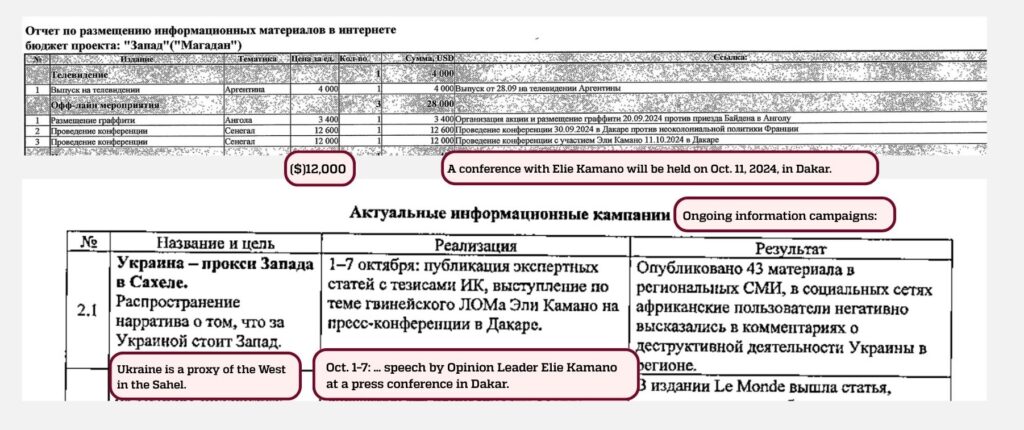
Expenses incurred by “The Company” for organizing a conference in Dakar featuring Elie Kamano as a guest (Graphic: Sofía Álvarez Jurado / Forbidden Stories)
According to “Company” documents, $12,000 was allocated for the conference with Kamano. Russian influence agents claim to have used him to “spread anti-Ukrainian narratives.”
From France, where he lives in exile, Kamano denies having been paid. “My commitment to socially conscious music is nothing new; I give talks wherever I go, in Dakar and elsewhere, and your claims do not concern me in the slightest. There is no contract in my name or bearing my signature,” he said to the investigative consortium, without specifying the conditions under which the conference was organized.
Youth movements exploited
To expand the AES, “The Company” also relies on youth movements. On Sept. 10, 11 and 12, 2024, the International Conference of African Youth was held in Bamako. The Malian Minister of Youth and Sports sent out invitations to his counterparts in countries across the region.
Senegal, Guinea and Chad attended. For three days, some 50 young people discussed “civic responsibility and patriotic spirit,” food sovereignty and the commitment of African youth in the face of insecurity and terrorism. The discussions were “rich; it was a wonderful initiative,” said Patricia Tourmadji, a member of the Togolese delegation.
But the mood soured during the closing ceremony. Several guests discovered that the Malian organizers wanted them to sign statements supporting their respective countries’ accession to the Alliance of Sahel States. “In other words, presenting Senegal as a country ready to join the AES,” reported one of the two Senegalese delegates, Ousmane Sonko, national vice-coordinator of the Patriotic Youth of Senegal (and a namesake of Senegal’s prime minister). He categorically refused to approve the text. “For us, it was unacceptable to approve a point about which our authorities hadn’t been informed.”
The narrative crafted by the Russians and simultaneously disseminated in the media of the AES countries overshadowed the guests’ hesitations. The Nigerien state-run daily Le Sahel framed the student conference as a “prelude to the activities of year one of the Alliance of Sahel States.” When interviewed by Malian television, an organizer stated that “the AES is open to all countries that want independence.”
“Unfortunately, we were unable to prevent this type of communication from being relayed,” Sonko said.
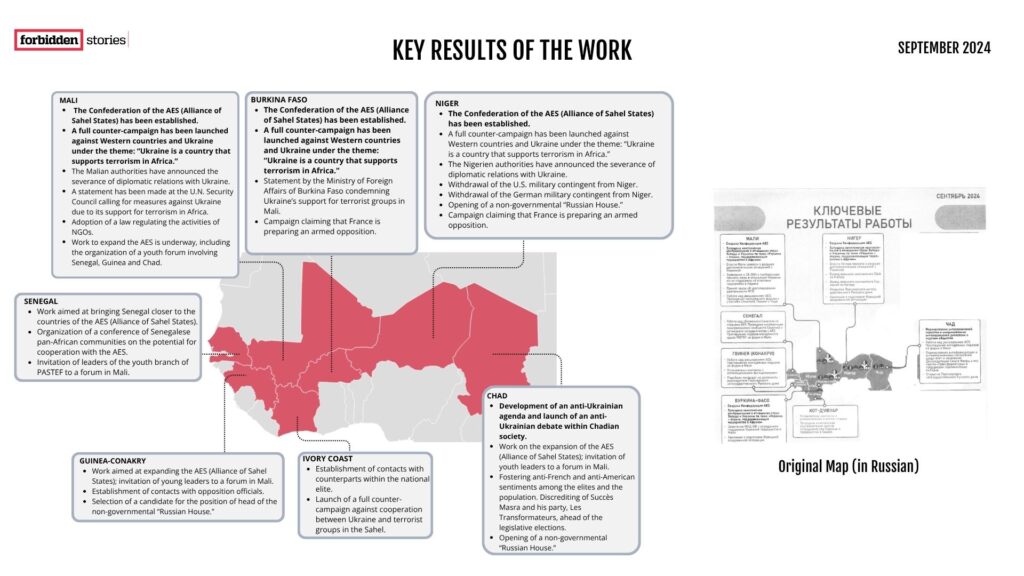
Maps appearing in internal “Company” documents, showing the network’s results in the Sahel in 2024 (Graphics: Sofía Álvarez Jurado / Forbidden Stories)
On maps created by Russian agents describing their activities country by country, the “organization of a conference of Senegalese pan-African communities on the potential for cooperation with the AES” is listed as one of its major achievements. The same applies to Guinea: “Work aimed at expanding the AES; invitation of young leaders to a forum in Mali.” Internal documents from “The Company” also shed light on the preparations for this summit. “Negotiations were conducted with the Ministry of Youth and Sports to hold a conference of youth organizations. … An ideological framework was defined,” reads a document dated July
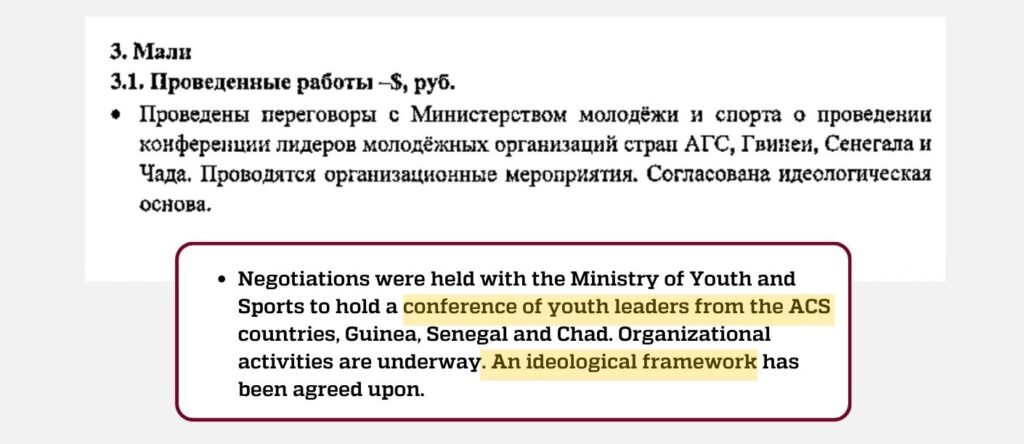
Excerpt from a work plan by “The Company” for Mali in 2024 (Graphic: Sofía Álvarez Jurado / Forbidden Stories)
Sights set on Togo
During their stay in Bamako in September 2024, some members of the international delegations remember two Russian men standing apart from the crowd, filming and conducting interviews. They also recall that the Russian House based in Mali covered their airfare, a detail one of the Malian organizers confirmed to Forbidden Stories.
In a video from the event, Forbidden Stories spotted one of the Russian agents that the consortium had previously identified as a “media specialist” stationed in Mali. Phone in hand, Maksim Grigorievich Kovaliev filmed as the young people began dancing in the conference room. “A young Russian man was there; he accompanied and guided us. He was introduced to us as a member of the organizing committee,” said Tourmadji from the Togolese delegation. “They’re their partners; it’s none of our business.”
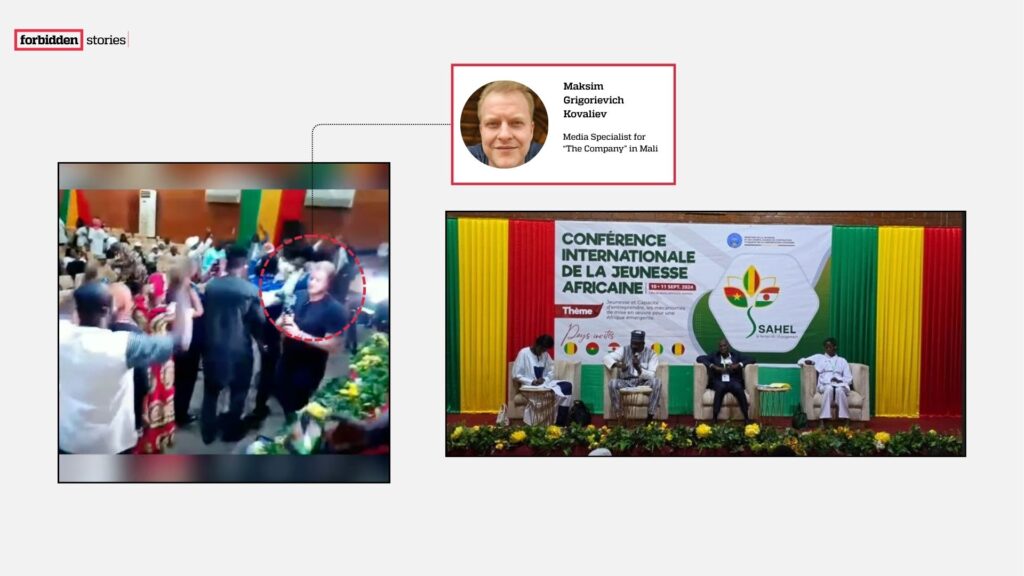
Maksim Grigorievich Kovaliev, a media specialist for “The Company,” at the International Conference of African Youth in Bamako, September 2024 (Credit: Forbidden Stories)
A year later, in Niamey, the first AES Youth Forum was held. This time, the Senegalese delegation was not invited. “We, the young people active in African Patriots of Senegal for Work, Ethics and Fraternity, are in favor of a united Africa, for economic sovereignty and the fight against the scourge of terrorism, based on mutual solidarity. We do not interfere in the alliances of AES countries; that is their right. But as a sovereign country, we refuse to be drawn into a cooperation where we would submit to this or that foreign power,” explained Sonko.
Chad, and for the first time, Togo, were invited as guests of honor and accepted the invitation “on the strong recommendation” of “our respective heads of state,” said Togo’s Minister of Grassroots Development and Youth, Mazamesso Assih, to Burkina Radio and Television. Was Togo the next target of “The Company”?
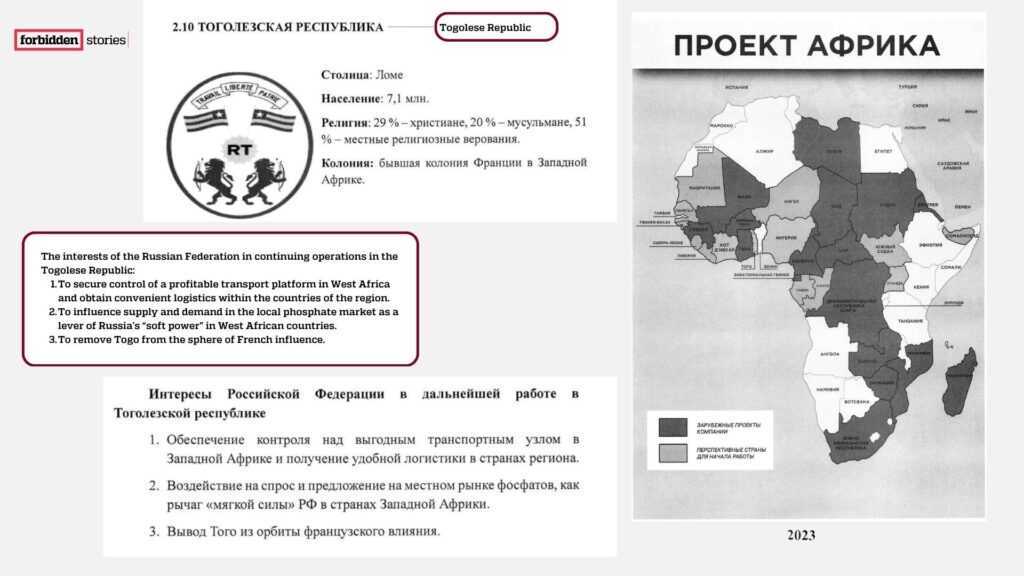
A screenshot of a 2023 strategic plan titled “Africa Project,” featuring a specific section on the Togolese Republic, considered a “promising country to begin operations” (Credit: Forbidden Stories)
Strategic plans by the Russian influence network seem to confirm this. As early as 2023, Togo appeared on a list of “promising countries to begin operations,” alongside Senegal and the Ivory Coast. In May 2024, “The Company” spent $807 on plane tickets, hotel accommodations and leisure expenses, while $5,500 was reportedly allocated for meetings with Togolese public figures “to gather intelligence.”
The network’s investments in Togo appear to have begun bearing fruit. In January 2025, the Togolese Minister of Foreign Affairs smiled as he declared, “What unites us with the AES countries is the same ideology: Africa first, our country first. … Ask the Togolese people if Togo wants to join the AES, and they will say yes.”
The country, bound by defense agreements with France since decolonization, signed a military agreement with Russia a few months after the minister’s remarks. The agreement provides for intelligence sharing, for Russian instructors to train Togolese military personnel, and above all, for Russia to potentially use the country’s port facilities. Securing access to the Gulf of Guinea was a priority in Russian strategic plans drawn up as early as 2023, “to ensure control of a profitable transport hub in West Africa and obtain practical logistics in the countries of the region.”
Read also