



Killing the journalist won’t kill the story.

Island under pressure

Indonesian energy giant's disinformation strategy

In Indonesia, the news site Floresa’s reporting on geothermal projects is a thorn in the side of the public utility company. To counter investigations by the independent media organization, PLN has reportedly recruited around 30 journalists to spread pro-geothermal messaging across the island of Flores. People close to PLN and supporters of the government have also been republishing a disinformation campaign on Facebook, targeting Floresa and opponents.

Credit: Forbidden Stories

Key findings
  • As shown in internal documents obtained by Forbidden Stories, the state-owned energy company PLN is paying journalists to spread positive messaging about ongoing geothermal projects on the island of Flores.
  • The exclusive testimony of a former PLN contractor describes systematic counter-propaganda aimed at discrediting the independent outlet Flores
  • According to Forbidden Stories’ analysis, government supporters and individuals close to the company targeted Floresa in a disinformation campaign launched by a dubious Facebook account

By Alexander Abdelilah and Floresa

January 15th, 2026

The sun was shining brightly in early October 2024 when Ryan Dagur’s phone vibrated. Nothing unusual for the managing director of the independent publication Floresa — but this message revived a trauma that had recently shaken the lives of his young team.

A source close to Indonesia’s state electricity company, Perusahaan Listrik Negara (PLN), was warning him of a destabilization operation underway against his outlet. The source shared a copy of a press release that he said PLN was discreetly circulating among journalists on its payroll.

The document targets opponents of geothermal power plant projects on the island of Flores. Designed to transform heat from volcanic subsoil into electricity, geothermal technology has become a strategic part of Indonesia’s decarbonization drive, according to the government’s national strategy

The press release clearly accuses Floresa and its independent journalists — who stand out from the local media landscape through their coverage of under-investigated topics — of being part of a cabal seeking to “mobilize certain residents” against geothermal energy. One paragraph particularly worried Dagur: it denounced Floresa’s editor-in-chief for working in “the interests of provocation and one-sided reporting.”

A few days before the message, police had beaten the editor-in-chief in question, Herry Kabut, while he was reporting on a protest against the expansion of the Ulumbu geothermal plant in Poco Leok. The police didn’t answer our questions about the journalist’s version of events. According to Kabut, one of the police officers called him a “provocateur” and criticized him for publishing overly negative articles about the geothermal sector. His words bear a striking resemblance to the talking points contained in PLN’s press release, which local media like Pijarflores and Info Pertama — who did not respond to Forbidden Stories’ requests for comment — circulated shortly after Kabut’s assault.

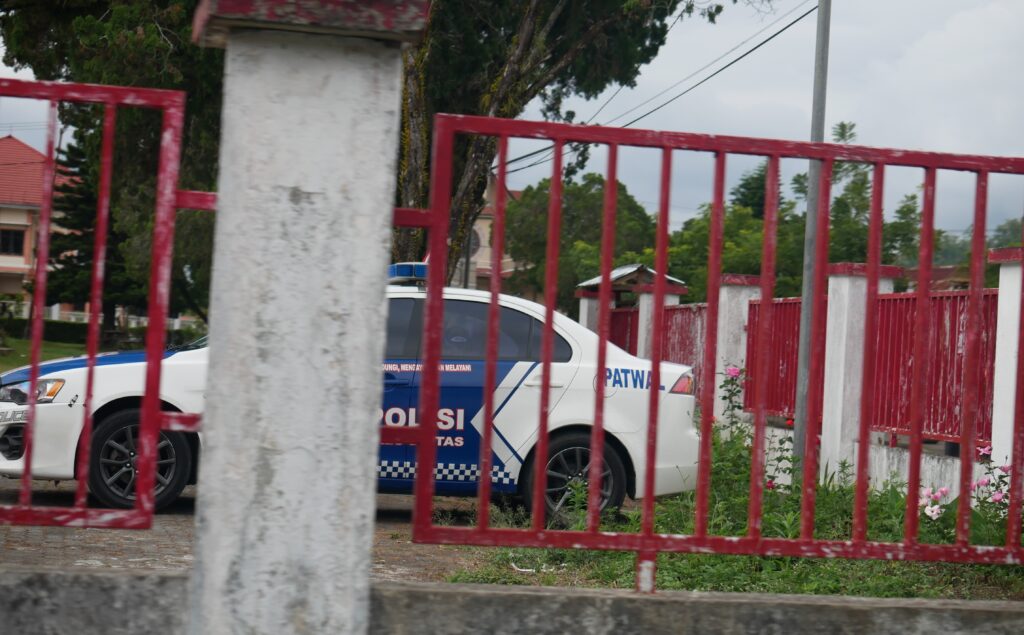
Police car in Mataloko (Credit: Floresa)

The state-owned company seems to have a profound influence on the island. Forbidden Stories’ investigation, conducted in partnership with Floresa, shows that from paying journalists to attempting bribery, PLN will stop at nothing to force through geothermal projects that the government prioritizes.

PLN’s strange “collaborations” with the media

It was close to 7 p.m. on Sunday, Dec. 22, 2024, when Dagur entered a tastefully decorated cafe west of Jakarta. He had refused this meeting twice already. Sitting opposite him that evening were an engineer and a communications officer from PLN who had insisted on meeting him, accompanied by two other people he didn’t recognize. A Floresa colleague, Petrus Dabu, sat by Dagur’s side.

According to Dagur, the PLN envoys got straight to the point: they offered to pay Floresa to “collaborate.” In return, “they hoped that Floresa’s reporting would align with their narrative about the geothermal project in Flores,” Petrus Dabu said.

Dabu recalls the PLN representatives mentioning “several other regional media outlets already working with them.” The two journalists refused and, according to Dagur’s recounting of the events, PLN did not back down and offered to pay Dagur personally for communications advice. Another refusal.

“They provided snacks, coffee and mineral water. However, my friend and I didn’t touch any of them. I’m a smoker, and one of them bought two packs of cigarettes, but I didn’t take them and asked them to take them home,” Ryan said. The meeting ended without any agreement between the reporters and PLN, which did not respond to Forbidden Stories’ questions.

On the left, Ryan Dagur; on the right, Petrus Dabu (Credit: Floresa.co / Screenshot Forbidden Stories).

If PLN is making such a direct approach to Floresa journalists, it is because other media outlets on the island have already accepted the company’s lucrative offer. Documents obtained by Forbidden Stories and Floresa outline the terms of this type of “collaboration” with the powerful energy company that operates two of the geothermal projects on the island of Flores.

Bank statements show transfers made via the personal account of a company employee to a journalist responsible for disseminating PLN’s talking points in the media. Invoices contain monthly summaries of all these publications as proof for the payment.

For a local journalist, an agreement with PLN guarantees a significant increase in income — sometimes doubling their original pay. For a total of 9 million Indonesian rupiah (around 460 euros), 169 articles celebrating PLN’s agenda were published across four different outlets over four months. This content praises the energy company’s successful territorial development and children-focused charity initiative, and presents geothermal energy as a “necessity for society and the times.”

To better understand how this system of influence set up by PLN works on a daily basis, a former contractor gave us an insider’s account. ‘Anton’ was one of the cogs in the machine for several months and has agreed to speak out for the first time. ‘Anton’ described press releases sent “once or twice a day” in a dedicated WhatsApp group of PLN executives and “around 30” journalists from the surrounding districts. Another WhatsApp group of around ten journalists was even dedicated to news about Poco Leok.

PLN “pressured us to publish” their messaging, he said. The remuneration — between 1 million and 1.5 million Indonesian rupiah (around 50 to 75 euros) per media outlet per month — represents a hefty sum in the region, where the minimum wage is 2.3 million rupiah.

Floresa was the subject of particularly close attention from PLN, explained ‘Anton’. “When a critical article came out, journalists would rush to Poco Leok the very next day and generate multiple pro-PLN articles to drown the narrative,” he said. It was a systematic counter-propaganda effort, according to him.

A dubious account and real disinformation

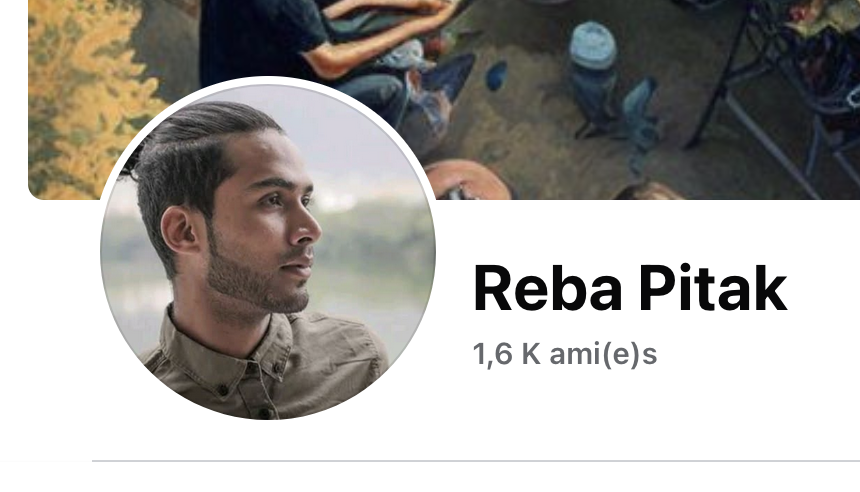
It was in this already hostile context that Floresa became the target of another type of offensive — this time via social media. Between early March and early June 2025, false information began circulating on Facebook, originating from a user called Reba Pitak. 

His posts reflect the position of PLN and the authorities, supporting the fight against “structural poverty.” Instead of personal content, Pitak’s account is populated with images and illustrations taken from other profiles and websites. Reba Pitak associates independent media and opponents of geothermal energy with entities allegedly financed by foreign interests, such as American billionaire George Soros and oil majors like ExxonMobil and BP.

A Reba Pitak post from May 13, 2025, paints Floresa as part of an anti-geothermal campaign funded by fossil fuel companies hostile to decarbonization, citing sources that are impossible to find online. It accuses Floresa of being a pawn in a “war financed by dirty money from Shell and the fossil oligarchy to keep Indonesia under the grip of dirty energy.”

Pictures used by the Facebook account Reba Pitak (Credit: Facebook / Forbidden Stories screenshot)

To better understand the motivations behind this disinformation campaign, Forbidden Stories conducted an in-depth analysis of 25 posts about geothermal energy from the Reba Pitak account, dated between March and June 2025.

A total of 13 separate profiles shared one or more of these posts — either to their own pages or in groups — potentially reaching 550,000 Facebook users. However, the exact number is difficult to know, as some users may belong to several groups and be counted multiple times.

Among the profiles that spread this false information, half also publish content supporting the authorities. Nearly a quarter work directly or indirectly for PLN. Other evidence appears to indicate a coordinated effort to amplify certain posts from Reba Pitak.

Accounts that relayed the disinformation campaign on Facebook between March and June 2025. (Credit: Forbidden Stories).

One post attacking the “absolute truth” supposedly espoused by opponents of geothermal energy was reposted by two separate accounts on June 7, 2025. On the surface, they appear to have no connection except for this almost simultaneous reposting two minutes apart, several hours after its initial publication. 

The first profile involved is anonymous and began relaying information about Flores in May 2025, with a focus on controversies surrounding the anti-geothermal mobilization. The second is an account supporting the re-election campaign of the regent of Manggarai, the district that includes Poco Leok. On the surface, there is no connection between the two profiles, other than this near-simultaneous repost. 

When contacted by Forbidden Stories, the Reba Pitak account introduced itself in a written message as a member of the indigenous community of Manggarai and stated that it “does not work for PLN, is not a contractor or company spokesperson, nor is it a government consultant.” In this message, the account denied publishing any disinformation, instead framing its posts as a “criticism of the media and of NGOs who completely reject geothermal and refuse any dialogue with the state and with PLN.” Among the 13 accounts that Forbidden Stories identified as having reshared Pitak’s content, only one responded to requests for comment, with a message saying it’s always good to have more than one opinion.

Indonesia: A playground for “buzzers”

This type of disinformation campaign is not an isolated case in Indonesia. It’s a glimpse into a veritable industry, whose actors have a name: buzzers.

“It’s a secretive world,” said Wijayanto, a political science researcher at the University of Diponegoro and expert on this milieu. Having spoken with some of these click mercenaries, he explained how campaigns are always triggered “through a broker, close to a politician.”

“Buzzers never see the faces of the people giving the orders; they only know their coordinator,” he continued. “Sometimes coordinators don’t know either, and get paid by a broker. The broker can be a political consultant or someone close to a politician.”

Indonesia’s roughly 284 million inhabitants help make up one of the largest social media user bases of any country in the world, with more than 150 million accounts on TikTok and 100 million on Instagram. That means just as many targets — or vectors — for disinformation campaigns.


* Name has been changed to preserve anonymity.

See also

xr:d:DAFgZViMGrs:3,j:45368062055,t:23041721
mining-secrets_data-leak_1
rafael-project__1