Killing the journalist won’t kill the story.

Afghan voices

“These rapes and videos are a way to silence us”

A women’s rights activist and frequent guest on Afghan radio programs, M. was arrested in Kabul in 2025 on the pretext that her hijab was improperly worn. During her detention by the Taliban’s morality police, she was raped, and after her release, her jailers threatened to circulate images of the abuse she had suffered in detention in order to silence her.
Having been a prominent voice for women’s emancipation—one of the most sensitive and forbidden issues in Afghanistan—she was forced to flee the country. From exile, she is now breaking her silence, sharing her story with Forbidden Stories while protecting her family by remaining anonymous.

Testimony gathered by Eloïse Layan

Avril 13th 2026

Illustrations by Mélody Da Fonseca

That day, I’d decided to go buy some new shoes. It was one of my rare outings in Kabul, where I had been living in seclusion since I fled my province. I rarely went out, except to buy bread or groceries. I’d rented a small room, where I spent my days alone, reading a book every day.

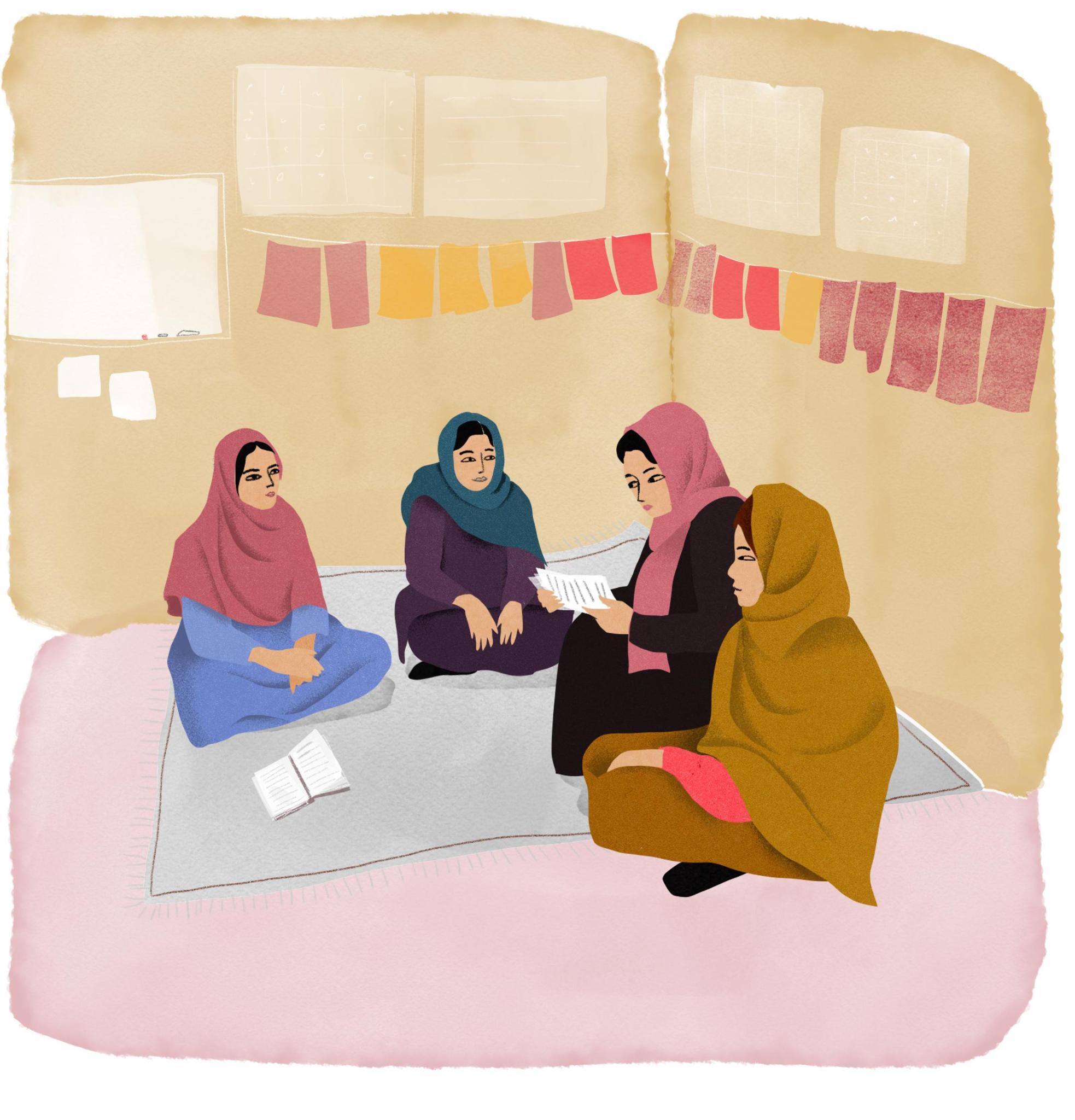
I’m 33 years old. Before the fall of the Republic (the Taliban’s takeover on Aug. 15, 2021, editor’s note), my life was fulfilling. I thrived. I worked with international organizations, advocating for the development of local communities and for women. I had responsibilities, and I also appeared on radio shows. With my salary, I was able to support my entire family and even pay for my brothers’ and sisters’ education. I dreamed of a bright future, of a progressive government. 

Afghanistan has become a prison for women. Now, we’re only valued for our reproductive organs. Every day, we had to endure new laws — their laws. I had to wear their clothing. I had to be accompanied by a mahram [a chaperone, usually a male relative], or I could no longer go out. And then one day, they banned women from working in my organization, and I found myself out of a job. Around the same time, I started receiving threats over the phone. This man, a Taliban member, I think, kept calling me and asking, “Where are you? Who are you working for?” Several of my friends had been detained, and I’d witnessed an arrest. I felt targeted, hunted. So I fled my region, convinced that the anonymity of a big city like Kabul would protect me.

To buy these shoes, I decided to go one of the city’s largest shopping malls. Before heading out, I made sure to cover myself with a long black hijab and a surgical mask. Only a tiny bit of my hair was showing. 

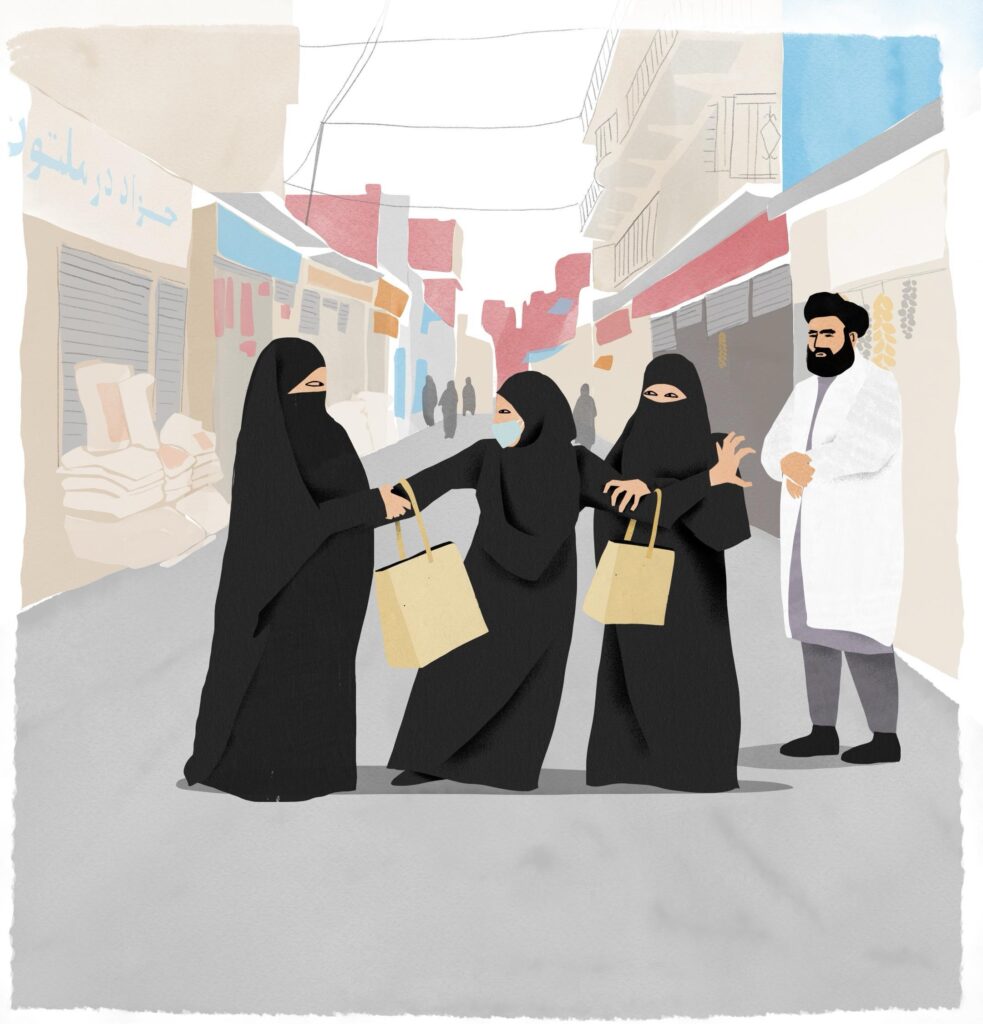
Is that why they arrested me? I was browsing the shops, carrying two bags, when I saw three men in white coats. I immediately recognized them by their uniforms. Agents from Amr Bil Ma’ruf, the morality police, our worst nightmare. They enforce the laws of the Ministry for the Propagation of Virtue and the Prevention of Vice (MPVPV). 

“Stop!” I didn’t even have time to turn around. Two women covered from head to toe, with only their eyes visible, grabbed my arms and dragged me toward a car. Everyone was staring at me. Women and girls were running in all directions, rushing into stores in the mall and adjacent streets to escape. My body was shaking, I couldn’t catch my breath, and my heart was pounding so hard I couldn’t say a word. I was terrified. 

At the police station, I was taken into a small room. An imposing man entered, said my name, and began to insult me: “You dishonorable Hazara women, with your little noses and your almond-shaped eyes.” As the Hazara minority, we face widespread discrimination, particularly from the Taliban, who are mainly Pashtuns. More than my so-called “improper wearing of the hijab,” which actually complied with their law, they were against my advocacy for women’s rights. The police officer accused me of having worked for international organizations and of being a “mercenary from the days of the Republic.” I spent my first night in that cell in a state of terror. I thought about my family. How would they take the news? How would they react? 

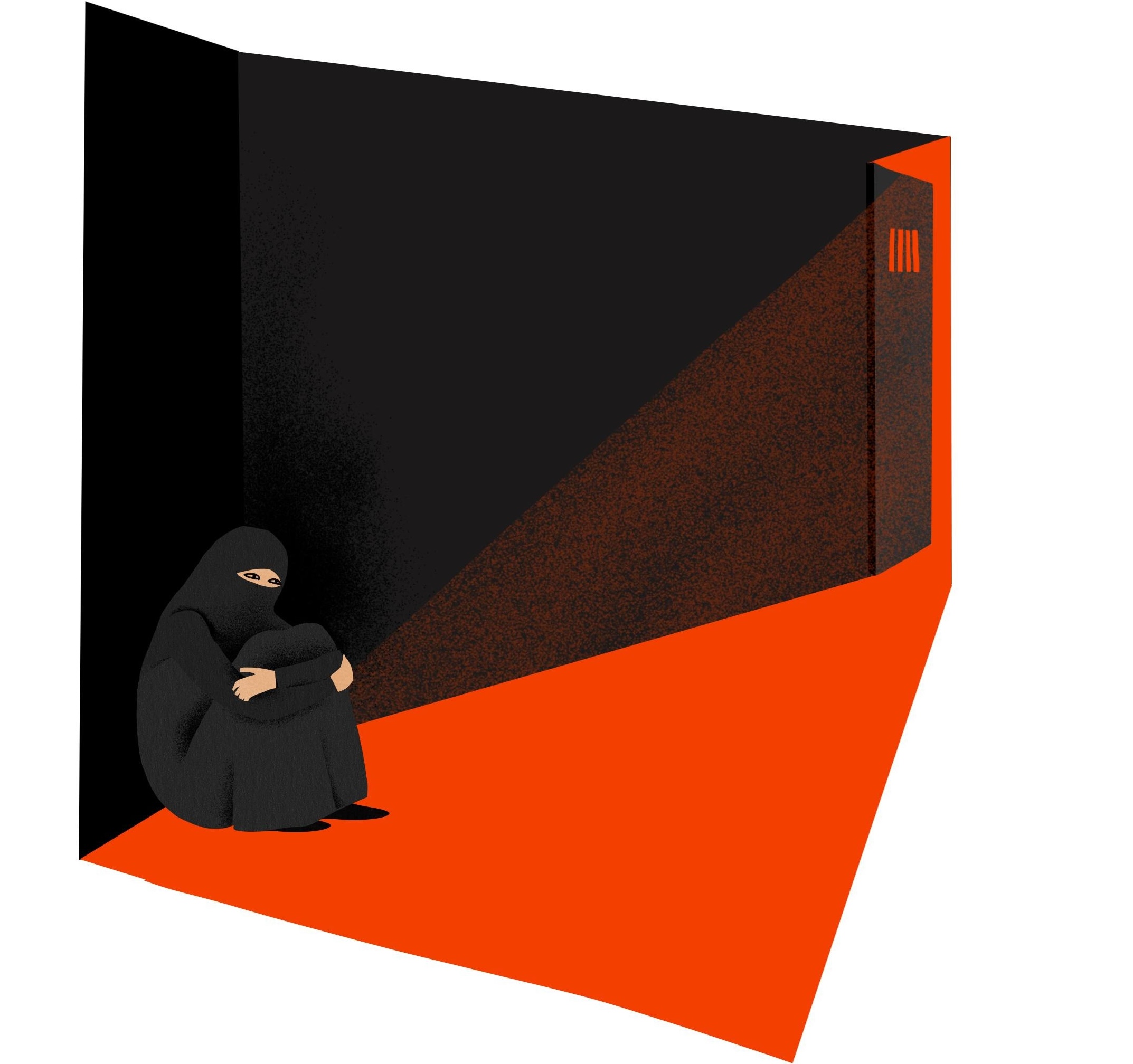
The room was plunged into near darkness. Sometime during the second night, I’m not sure exactly when, I saw a corner of my cell light up. It must be the light from the hallway, I thought to myself. A Taliban man came in. He approached me. I backed away. I was trembling. I resisted. He hit me on the head with his baton, grabbed my face and threw me onto the mattress. He raped me. And I just cried. That was the first time. There would be two more. The second and third times, they took photos and videos with their phones while I was naked. Nothing made sense anymore. Nothing mattered to me anymore. 

I spent nine days in detention. I was interrogated repeatedly. They asked me over and over again, “Who did you work for? What propaganda did you spread?” All the while insulting me, “You’re a prostitute of the Republic.” I spoke on the radio. The hijab was just an excuse. They were after my activism, my fight for women’s rights in Afghanistan. That’s why I was arrested. On the ninth day, a guard told me, “You’re free.” My sister came to pick me up, accompanied by my brother, who refused to speak to me or even look at me. They had to pay a bail bond for my release. But before letting me go, they warned us: If we made even the slightest mistake, if I spoke about what had happened at the police station, my entire family would be in danger.

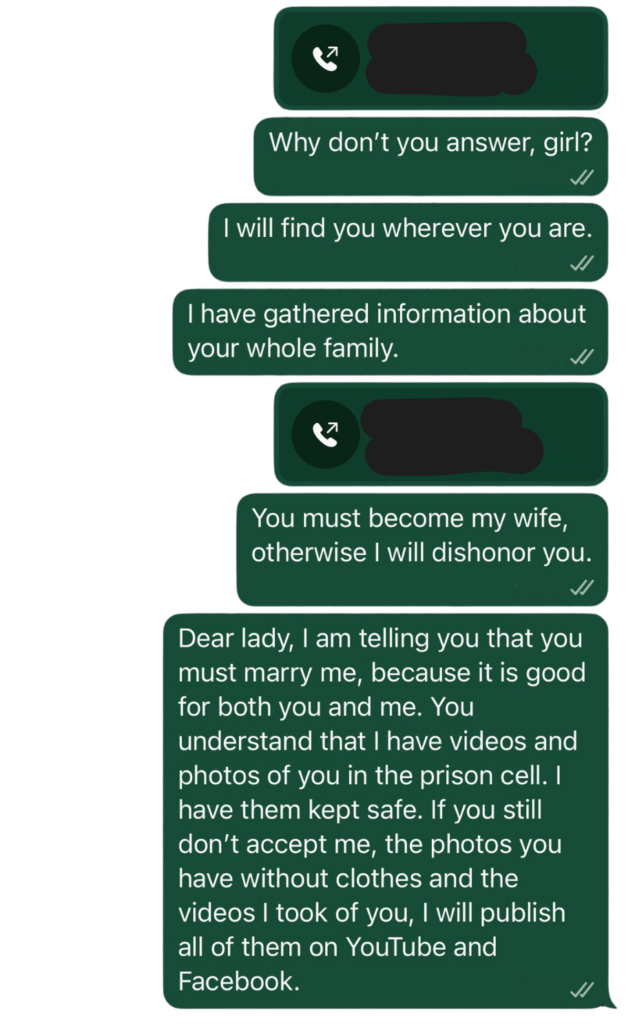
I didn’t know what they were going to do with the images. A few months later, a man nicknamed Qari A* [a term for those who follow the Quran] contacted me. He sent me the photos and videos they had taken of me while I was naked via WhatsApp. “If you don’t marry me, I’ll post the videos on Facebook and Instagram.” He kept calling me. I didn’t answer. I was very scared. It’s a way to silence us when we get out of prison. During that week in detention, I didn’t see the other inmates. I only heard their voices, their screams. 

After my release, I had to flee once again. I left my country, its mountains and valleys, and the people I loved. Today I live in Pakistan, where I rent a tiny room. I hardly speak to anyone anymore. I live in a constant state of anxiety. I don’t go out anymore, because the Pakistani police arrest and deport Afghans. For me, that would be equivalent to a death sentence. My family has cut ties with me. They no longer speak to me, except for my sister. They are very religious, especially my father. My sister told me that he would have “preferred that I were no longer in this world.” Her words had a terrible impact on me. In his eyes, I have dishonored him; I ruined his reputation as a religious man. One must keep the regional context in mind. My family is Shia; the Taliban are Sunni. Beyond this rivalry, there is no greater disgrace than seeing one’s daughter arrested and raped by the Taliban. They are using us.

I don’t know if my family received the video, but I know it’s not my fault. As women, it’s not our fault. That conviction helps me keep going. Everything that happens to women is rooted in the structures of this deeply religious and misogynistic society. It’s unjust. That’s what my years of working for human rights, women’s rights and international organizations have taught me. I am now living off my savings, with the sole hope of reaching a safe country where I can live with dignity. I have submitted applications to several embassies. So far, I have not received a response.

Read also

COVER-V2
Cover (2)
Subway-1