- Reading time: 10 min.
“I’ll rip your head off”: In Peru, the Guardianes de la Trocha gang controls the gold mines and spreads terror across La Pampa
In Peru, the gold rush is ravaging the Amazon rainforest. In the department of Madre de Dios, the Guardianes de la Trocha gang has taken over La Pampa, a gold-rich area running alongside the Tambopata National Reserve, one of the most biodiverse regions on the continent. Forbidden Stories and its partner Mongabay Latam reveal how this criminal organization spreads terror, silencing any opposition with the help of rising corruption in the country.
Credit: Max Cabello Orcasitas / Mongabay Latam
- Despite the code of silence imposed by Guardianes de la Trocha, victims explain how the gang took control of gold mines and sowed fear throughout the department of Madre de Dios.
- Peruvian authorities, both local and national, seem unable to respond. Operations to combat illegal mining rarely result in arrests, and deforestation has increased by 425% since 2011.
- Endemic corruption has rendered the authorities’ interventions ineffective, as numerous security and judicial sources reveal.
By Emmanuel Colombié with Mongabay Latam
February 03, 2026
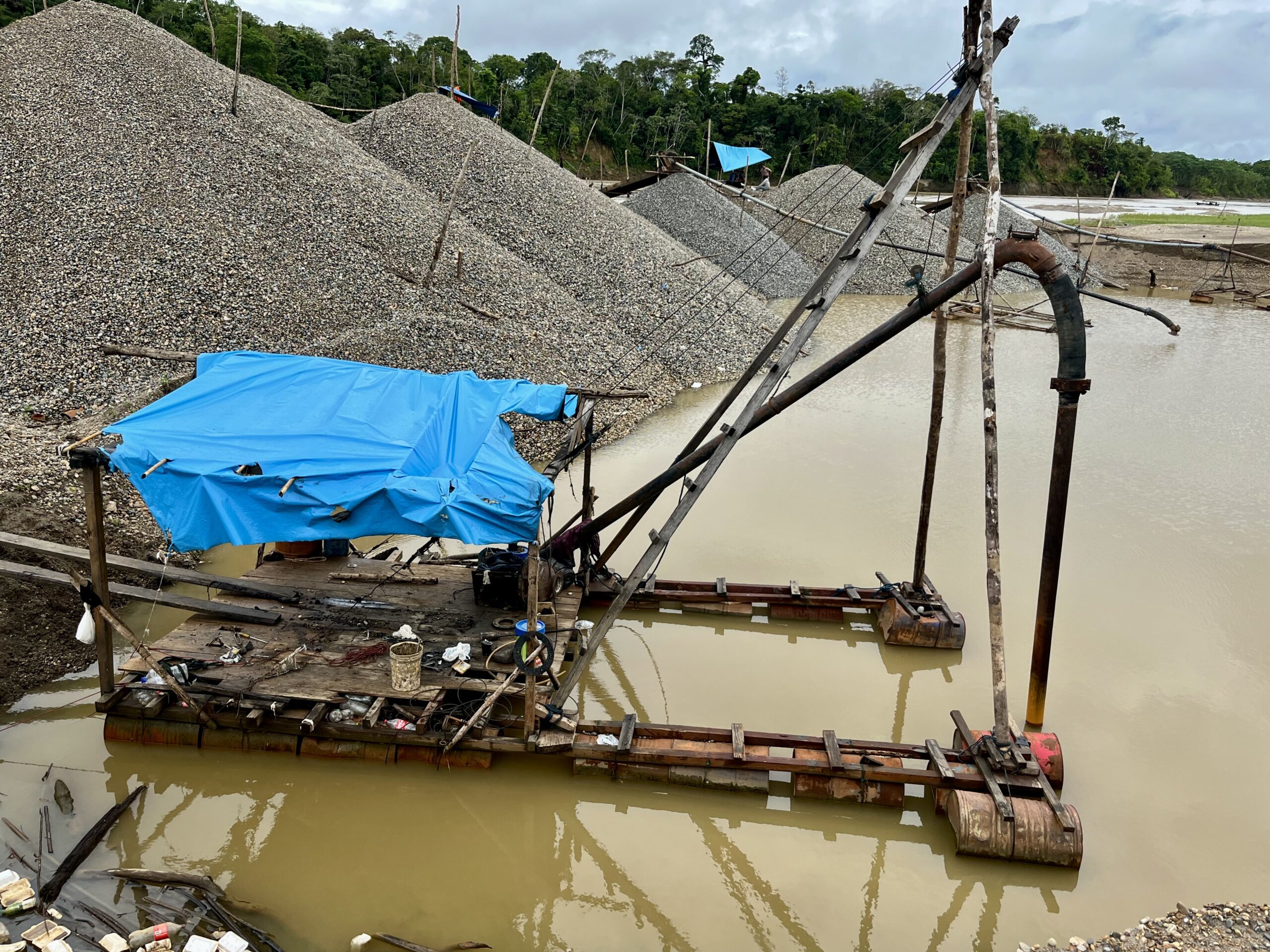
The once-lush forest is now little more than a wasteland. For 15 years, illegal miners have been setting up camp in La Pampa, in southeastern Peru, in the department of Madre de Dios.
Previously covered in tropical jungle, the area surrounding the Interoceanic Highway has become a living hell. Every day, men tear up the ground and pollute the waterways.
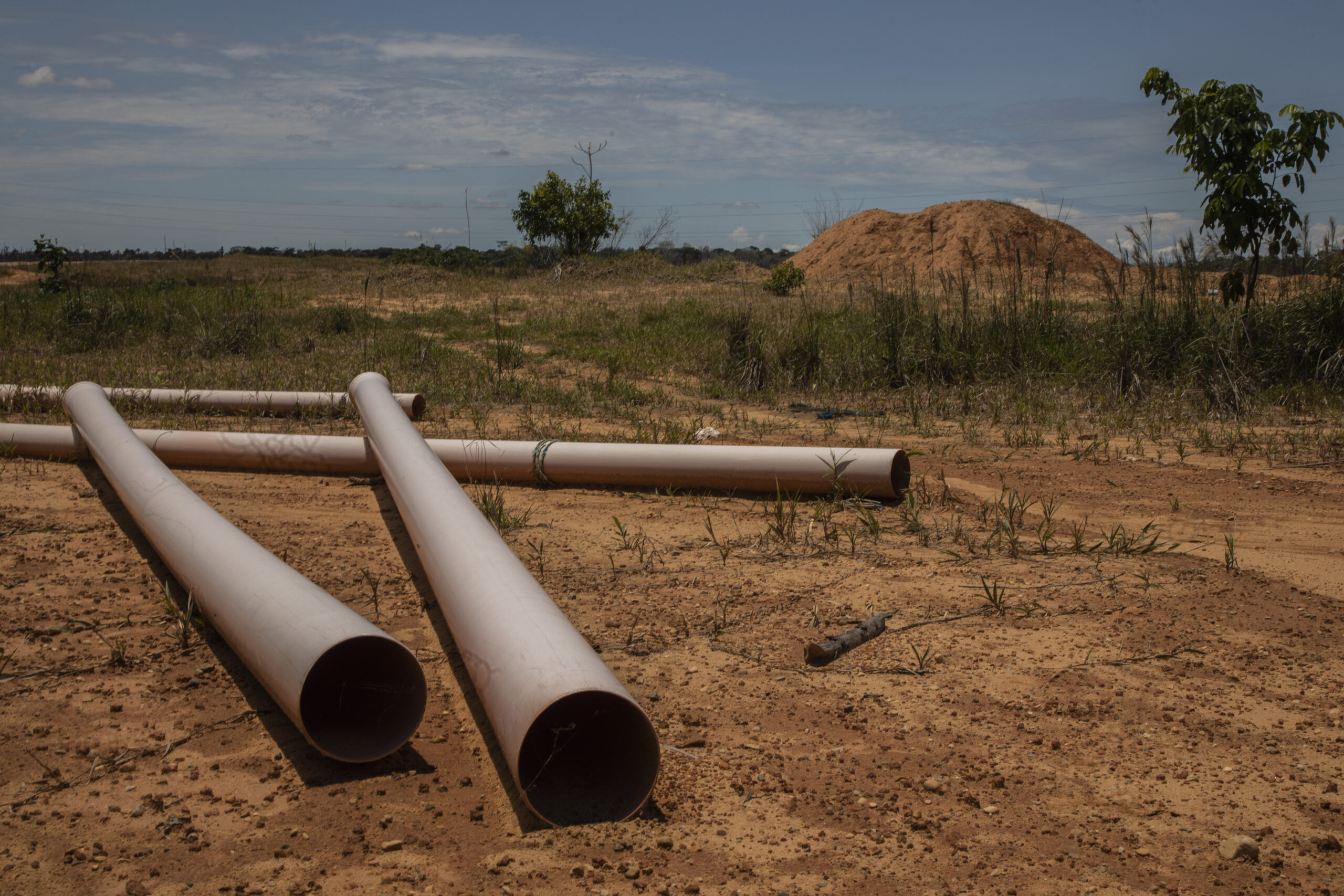
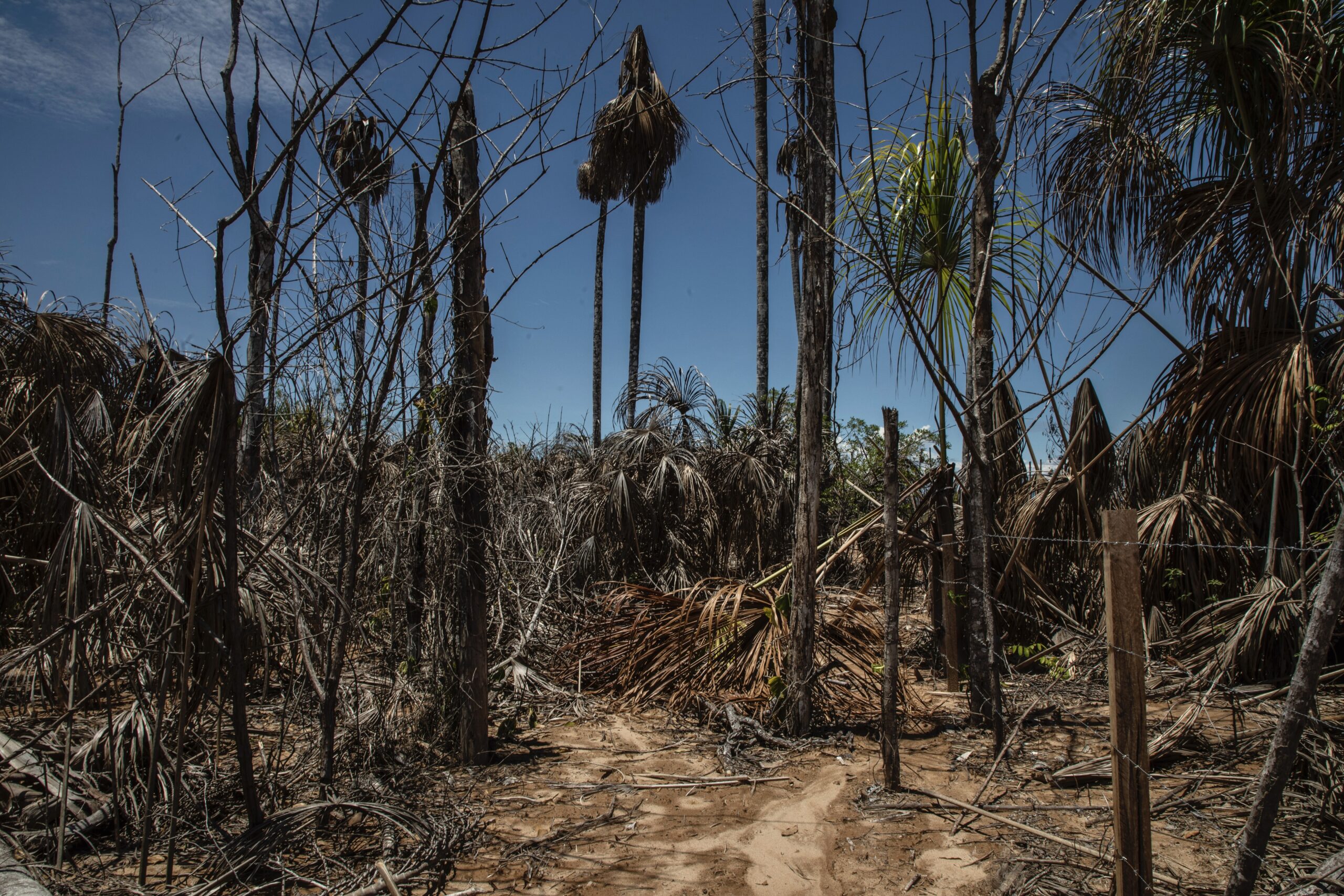
“Birds don’t like the mine. They’ve all left,” said Diego Torres,* a farmer with a front-row seat to the gold fever that has seized his region. For the past two years, orange mud has covered his plot, along with fuel canisters and scraps of wood and metal. Torres’ dogs wallow in patches of oil-stained land. Here and there, miners have left huge metal pipes abandoned among dying palm trees.
Credit: Max Cabello Orcasitas / Mongabay Latam
Upon arriving at Torres’ farm, the roar of dredgers and gold-extraction machinery is immediately audible. Visible between the dead foliage, the looters are hard at work. Near a washing ramp, designed to trap gold particles on a mat, several men stand guard — over Torres’ own land.
Torres says as soon as they arrived, he reported the looters to the Specialized Environmental Prosecutor’s Offices of Peru, also called FEMA. Police visited him in March 2024, but the miners were not there that day, apparently tipped off in advance. A few days later, they were back to work with total impunity, under the protection of armed men, less than a kilometer from an active military base.
Determined to defend his land, Torres has already confronted the illegal miners on his property. He says he is not afraid of them. However, Torres is reluctant to discuss Guardianes de la Trocha, the criminal group that controls gold-extraction activities in La Pampa. “Through intermediaries, they told me not to oppose the miners, not to say anything or to leave, otherwise they could eliminate me … But where could I go? I have nowhere else to go,” he said.
Credit: Max Cabello Orcasitas / Mongabay Latam
Keep quiet or face death threats: independent journalist Manuel Calloquispe deals with the same dilemma. For more than a decade, he has been one of the only local reporters documenting and denouncing the activities of illegal gold miners in the region. He has paid a steep price. Calloquispe has been beaten and had his equipment stolen, and he has lost count of the threats and intimidation he has received — even from right outside his home.
In 2022, Calloquispe’s family had to leave Puerto Maldonado, the capital of Madre de Dios. With danger growing, in January 2025, the journalist decided to join Forbidden Stories’ SafeBox Network to protect sensitive documents: the product of years of investigations.
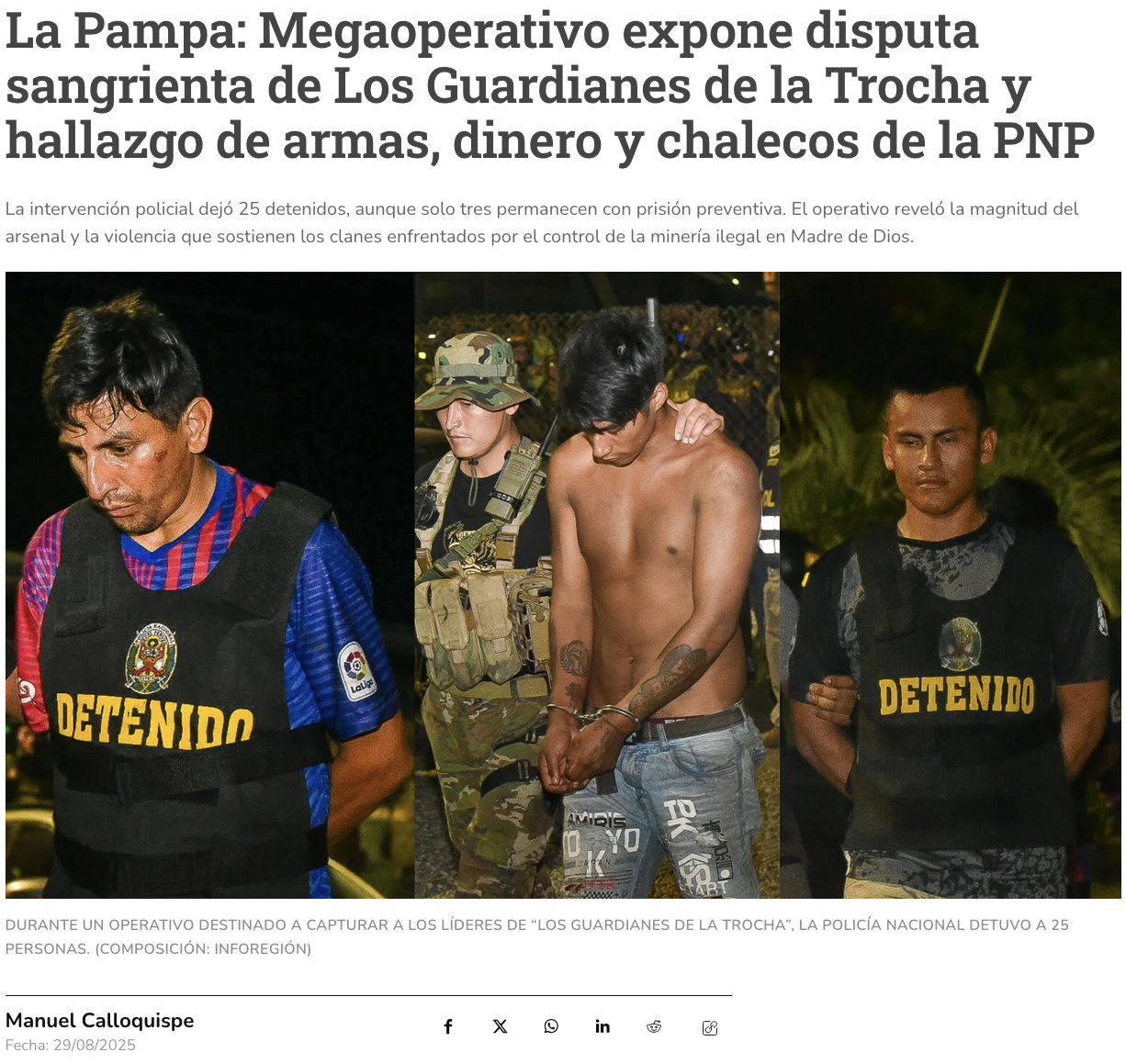
In early 2025, Calloquispe was investigating Edison Fernández Pérez, alias Chili, one of the two leaders of Guardianes de la Trocha. In an investigation published on the Inforegión website, he revealed the seizure of numerous weapons and shed light on the gang’s internal struggles.
On Aug. 28, 2025, a few days before releasing his article, Calloquispe received a chilling phone call. On the other end, he recognized Alver Carranza Fernández, Chili’s lieutenant. The warning was unambiguous: “I’m going to rip your head off … Who will speak when you’re gone? You’ve already been identified. We’re going to kill your son, your brother. We know where you are, we know where your family is.”
Shaken by the call, Calloquispe says he had to stop publishing and left the city to go into hiding for the fourth time since 2011. With his consent, in October 2025, Forbidden Stories and publication partner Mongabay Latam decided to travel to Madre de Dios to continue his work.
Calloquispe has tirelessly documented and denounced the activities of Guardianes de la Trocha, which has spread terror in La Pampa for nearly 15 years. Madre de Dios is Peru’s least populated department — but one saturated with gold. The country’s Geological, Mining and Metallurgical Institute estimates that it now accounts for 11% of national production.
As the main artisanal mining area in Peru, Madre de Dios is home to widespread illegal gold mining, which has exploded there since the Interoceanic Highway opened in 2011, according to the Center for Amazonian Scientific Innovation. The center notes that deforestation is directly linked to gold mining and has increased by 425% since the new paved road made the region more accessible.
The rainforest: A victim of the gold rush
Logging and agricultural operations, primary forests, private property: In this region, nothing can withstand the gold rush and its immense damage. By mid-2025, 97.5% of the 139,169 hectares of forest that illegal mining has destroyed in Peru were in Madre de Dios, according to the Monitoring of the Andes Amazon Program, or MAAP.
La Pampa lies in the province of Tambopata, home to a national nature reserve popular with tourists and boasting some of the richest biodiversity in Latin America.
Since 2011, Guardianes de la Trocha has ruled La Pampa with an iron fist, controlling most illegal gold production there. At first, the gang consisted of a handful of men providing security for artisanal mines. Their power grew as mining expanded on both sides of the Interoceanic Highway, until they were able to impose their own law.
“Starting in 2013, Guardianes de la Trocha set up tolls, managed mine security and began killing. In 2015, there was a second wave of violence: no one could enter La Pampa without their authorization,” said Rodrigo*, a La Pampa resident whose name has been changed as a security precaution. The gang killed one of his relatives for opposing its invasion of his family’s forestry concession.
Meeting Rodrigo means passing through a heavily armored door protecting the entrance to his property. The site is a veritable bunker, with barbed wire surrounding each of the farmhouses. A witness to the gang’s rise, Rodrigo’s own life has come under threat.
“In 2017, a line was crossed: extortion increased, they started calling themselves ‘Security,’ and they brought in their own machines to extract gold. During the pandemic, they took over all extraction sites, and starting in 2022, they began to show themselves openly in public,” Rodrigo said. “After the murder, we thought about leaving, but my parents didn’t want to, so we decided to stay and confront them.”
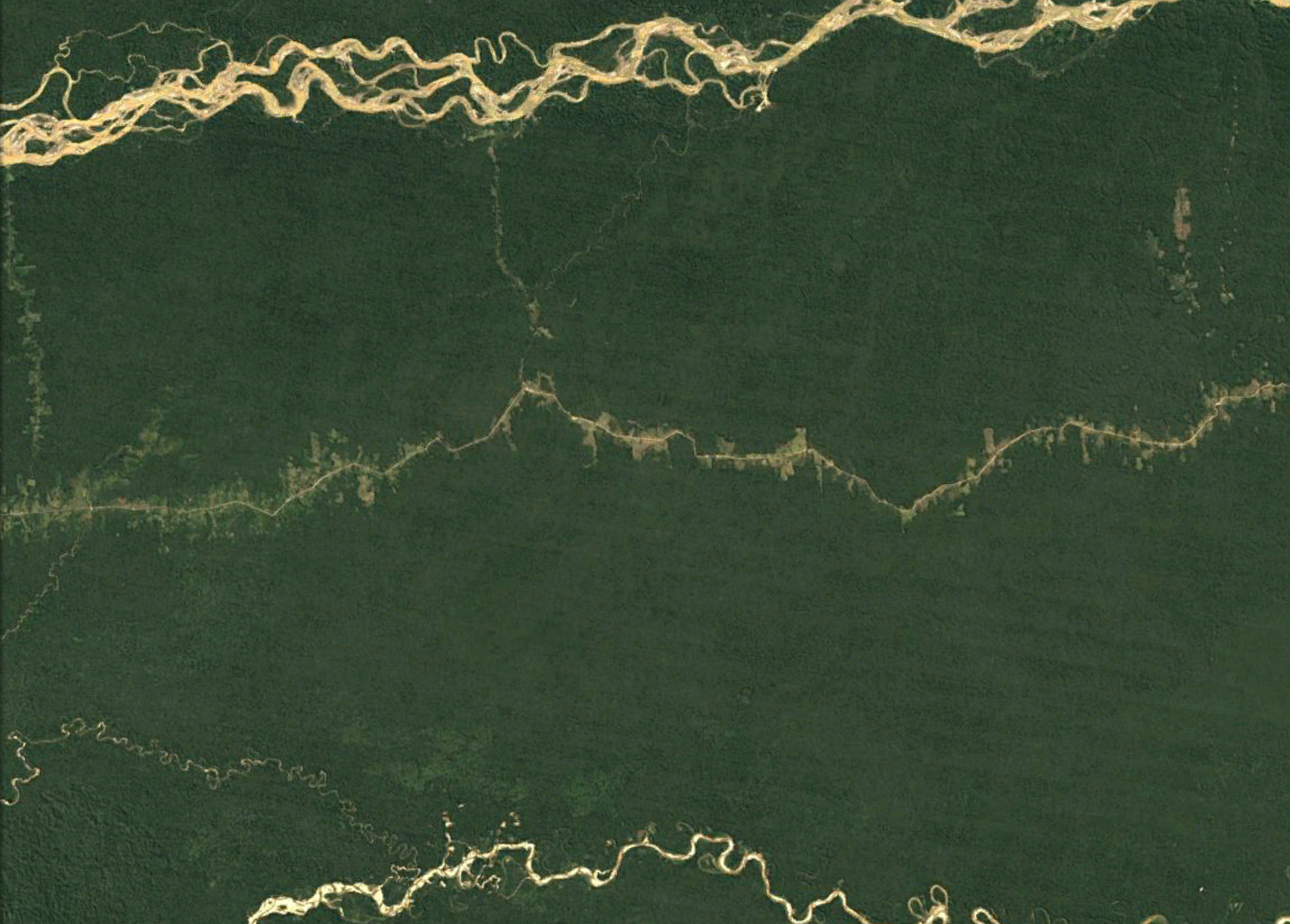
2006
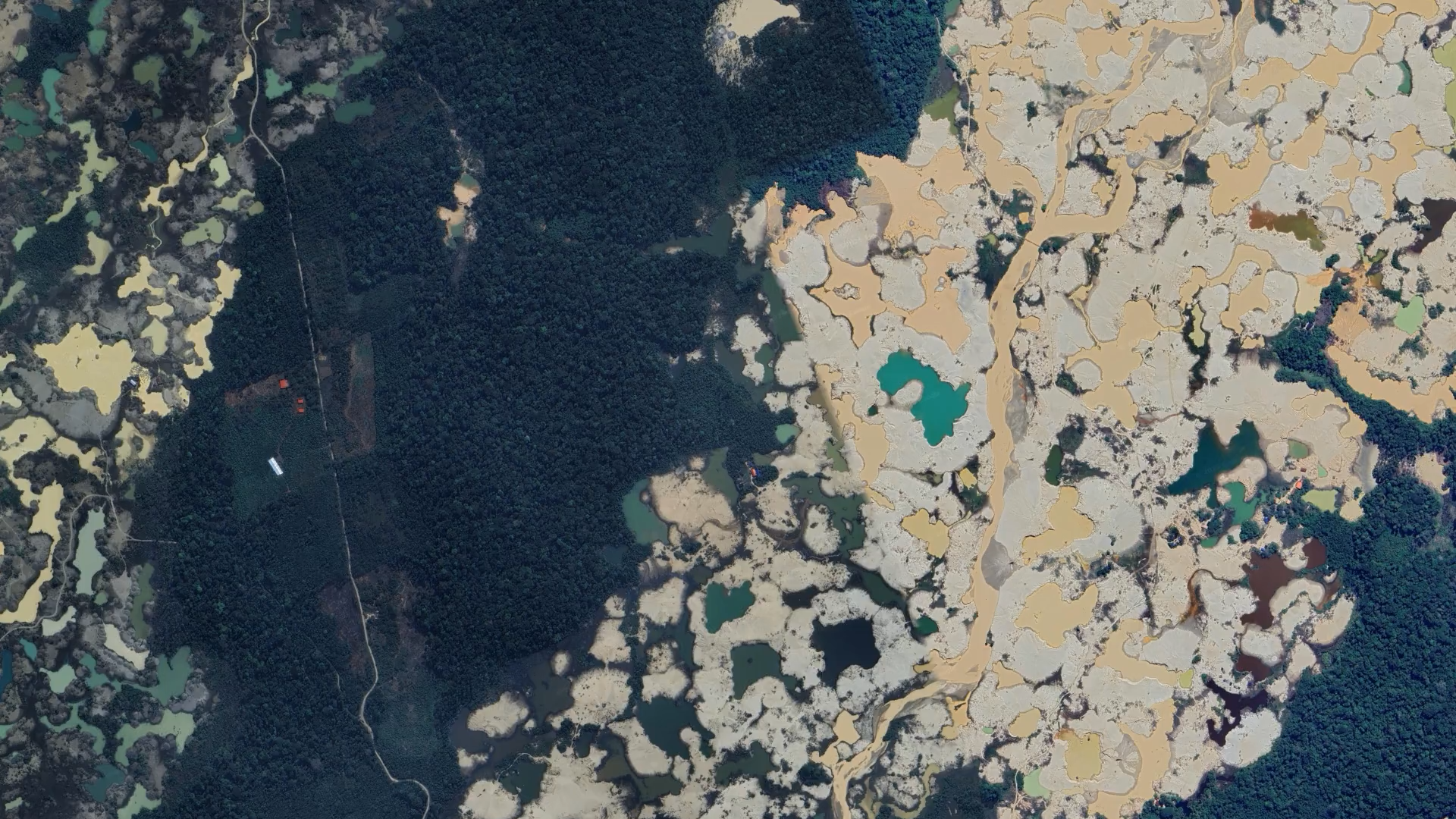
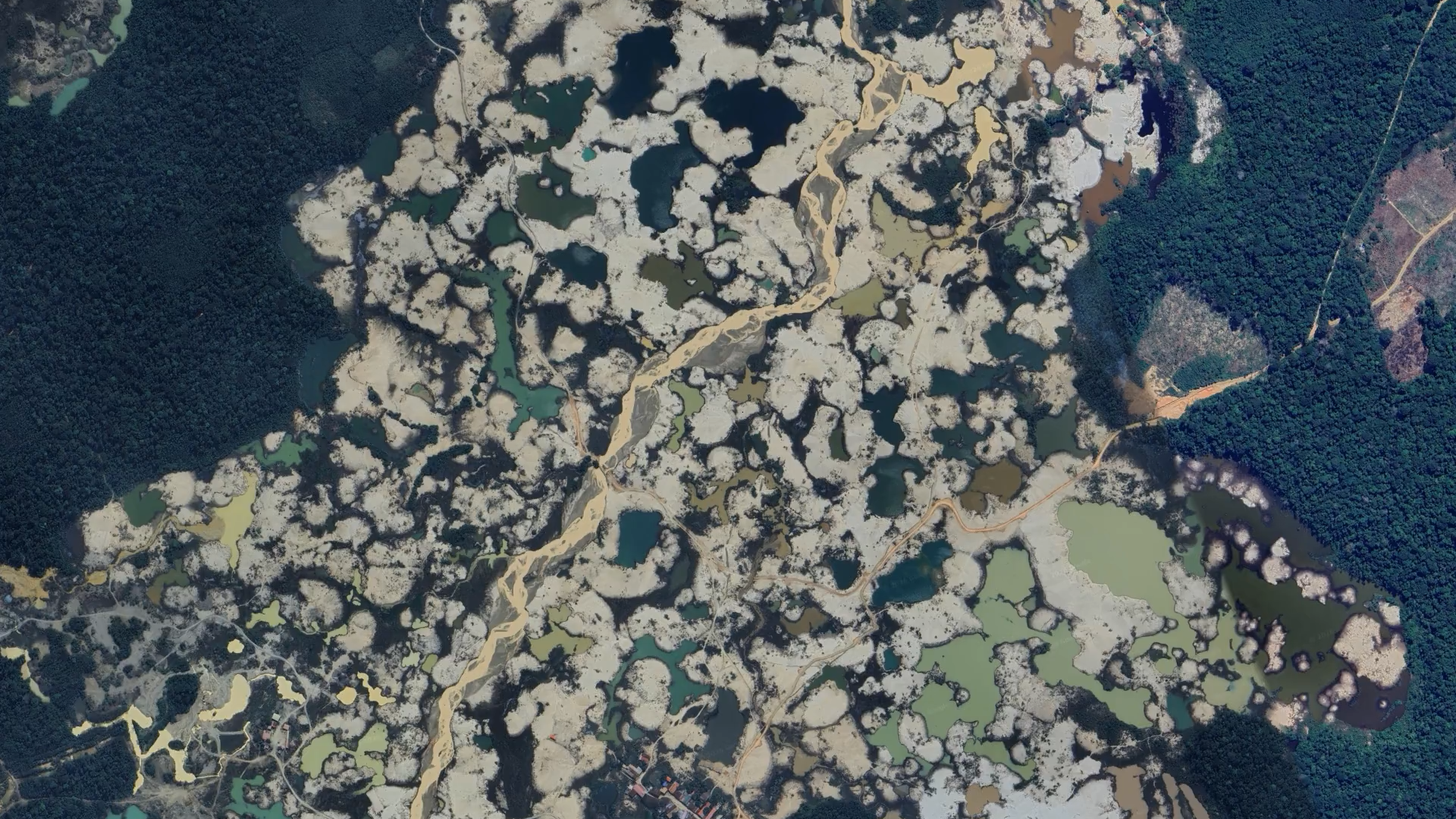
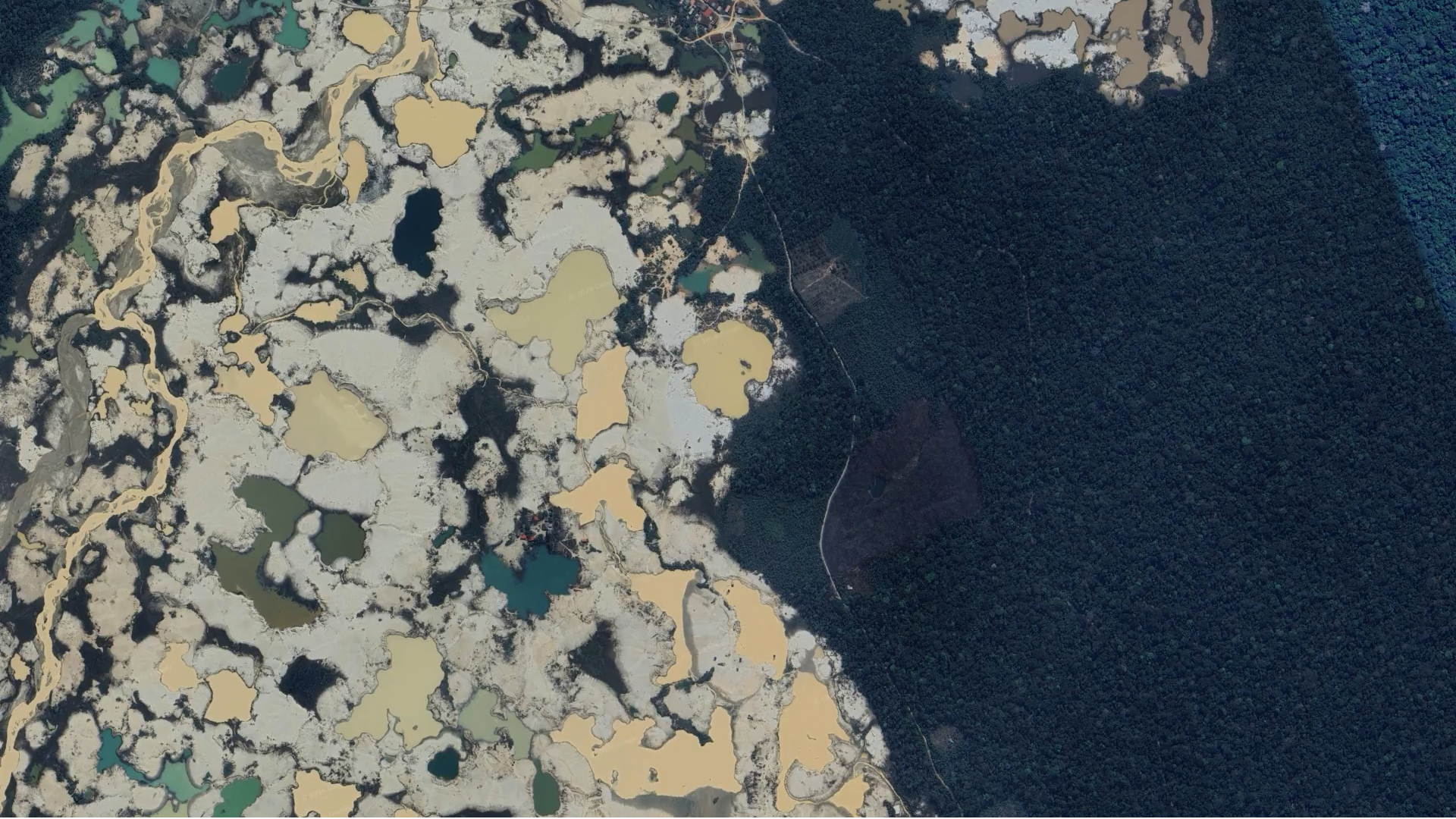
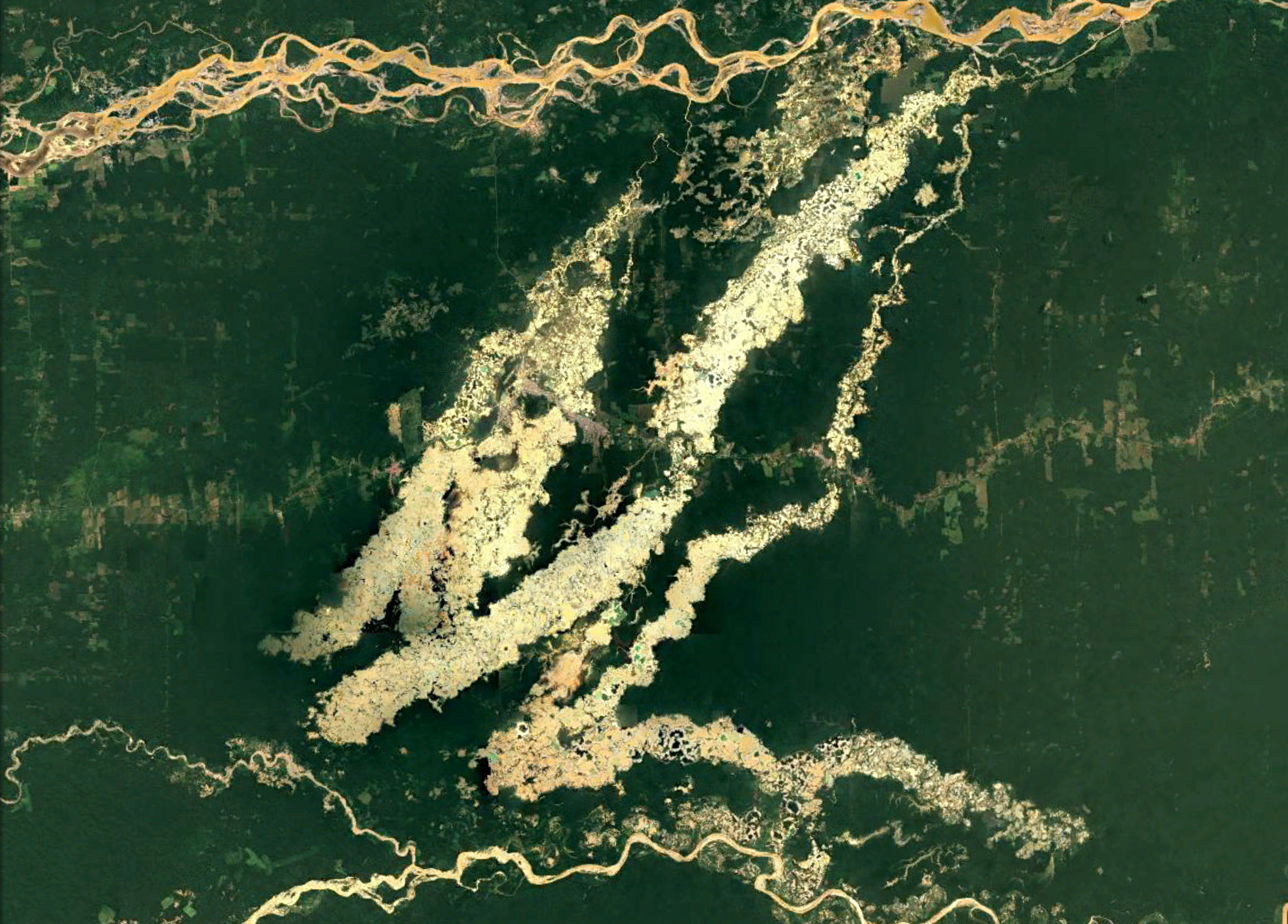
Over the past 15 years, more than 20,000 hectares of the Pampas have been deforested.
2025
Unfortunately, Rodrigo’s family is not the only one this climate of violence has affected. Having cross-referenced official information, police sources and his own work, journalist Calloquispe estimates that at least 400 people may have been murdered or gone missing since 2014. “There are students, transport workers and taxi drivers who went into La Pampa and never came out,” he said.
Gold: A crucial resource for Peru
In 2025, mining was Peru’s main source of foreign income, according to the Ministry of Energy and Mines. The High Commissioner for the Fight against Illegal Mining, Rodolfo García Esquerre, states that in 2024, “Peru exported around 180 tonnes of gold, but of that amount, at least 80 were of unknown origin,” citing the Peruvian Institute of Economics (IPE). This think tank considers that 44% of the illegal gold extracted in South America comes from Peru and that, over the past two decades, “the volume of illegal gold exports has increased eightfold and, by the end of 2025, will reach that of legal gold.”
“In 2024, this amount was almost six times higher than what was generated by the illegal drug trafficking economy, which amounted to around 1.2 billion dollars,” García Esquerre adds.
Boosted by soaring gold prices, these organizations have built up arsenals over the years to protect their increasingly lucrative business.
Credit: Max Cabello Orcasitas / Mongabay Latam
With this weaponry, Guardianes de la Trocha sows fear throughout La Pampa. “Since June 2025, it’s gone crazy. You’d need a tank here to fight back, because there are between 40 and 60 people armed with machine guns, submachine guns and grenades,” Rodrigo said. He revealed his own gear: a rifle, a pistol and even a drone, which he intends to use to protect his family in the event of another invasion.
Police echo the same concern, as described by Commander Carazas, the imposing head of the Criminal Investigation Division in Madre de Dios. Forbidden Stories met him in his small office in Puerto Maldonado, cluttered with stacks of files. “Brayan has military-grade, heavy-caliber equipment and Uzi machine guns,” he said, in reference to one of Guardianes de la Trocha’s current leaders. “We don’t have enough people to fight that.”
On surveillance footage journalist Calloquispe obtained, Chili and several dozen men move around La Pampa heavily armed, equipped with bulletproof vests and night-vision goggles. Some of them wear police uniforms. One clip shows the daylight execution of Ana Denisse García Solsol on Jan. 10, 2025. In the streets of the village of Virgen de la Candelaria, this trade unionist — who was responsible for allocating municipal land — is shot dead by armed men in the back of pickup trucks. The killers disappear to cries of “Viva el Chili.”
Credit : DR
This well-equipped private army, ready to kill, is therefore fully capable of protecting illegal mining activities. To guard extraction sites, “they hire retired police officers as security agents,” Carazas said.
On the trail of the nuggets
Although illegal mining is a punishable offense in Peru, the purchase of small quantities of gold is poorly controlled. As a result, impunity reigns, fueling the informal economy. Once extracted from the mines, clandestine gold is easily resold in “acopiadoras,” authorized collection shops where anyone can sell nuggets in exchange for a simple receipt.
Opening one of these shops requires going through a series of government-imposed procedures. The law mandates that individual gold purchases over $10,000 and cumulative purchases of up to $50,000 per month be declared. Below those thresholds, gold is virtually untraceable. Each individual encountered during reporting attested to this difficulty. In a lawless area like La Pampa, the subject is extremely sensitive and dangerous.
Over the years, Calloquispe has tried to investigate the origins and destinations of illegally mined gold. According to the journalist, before the coronavirus pandemic, “Guardianes de la Trocha extorted shops already established in the area in exchange for their security services. Then from 2024, they gradually took control of the existing shops by placing family members and friends there, and by creating their own collection centers.”
Rodrigo confirms this takeover of the gold collection process. “Security sees everything. They even have surveillance cameras in front of wherever they buy gold,” he said.
What happens to the precious nuggets next? Guardianes de la Trocha may have entered into agreements with gold export companies, according to Calloquispe’s observations and information. These companies reportedly finance the shops at a rate of one Peruvian sol (around 0.25 euros) per gram of gold collected.
The accumulated gold is then allegedly transported overland in convoys protected by company personnel, gang members and sometimes even the local police, toward the regions of Puno and Arequipa or into neighboring countries to be smelted and reintroduced into the legal circuit.
According to César Ipenza, a lawyer specializing in environmental issues, illegal gold mined in La Pampa takes several routes. The main one leads to neighboring Bolivia, where the metal is exported as Bolivian gold. Other channels pass through the Peruvian department of Cusco before reaching the capital, Lima. “It wouldn’t be surprising if the gold went through Brazil,” Ipenza said. “I’ve taken that road, and checks are almost non-existent.”
Calloquispe estimates that the amount of gold extracted in La Pampa “could exceed 40 tons per year,” the equivalent of $6.55 billion calculated from the price of gold on Jan. 26, 2026.

Credit: Airbus
Faced with vast gold volumes, an opaque supply chain and rampant corruption, the state appears powerless. The rapid spread of illegal gold mines has also benefited from weak regulation, despite the Ministry of Energy and Mines establishing the Comprehensive Mining Formalization Registry, or REINFO, in 2016. Originally, the system was meant to enable artisanal operations to legalize their activities by committing to comply with environmental standards within a limited period, without ceasing to operate.
But the system has proved deeply flawed: Deadlines for meeting environmental criteria, initially set for 2020, have been extended until December 2026. The registry can also provide cover for gangs that simply appropriate the forms of duly registered miners.
“In practice, there is no oversight mechanism,” said Ipenza. “And what often happens is that the REINFO is simply rented out.” According to the lawyer, people who illegally rent or buy REINFO forms transport and sell gold as if it came from concessions they genuinely operate.
As of Jan. 26, 2026, of the 31,628 miners registered with REINFO across Peru, only 23,809 are reportedly valid. In other words, nearly a quarter of them appear to be operating without any oversight. In Madre de Dios, that proportion rises to ¾ of the miners. In the province of Tambopata, where La Pampa is located, 1,021 of the 1,489 concessions registered benefit from this legal gray area and operate with free rein. They do so under the governance of authorities that seem to have neither the resources nor the capabilities needed to stop them.
Support us so that we can continue investigating
We need your help to expose what the enemies of the press try to keep quiet.
Lima unable to fight illegal mining
Nevertheless, the Peruvian government launched the high-profile Operation Mercury in 2019 to “totally eradicate” La Pampa’s illegal mines, according to the defense minister at the time. Some 25,000 miners were expelled from the area, and MAAP indicates deforestation fell by 92% that same year.
Shortly after these expulsions, the government sought to implement a “restoration plan” to promote new activities in La Pampa and, above all, extend the fight against illegal gold mining to the entire department of Madre de Dios and the regions of Cusco and Puno.
However, due to a lack of resources and political will, it was unsuccessful, and the miners who had been expelled not only retained control of new mining areas but also returned en masse to La Pampa. By 2023, the number of mining infrastructures had jumped by 400% compared to 2021, according to MAAP.
Credit : Emmanuel Colombié / Forbidden Stories
Smaller-scale, less publicized interventions coordinated by police and prosecutors to seize or destroy illegal miners’ equipment also tend to prove ineffective. Well-informed miners often hide their machines in waterways and leave the area before police arrive. “They just have to wait a few days and retrieve them from the bottom of the water. We don’t have the means to bring them to the surface,” explained a representative of FEMA, which is responsible for these operations.
Forbidden Stories and Mongabay Latam met with this representative in Puerto Maldonado. Fearing for her life, she chose to remain anonymous and took numerous precautions before the meeting, which happened in a discreet location. “My family doesn’t live with me here; it’s too dangerous,” she said, before sharing a video that showed miners fleeing as the FEMA team arrived.
Credit: DR
Worse still, these operations are sometimes nothing more than staged interventions designed to boost official statistics and feed corruption. Speaking on condition of anonymity, a local official, well-informed about government action against illegal mining, elaborated.
“I was told that during an intervention, three machines out of 10 are destroyed,” he said. “Why? What’s the theory that always circulates? That they only destroy the ones they don’t pay for. Then they give false information about the operations. … Police information differs from FEMA’s, and the law doesn’t allow operations without FEMA present.”
“Gold brings in more money than drug trafficking here.”
In response to Forbidden Stories’ questions, the FEMA representative agreed. “We have very few convictions,” he said, on the topic of illegal mining. “I would say that it doesn’t even reach 5% of cases. We need new legal measures. We need to hit these miners financially with operational bans, pretrial detention and sanctions. The problem is that there’s populist rhetoric and so much money at stake that the current situation benefits everyone. Those who denounce it are seen as enemies of the people.”
Following requests for comment, Frank Almanza Altamirano, the prosecutor in charge of national coordination for FEMA, said that in 2025 in Madre de Dios, six people were placed in pretrial detention and 84 convictions were handed down for various offenses related to illegal gold mining. He added that 193 operations to shut down clandestine mines had been coordinated in the department. But these figures cannot hide the unbridled corruption in La Pampa or the inertia of authorities, who constantly pass the buck from one department to another.
“It’s like a giant pizza. Everyone takes their slice”
When he met with Forbidden Stories and Mongabay Latam in Puerto Maldonado, a senior official at the Madre de Dios Prosecutor’s Office, who requested anonymity, admitted his powerlessness and openly denounced the endemic corruption in his department. “I don’t work with the local police because they’re corrupt; I try to work with Lima. We need undercover personnel who are fresh and focused,” he said.
In this official’s view, every authority responsible for fighting illegal mining is corrupt. “It’s like a giant pizza. Everyone takes their slice: the police, the justice system, the navy, the army, the SUNAT … and there’s a lot to go around. Gold brings in more money than drug trafficking here,” he said.
The senior official also deplores the lack of coordination between agencies. “There are two or three cases here linked to Guardianes de la Trocha, but you have to check with the Organized Crime Prosecutor. His office is right next to mine, but I don’t know him; we’ve never spoken,” he said.
Calloquispe is all too familiar with the authorities’ shortcomings. “You can’t trust anyone,” he said. A few days after receiving threats from Fernández, Chili’s lieutenant, he filed a complaint. The police, who were supposed to patrol around his home, allegedly leaked photos of his house to the local press, putting him in serious danger.
Rodrigo went a step further in his assessment of the authorities. “Illegal mining is run by the police. Everyone turns a blind eye. It’s the Prosecutor’s Office and the police who make the most money. And as soon as someone speaks out, they’re eliminated. It’s hard to live here,” he said. The army and police have four bases in the La Pampa area.
“The military and police bases are corrupt,” said a former state official specializing in forest conservation policies in the region, speaking anonymously. “There are hundreds of troops deployed, but they’re nowhere to be seen. They patrol, but they don’t intervene.”
Edison Fernández Pérez, known as “Chili,” during a hearing at the Madre de Dios Superior Court of Justice on January 3, 2025. Credit: Madre de Dios Superior Court of Justice.
“When I drive through La Pampa, I go 100 kph and don’t stop, because people recognize me,” said Carazas, the police commander from Madre de Dios. In the world of gold, the kingpins make the rules. And Guardianes de la Trocha are diversifing their activities. Now, “to launder their money, they are building hotels, synthetic football fields and private schools,” Carazas said.
Calloquispe recently discovered that Chili, himself a fugitive sentenced to 15 years in prison, had allegedly put a price of 30,000 sols (just over 7,500 euros) on his head. Calloquispe says his editors don’t want to publish his findings anymore for fear of suffering heavy reprisals themselves. He no longer goes out in Puerto Maldonado without his bulletproof vest.
The Ministry of the Interior, the army, and the Ministry of Energy and Mines did not respond to Forbidden Stories’ and Mongabay Latam’s requests for comment.
Protect your stories
In February 2026, peruvian journalists were already regularly safeguarding its ongoing investigations with Forbidden Stories.
Are you also a journalist under threat because of your reporting? Secure your information with the SafeBox Network.
Yessica Bazalar Sequeiros
Analí Andrade Pareja
Paola Ugaz
Maritza Ramírez
Ivan Brehaut
Gonzalo Haro
See also