- Reading time: 8 min.
How morocco allegedly spies on an african ally
In the midst of Gabon’s succession crisis in March 2019, Moroccan intelligence agencies selected members of former President Ali Bongo’s inner circle as potential targets of Pegasus spyware.
Credit: Mélody da Fonseca
- Noureddin Bongo Valentin, son of Ali Bongo, and Brice Laccruche Alihanga, his chief of staff, appeared on a list of potential targets of Pegasus spyware
- The list also appears to include the phone numbers of two of Ali Bongo’s main opponents in the 2016 election: Jean Ping and Dieudonné Minlama Mintogo
- A targeting operation carried out despite the close ties between the two countries, according to a source within Morocco’s DGST, who even mentioned joint training between the two intelligence services.
By José Bautista, Eloïse Layan, Hicham Mansouri, Phineas Rueckert and Guillaume Vénétitay
July 16, 2026
In March 2019, nagging questions lingered in the corridors of Libreville, the capital of Gabon, a small, oil-rich country. What did the future hold for President Ali Bongo Ondimba, in power for 10 years? Would a new head of state need to be appointed, and if so, who?
The battle for succession had erupted four months earlier. On October 24, 2018, President Bongo, son of the country’s strongman Omar Bongo, suffered a stroke. After recuperating for a month in Saudi Arabia, he was evacuated to Rabat, Morocco, on November 28.
Less than two months later, a failed coup further weakened the government. The coup, led by Lieutenant Kelly Ondo Obiang, a member of the Republican Guard, was thwarted, and Obiang was arrested. Even after Bongo regained control, questions circled about his future. He rarely made public appearances, and a theory emerged that the leader of Gabon was actually dead and had been replaced by a body double.
Potential successors positioned themselves — Pascaline Bongo Ondimba, Ali Bongo’s sister and former chief of staff to her father, Omar Bongo; Frédéric Bongo, one of Ali Bongo’s half-brothers and head of Gabon’s intelligence service; Marie-Madeleine Mborantsuo, president of the Constitutional Court and Omar Bongo’s mistress.
But two stood out: Noureddin Bongo Valentin, Ali Bongo’s eldest son, and Brice Laccruche Alihanga, a young Franco-Gabonese man and the president’s chief of staff.
Noureddin mainly grew up abroad, studying at top English schools and pursuing a career in the private sector. In 2018, after his father suffered a stroke, he was thrust into politics. Alihanga, on the other hand, was considered by some to be “Gabon’s true strongman.”
In the middle of the succession crisis, a discreet observer emerged.
On March 5, 2019, the phone numbers of roughly 10 Gabonese political figures were added to a list of potential targets for the Pegasus spyware, including Noureddin Bongo and Brice Laccruche, according to our information. This software, capable of remotely infecting a cell phone without the victim’s knowledge, is sold to governments by the Israeli company NSO Group. Behind the move appear to be Moroccan intelligence services, ostensibly Gabon’s allies.
Noureddin Bongo and Brice Laccruche Alihanga weren’t the only people of interest to the Moroccans. Two members of the two contenders’ inner circle, nicknamed the “young team,” were on the list. Opposition members were also targeted, notably two former presidential candidates, Jean Ping and Dieudonné Minlama Mintogo. (Without a technical analysis of the phones, Forbidden Stories cannot confirm whether the targets were actually infected.)
The infection attempts arrived at a critical time in Gabon.
For the Bongo regime, “this was a moment of great weakness,” an expert on Gabon said, on condition of anonymity. “It doesn’t really surprise me that Morocco would monitor the situation, trying to see who was doing what; who was scheming together; who was allying with whom.”
“We’re the ones who train them.”
To better understand why Moroccans were interested in spying on their Gabonese counterparts, we need to go back a few decades.
“Morocco is sort of Gabon’s boss,” the same expert said. “It’s the boss in the sense of ‘patron-client’— the protector of the Gabonese regime.”
This special relationship dates back to the time of King Hassan II, noted Safir,* a former DGST agent who fled his country.
“There are always people from Morocco in Gabon,” Safir said. “They go there to work and conduct surveillance, all in the name of counterterrorism. They monitor people with ties to Iran, for example, because in West Africa, there was a problem with Iranian infiltration.”
According to Safir, Morocco regularly sends intelligence agents on assignments to Gabon, where they are reportedly well paid but report not caring for the local food. According to open-source information reviewed by Forbidden Stories, one of these agents, a man named Farid S., made numerous trips around the world, notably to Herzliya — the Israeli city where NSO Group, the developer of Pegasus, was headquartered until 2024 — and to Libreville, the capital of Gabon.
“In Gabon, we’re the ones who train them,” Safir said during one of our meetings. “There are about 20 people who visit every six months, and it’s a rotating schedule.”
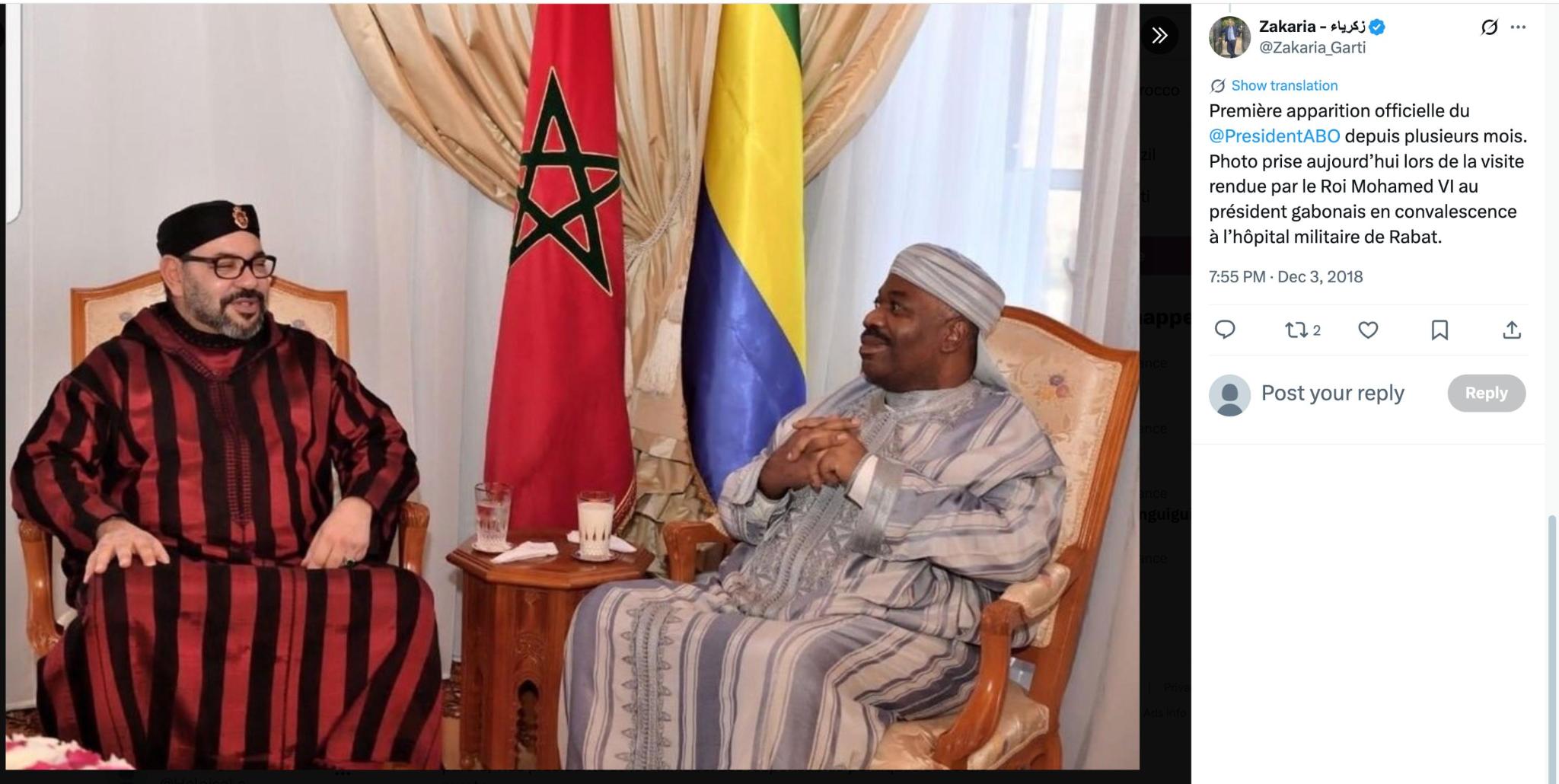
Tweet about the meeting between King Mohammed VI and Ali Bongo on December 3, 2018 (Credit: Twitter / Screenshot by Forbidden Stories)
Mohammed VI, the heir of Hassan II, regularly visited Gabon during his reign and expanded bilateral relations, first with Omar Bongo and then Ali Bongo. He prioritized Moroccan companies and awarded scholarships to African students at Moroccan schools and universities.
According to several open sources, Gabon sends military personnel to Morocco for training. The current president, Brice Oligui Nguema, is a graduate of the Meknes military academy, and served for a time as a military attaché in Rabat. The Moroccans, for their part, have also benefited from Gabon’s unconditional support on the question of Western Sahara’s Moroccan identity.
However, according to our information, SILAM — the Gabonese surveillance agency — was reportedly unaware of the use of Pegasus against high-ranking officials in Gabon. We don’t know whether Ali Bongo, who was still in Morocco in March 2019, was informed.
“The country was in an uproar. For Morocco, it was absolutely essential to know what they were planning,” reported a security source close to the Kingdom of Morocco.
The end of the “young team” era
In late March 2019, Ali Bongo returned to Gabon. Weakened, the former strongman stepped back from the limelight. Some say that the “young team,” along with Noureddin Bongo and his mother, Sylvia, were considered the true power brokers.
According to press reports at the time, the young Laccruche started to overshadow Noureddin. In a cabinet reshuffle, he was dismissed from his role as chief of staff, then arrested in December 2019 and placed in pretrial detention as part of a wide-ranging anti-corruption investigation. Noureddin Bongo officially joined the government when Ali Bongo appointed him General Coordinator of Presidential Affairs.
Four years later, another military coup shook the country in 2023. This time, the head of the Republican Guard, Brice Oligui Nguema, seized power. Noureddin, Sylvia and several members of the “young team” were arrested and charged with corruption: embezzling public funds, money laundering and abuse of office, among other crimes. They denied the charges outright. Noureddin was sentenced in absentia to 20 years in prison. In an article in Le Monde, Noureddin contested the charges and claimed he was tortured in prison.
Several of the victims expressed certainty that they had been regularly wiretapped and carried three or four phones to try to confuse the authorities. But regarding Pegasus, they doubted that such an expensive piece of software had been used against them.
Jean Ping, a 2016 presidential candidate whose number was on the list of potential targets from March 18, 2019, was not shocked. “Wiretapping is common in Gabon,” he said. “If it’s proven, I might file a complaint.” At press time, Mintogo had not responded to questions sent by Forbidden Stories.
When contacted, neither Noureddin Bongo nor Brice Laccruche Alihanga responded to our questions. Nor did the Kingdom of Morocco, the Gabonese government, or a representative of Ali Bongo.