- Reading time: 12 min.
Deported to the Prison City: A journalist expelled to Mexico’s southern border
In Venezuela, Roberto Betancourt received death threats for his work as a journalist. After a decade in the United States and a hellish detention ordeal, he’s been deported to Mexico, where he awaits the outcome of a Kafka-esque administrative nightmare. His case is one among around 20,000 third-country deportations to Mexico under the second Trump administration.
People deported from the United States to Tapachula confer with local activist Luis Villagrán about documentation in Tapachula’s central park on March 24. (Credit: Georgina Pease)
- The Trump administration has deported tens of thousands of immigrants with no connection to Mexico to southern Mexican cities under an unprecedented third-country deportation policy that immigration lawyers say violates due process.
- Near Mexico’s southern border, deportees are trapped in historic immigration chokepoints with no protection, no legal status, and limited information. They are vulnerable to organized crime and immigration enforcement operations.
- A Venezuelan journalist who lived in the United States for over a decade after facing persecution for his work in his home country was deported to the city of Tapachula in January, and remains in Mexico.
By Georgina Pease
September 23, 2026
María de Jesús Peters and Juan de Dios García Davish contributed reporting
Advising from Susie Neilson, Eduardo García, and the U.C. Berkeley Investigative Reporting Program
On January 26, an eight-seater immigration van wound through the Sonora desert’s undulating hills in southern Arizona, then pulled into the bustling border crossing in the city of Nogales. From inside the van, Roberto Betancourt peered out at the rusted steel wall that has sliced the border community in two since it was erected in the 1990s.
He watched immigration agents shepherd other detainees from Venezuela, Cuba, Haiti and Central America across the tarmac towards three sleek white buses on the Mexican side of the port of entry.
Betancourt had no intention of boarding those buses. “I’ll just refuse to go. It’s my right,” he remembers thinking.
By then, Betancourt was used to the vagaries of American immigration enforcement. Since the Venezuelan journalist was detained on July 14, 2025, U.S. Immigration and Customs Enforcement agents had shuttled him between 12 different detention facilities and had already attempted to deport him twice.
The first time had been in late December 2025, when immigration agents bussed Betancourt to San Diego’s border with Tijuana. Betancourt told authorities that they couldn’t obligate him to cross — Mexico wasn’t his country, he was scared of what would happen if he were sent there without any legal status, and deporting him without due process was illegal. The agents relented and returned him to detention.
Then, a month later at Arizona’s Mesa Gateway airport, immigration agents tried to force Betancourt onto a plane to Venezuela. He told them that an immigration judge had granted him protection from deportation to Venezuela in a 2024 court order, a decade after he fled political persecution in Caracas. ICE agents ignored his objections until a U.S. Marshal intervened on his behalf.
In Nogales, though, things unfolded differently. Four armed immigration agents clambered into the van and closed in around Betancourt. “They’ll deport you with punches if it’s necessary,” Betancourt said.
During six months in detention, Betancourt regularly experienced what he described as inhumane and dehumanizing treatment, including periods of up to 25 hours in shackles, and days on end shut with other immigrants in holding rooms so cramped that the detainees had to take turns lying down to rest. But he was determined to continue fighting his case, and return to the life he’d built with his family over the last decade in Miami. And to do so, he would need to remain inside the United States.
Hoping to avoid a beating, Betancourt crossed the border intending to explain his case to Mexican migration authorities — maybe they would listen. “But they didn’t respond,” he said. “They literally pretended not to hear me.”
The American agents forced Betancourt onto the Mexican bus with around 40 other detained passengers. Moments later, they were rolling south through rural Sonora towards an unknown destination in an unfamiliar country.

In Nogales, Avenida Internacional runs parallel to the wall on the Mexican side of the border. Before the wall was erected, the road was the main marker of the international boundary. (Credit: Georgina Pease)

Automobiles and pedestrians cross between the United States and Mexico at a port of entry in Nogales, where ICE began regularly deporting non-Mexican nationals in 2025. (Credit: Georgina Pease)
Mexico at the core of the Trump administration’s third-country deportation agenda
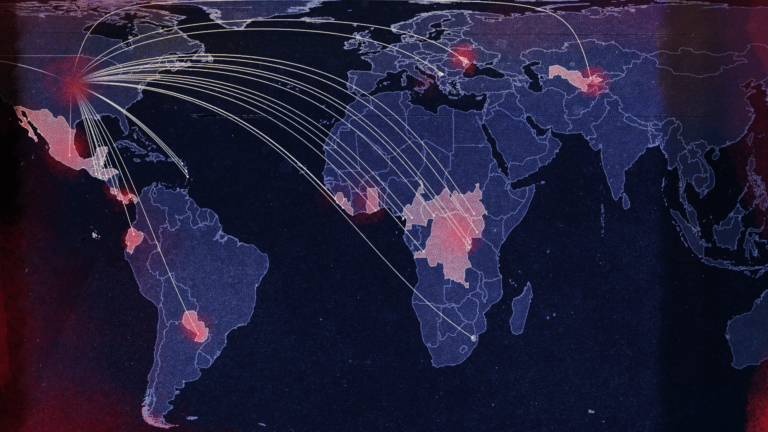
Betancourt’s experience in Nogales used to be exceedingly uncommon. But in the past year and a half it has become typical. Since Donald Trump took office for the second time in January 2025, Mexico has received nearly 80% of the 25,427 immigrants deported to countries other than their countries of origin. Under previous administrations, such deportations — known as third-country transfers — occurred very rarely, on a case-by-case basis. But a month into Trump’s second term, the Department of Homeland Security issued a directive that transformed them into a central tool in the administration’s crackdown on immigration.
This novel deportation policy has minimal oversight. It has been tied to violations of due process and human rights abuses in the United States as well as in countries receiving deportees, who are often in the dark about where authorities are sending them until moments before their deportation, according to immigration attorneys. Over six months, 72 journalists from 26 newsrooms in 15 countries collaborated in a Forbidden Stories investigation to interrogate these deportations and their impacts.
Late last week a U.S. federal appeals court affimed a lower court’s ruling that the third-country removal policy is unlawful: the court reasoned that authorities aren’t giving immigrants sufficient prior notice of their deportation, and denying them a meaningful opportunity to object to the transfer. Immigration attorney Trina Realmulto called the decision a “major victory,” however DHS attorney James Percival posted on X that the ruling “is not currently in effect” and that “the third country deportation policy continues.” Legal experts say DHS will likely to appeal the decision before the Supreme Court.
White House spokesperson Lauren Bis told Forbidden Stories that “the only illegal aliens going to third countries are those whose home countries won’t accept them including dangerous criminals or illegal aliens with orders of removal who have asked to not be removed to their home country.”
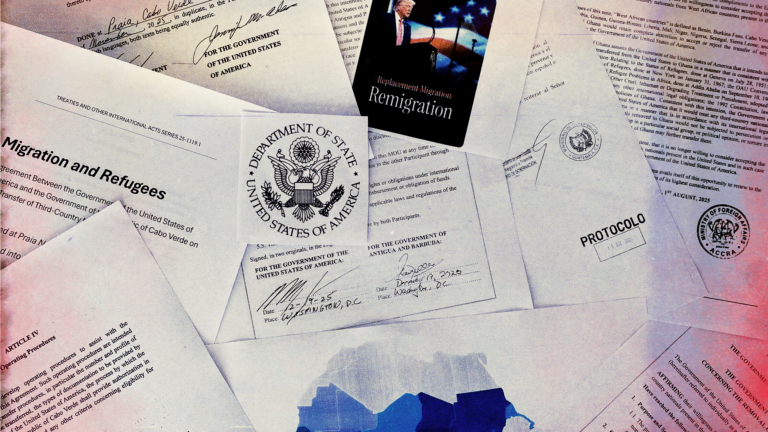
In contrast to at least 35 countries that have signed formal third-country transfer agreements with the U.S., the understanding governing third-country deportations to Mexico is secretive and opaque. In March, DHS official John A. Schultz stated in court that U.S. Immigration and Customs Enforcement has “established a third-country removal pathway to Mexico, ” however Mexican President Claudia Sheinbaum has denied publicly that Mexico has signed any safe third-country agreement. The Mexican government reiterated Sheinbaum’s statement in an email to Forbidden Stories, but did not respond to further questions.
Exhaustion, anxiety, uncertainty
As hours stretched into days on the bus, Betancourt wondered if his brother, who had so carefully tracked his whereabouts as ICE transferred him back and forth between detention sites across the southern United States, would find out what had happened to him. He wondered how his wife and parents would hide their worry from his seven-year-old son and ten-year-old daughter when Betancourt’s name disappeared from ICE’s detainee locator without a trace.

During six months in ICE custody, Betancourt was transferred between 12 detention facilities across the southern United States before being deported to Mexico. (Credit: Georgina Pease)
“The exhaustion defeats you, the anxiety, the uncertainty,” he said.
As Betancourt shifted his gaze from the arid desert landscape sliding past the window to the dozens of people confined to their seats in the rows ahead of him, curiosity cut through his fear and doubt. One young woman looked barely beyond adolescence, and others had hair streaked with grey.
The group looked disheveled, and the heavy aroma of unwashed bodies was a constant reminder of the conditions they’d endured in detention. Many had not been allowed to shower or brush their teeth for nearly a week, cramped in overcrowded hangars at Arizona’s Mesa Gateway airport. Worry wore into the passengers’ faces, and Betancourt saw some of their cheeks were stained by tears.
It was the first time in months that Betancourt was transported without shackles, and he took advantage of sporadic walks down the narrow central aisle to exchange stories with other detainees. He found out that many had lost their permission to live and work in the United States when Trump cancelled Biden-era parole programs.
Other Venezuelan nationals told him that to escape the conditions in detention they had agreed to voluntary deportation — but to Venezuela. They said immigration agents had told them that the bus was taking them to Mexico City, where they would be transferred to a plane to Caracas.
The bus passed through Mexico City, and continued south.

Betancourt refused to sign the notice of removal to Mexico presented to him by an ICE deportation officer.
At the rear of the bus Betancourt sat shoulder to shoulder with a man named Darwin Maldonado. They took turns in the aisle and window seats as the sun set and rose and set again. Maldonado, who had left Honduras as an eight-year-old to join his mother in the United States, told Betancourt about his four daughters in Southern California. Betancourt told Maldonado about his own children, born in Florida after he moved to the United States to escape intensifying political persecution in Caracas.
“We all had years of effort that we were leaving behind, from our family ties to the material things that we’d worked so hard for,” said Betancourt. “It was an immense shock for us, as human beings.”
Censorship and intimidation
In the United States Betancourt worked as an audiovisual journalist and producer. Alongside the prominent exiled Venezuelan journalist Patricia Poleo, he produced political analysis of Latin America for the platform Factores de Poder.
As a student at Caracas’ Santa Maria University decades earlier, though, Betancourt had no intention of delving into politics. His grandmother — recognizing his personable nature, his lifelong enthusiasm for baseball, and his propensity for asking questions — had suggested that he would make a good sports journalist, and that’s what he became.
In the years following the 2002 coup attempt that interrupted then-President Hugo Chávez’s first term in office, Betancourt was completing his degree and broadcasting commentary to the soccer and baseball fans of Caracas. He enjoyed the work, and it was more or less the career he’d envisioned. But in the run-up to the 2006 presidential elections he was assigned to cover the opposition candidate Manuel Rosales’ campaign. He said that after three months tracing Rosales’ campaign trail across the country, “political journalism stayed with me like a little thorn.”
Betancourt’s affinity for politics came at a cost. Around 8 a.m. on June 3, 2010, shortly after Betancourt arrived at his office in Venezuela’s capital, two armed attackers burst into the building. Threatening him at gunpoint, the attackers bound Betancourt’s hands together, gagged him, and grabbed the office computers.
At the time, Mr. Chávez had been president for over a decade. His government leaned heavily on colectivos — pro-government community organizations with roots in mid-twentieth century guerilla movements — to intimidate political opposition, human rights defenders, and the media.
“Cállate la boca,” the attackers threatened. Shut your mouth. “And Delvalle’s too.” Betancourt had been working for months producing a political radio show alongside Delvalle Canelón, a journalist and on-air personality who has consistently spoken out against the regime’s suppression of free speech.
After the attackers left, Betancourt strained against the ties binding his hands until they broke, which cut off his circulation and left his thumb without any feeling for months.
His office was attacked and burgled a second time in 2012, and that same year colectivos ambushed and shot at him. Betancourt was left uninjured, but with a clear warning from the allies of the regime.
Delvalle Canelón interviews a guest on the radio program that Betancourt produced in 2012. (Credit: courtesy of Roberto Betancourt)
When Mr. Chávez died in 2013, Nicolás Maduro assumed the presidency, and brought to the role an increasing reliance on violence and repression. That year the colectivos threatened to burn Betancourt alive in his car. Then the state-run telecommunications commission censored him and threatened to imprison him for treason.
In February 2014, the same week anti-regime demonstrations swept the country from the western border town of San Cristobal to the capital, Betancourt and his wife joined Venezuela’s growing diaspora in Miami.

Betancourt’s press credentials from 2006, when he spent three months covering the campaign of the opposition candidate Manuel Rosales for Radio Venezuela, one of the country’s principal radio stations. (courtesy of Roberto Betancourt.)
In Florida, Betancourt dove deeper into political commentary. His work with Patricia Poleo generated an influx of threats over social media from allies of the Venezuelan government. (Poleo had been living in exile since 2004 when the Venezuelan government accused her of terrorism — charges that human rights groups say the regime fabricated.)
“I strongly believe that if I return to Venezuela, my life will be at risk, facing the possibility of a certain death, because of the political ideals I represent and the profession I have practiced for 13 years,” Betancourt wrote in his 2014 asylum application.
But in 2019, before his case wound its way through U.S. Citizenship and Immigration Services’ backlog to an immigration judge’s desk, Betancourt was involved in a traffic accident that left a motorcyclist dead. Sentenced to four years in prison for a DUI-manslaughter charge, Betancourt became ineligible for asylum.
The International Convention Against Torture
Betancourt said that after the accident he was terrified. Of what he had done, of his own conscience, and of the prison sentence facing him. Until then, he’d never incurred so much as a traffic ticket.
“When I made the mistake that I did,” he said, “my main focus was to be responsible and congruent with my values, with the values my parents had instilled in me throughout my life, and above all to set the best example I could for my family and kids.”
Betancourt was still in prison when his immigration court date finally arrived. In the United States immigrants convicted of felonies are not eligible for asylum, but the Convention Against Torture — an international treaty codified in U.S. law — prohibits the government from returning people to countries where they are likely to face torture. The judge prohibited authorities from carrying out Betancourt’s final order of removal to Venezuela with a court protection known as “Deferral of Removal.”
Immigration attorney Matt Adams said that under previous administrations there was “generally an expectation” that people with such protections would be able to remain in the United States despite having final removal orders. That precedent was turned on its head by DHS’s February 2025 directive that instructed ICE officers to re-detain people with Convention Against Torture protections as candidates for third-country removal.
When Betancourt completed his prison sentence in July of 2025, an ICE officer was waiting to take him into custody. Two months later, DHS included Betancourt’s mugshot in a press release that misidentified his crime as “murder–homicide” and labeled him and 50 other detainees “barbaric criminal illegal aliens.”
Betancourt said that the article, which some U.S. news platforms uncritically regurgitated, was a “breaking point” for him. The “American Dream” lost credibility — the only reason to stay in the country was for his family. After facing the consequences for his crime and completing his sentence, the defamation and banishment to Mexico felt like a kind of double jeopardy. “I took responsibility for my mistakes with courage, to repay what I owed society,” he said.
“I come from a country where we’ve had 27 years of a regime where practices like this are normal,” he added. “For me, it’s unacceptable that the supposed ‘country of liberty,’ the most stable democracy in the world, is acting like this.”
Trapped at Mexico’s southern border
At the southernmost point of North America, the city of Tapachula’s colorful colonias and bustling streets interrupt the dense stretch of cloud forest that links Mexico and Guatemala. On the edge of a highway in the outskirts of the city, towering red and white concrete walls enclose the Siglo XXI migration center, which is widely regarded as the largest migration detention center in Latin America.

The Siglo XXI detention center borders the highway in the northern outskirts of Tapachula. (Credit: Georgina Pease)
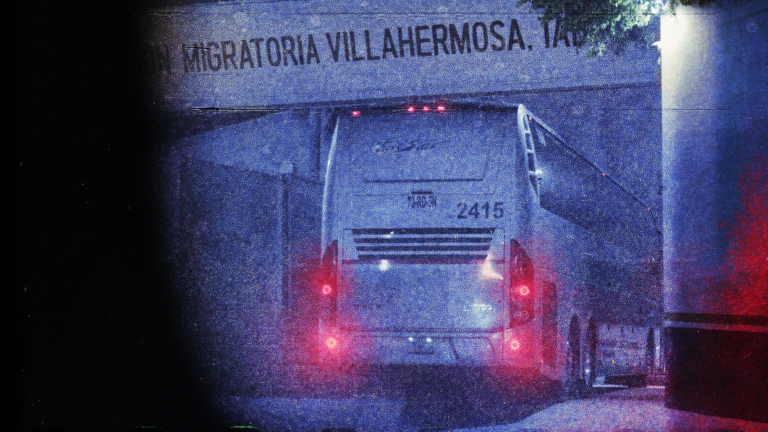
Around 7 p.m. on January 28, two nights and three days after leaving Nogales, the buses pulled off the highway and through the detention center’s barred gates. Betancourt and the other passengers clambered off, their feet aching and swollen from lack of circulation. They registered their names and fingerprints with immigration agents, who gave each person a document. It allowed them ten days to either begin a process to apply for refugee status in Tapachula, or leave Mexico.
Then, Betancourt said, authorities simply opened the door and told them, “‘Get out of here. Figure it out.’”
According to local activist Luis Villagrán, Tapachula is the “neuralgic center of migration in the Americas,” where flows of migrants arriving from every continent collide with increasingly militaristic migration control policies.
For decades, the city of 400,000 has been an entry point into North America for Central Americans fleeing the civil wars of the late twentieth century; and more recently drought, economic hardship, and the violent hold of transnational gangs. The city also received hundreds of thousands of migrants from South America and around the world who traveled north through the hazardous Darien Gap during the past decade.
The U.S. and Mexican governments have responded with policies that prevent migrants from reaching northern Mexico and the U.S. border, turning Tapachula into the frontier of what analysts call a “vertical border.” In 2014, Mexico leaned on U.S. funding to implement Programa Frontera Sur — the Southern Border Program — which increased migration checkpoints in Mexico’s southern states and escalated deportations of Central American migrants back to their countries of origin.
Four years later the first Trump administration pushed nearly 70,000 non-Mexican migrants awaiting asylum hearings in the United States back into Mexico under the “Remain in Mexico” program, and pressured Mexico to ramp up deportations or face tariffs.
“That’s where we first started seeing people from third-country nationalities be returned to Mexico,” said Gretchen Kuhner, director of the Institute for Women in Migration. “Once you open that door, so many things can happen … you start normalizing it.”
The Biden administration suspended “Remain in Mexico” due to concerns over human rights violations, but after migrant encounters at the U.S. border surged in late 2023, Mexican authorities suddenly began bussing migrants apprehended in northern Mexico en masse back to cities near the southern border, which migrants dubbed “prison cities.”
Now, the Trump administration is condemning hundreds of third-country deportees each month to the long-established containment infrastructure at Mexico’s southern border.

Caption: Just five miles from Mexico’s border with Guatemala, Tapachula has become a point of confinement for thousands of migrants and deportees. (Credit: Georgina Pease)
Escaping the prison city
Stranded on the shoulder of a dark road in the outskirts of Tapachula in the shadow Siglo XXI, Betancourt remembered how ICE agents at Arizona’s Mesa Gateway Airport had circulated false claims that Mexico would offer detainees asylum, in a bid to get them to accept deportation to Mexico.
“In the end they sell you a dream that doesn’t exist,” he said.
Betancourt and Maldonado found a public bus to the city center, where the storefronts were shut and the streets all but deserted.
They ducked off the street into a hotel, where they shared the cost of a cheap room. Betancourt relied on money transfers that his wife and brothers pooled together, but other deportees couldn’t lean on family for financial support, or simply couldn’t receive wire transfers because they were deported without their identity documents. (Betancourt’s family mailed his expired Venezuelan documentation to Tapachula.)
“There are people who are completely vulnerable, without a cent in their pockets, without friends or a support network, without food, without having anywhere to sleep,” Betancourt said.
Days stretched into weeks as Betancourt pivoted between state and federal agencies in Tapachula, probing the bureaucratic labyrinth for an escape.
“All their answers are evasive or generic. There’s no resolution, they don’t make commitments, they don’t give specifics,” Betancourt said.
Authorities instructed him to apply for refugee status. Only if his application was approved — which would likely take over a year — would he be able to leave Mexico’s southernmost state. If his application was denied, he’d have to repeat the same process and hope for a better outcome.

Immigrants wait in line outside the federal refugee agency’s office in Tapachula at 7 a.m. on March 25. (Credit: Georgina Pease)
Denisse Lugardo, Tapachula’s Director of International Relations and Cross-Border Development, said that her department first became aware of third-country transfers bussed to Tapachula in early February, just after Betancourt arrived.
“The foreign deportees weren’t in Mexico’s panorama,” Lugardo said in an interview in March. “Neither the refugee commission nor the migration agency have done anything for them.”
“They left them here abandoned,” said Villagrán, the local activist, who has spent long hours in Tapachula’s central park providing refugees with information and helping them with paperwork.
“And Tapachula is one of the poorest cities in Mexico. It lacks the basic infrastructure to even attend to its citizens in terms of healthcare, education, and security,” he added. “Migration has completely overwhelmed the city’s capacity.”
“We’re talking about 70,000 or 75,000 migrants stranded here against their will,” he explained. He said that around 2014, these numbers had hit 100,000, over a quarter of Tapachula’s resident population.
The Mexican government told Forbidden Stories that any foreign nationals in Mexico can apply for legal status through the federal migration and refugee agencies, or seek government assistance to return to their country of origin.
But this year, many deportees facing bureaucratic delays and dead ends turned to informal, often dangerous pathways to escape the city.
Smugglers circulated rates for forged travel documents or clandestine transport north: to reach Queretaro would cost 1,200 U.S. dollars; $1,600 to Cancun; $1,800 to Mexico’s capital. “The prices are higher if you don’t have documents, and we have to pay a bribe to get you out of Tapachula,” said one smuggler in a voice note.
People who tried to travel north were detained and returned to Siglo XXI, or sometimes deported to Central American countries that have deportation arrangements with Mexico, like Guatemala and Honduras.
Humberto García, a Cuban national deported after 35 years in the United States, tried to travel through the mountains to avoid migration checkpoints, but was approached by three armed attackers, who robbed him and shot him twice in his torso. He stumbled for nearly an hour until he reached a road and authorities transferred him to the nearest hospital. The bullets hadn’t damaged any organs, but after three days recovering he had no choice but to return to Tapachula.
“I had to go back to Tapachula and stay in the park, with nothing to eat, nowhere to sleep, the same story,” García said.
Many of the Venezuelans who had been told a plane would take them from Mexico to Caracas confronted the route south through Central America and Panama’s Guna Yala archipelago to reach Colombia’s northern coast. A boat carrying a passenger deported alongside Betancourt — who requested to remain unnamed due to fear of repercussions from authorities — capsized on February 10, killing two Venezuelan women and one Colombian man.
While Betancourt approached authorities day after day searching for a legal pathway out of the city, he watched other deportees risk informal routes. “I don’t know what their luck will be, if they’ll reach their destination or not, but there’s no doubt that it’s an incredibly dangerous situation,” Betancourt said.

People deported from the United States walk alongside people migrating north from Central and South America on in a caravan that left Tapachula on March 24. (credit: Georgina Pease)
Uncertainty in the Mexican Capital
One month after arriving in Tapachula, repeated visits to the federal migration office and a chain of emails with Mexican and Venezuelan authorities secured Betancourt permission to travel to the Venezuelan embassy in Mexico City. He told authorities he needed to renew his passport to fly back to Venezuela, but as soon as he arrived in Mexico City he applied for refugee status there.
“It was the only way to leave Tapachula legally,” said Betancourt. He hoped his effort would create a precedent that others deported to Tapachula could follow. But six months later he has not heard of anyone else who has managed to use the same pathway.
In Mexico City, Betancourt is no longer at the nucleus of containment policies trapping migrants in the south, but Mexico’s refugee agency requires him to remain in the capital until he receives a decision on his application.
“I’m not really free,” said Betancourt. “In the United States, they supposedly granted me protection for my human rights, then they violated them. They’re violating them here too, simply with the lack of celerity in a process that limits my day to day life with so many obstacles that I don’t feel fully free.”

Immigrants applying for refugee status line up for biweekly checkins outside the federal refugee agency in Mexico City on August 14. (Credit: Georgina Pease)
Nevertheless, Betancourt said he’s approaching his time in Mexico City as a “new opportunity to restart.”
Last summer while the world’s eyes were trained on Estadio Azteca’s World Cup matchups and the river of fans enveloping the city’s iconic monument of the Angel de la Independencia, Betancourt launched a sports journalism platform that interrogates professional sports’ economic drivers.
“I’ve been able to reconnect with sports journalism in a different way,” said Betancourt.
He hopes to build a stable remote career that would allow him to move wherever bureaucratic migration policies offer the chance to be with his wife, daughter and son. Aside from journalism, he’s working as a marketing and communications contractor.
“I need to find a way to guarantee stability for my family, for my kids,” he said.

Betancourt in Mexico City in March, shortly after leaving Tapachula. (Credit: Georgina Pease)
In August, Betancourt flicked through photos that his family sent of his children’s first day back to school. With no way of knowing when or where he’ll be able to see them, he said looking at the pictures filled him with simultaneous love and hurt.
“We’ve worked so hard to stay together, so that my kids and their cousins can enjoy growing up together, like we did as children, even if it’s not in our country of origin,” said Betancourt. “It’s my parents’ biggest dream — that somehow we all stay as close together as we can.”
“I feel frustrated realizing that migrants are treated as second-class citizens,” said Betancourt. “But this is my reality.”
But Betancourt stressed that while he’s been able to begin to rebuild, countless others caught up in Trump’s third-country deportation policies remain in legal limbo in Tapachula.
“Others are in vulnerable situations without access to a bank, without access to formal employment, without access to healthcare, without access to a whole host of things that logically should be a non-negotiable part of freedom,” he said. “They’re terrified.”
See also