- Reading time: 10 min.
The office of Remigration: “America First” and its overseas negotiations
Iranians in Panama, Laotians in Eswatini, Venezuelans in Liberia. Since President Donald Trump took office in 2025, his administration has signed bilateral agreements with 35 countries to deport to them people who aren’t originally from there. Some 25,000 people have since been removed to countries they have no ties to. But the mechanics of third country removals are couched in layers of administrative, diplomatic, and financial secrecy.
Credit: Mélody da Fonseca / Forbidden Stories
- Since January 2025, the Trump administration has concluded deals with 35 countries to deport third country nationals. The details of these agreements have been clouded in secrecy.
- The Office of Remigration, a new division of the Department of State created in 2025, negotiates most agreements.
- Internal documents reveal the Office of Remigration planned to spend at least $410 million in payments to governments and humanitarian organizations as part of the deportation agreements.
By Magdalena Hervada
September 21, 2026
Additional reporting by Adam Taylor, David Nakamura (The Washington Post), Louisa Loveluck (The Guardian), Sofía Álvarez Jurado, Léa Peruchon, Sofia Soldà (Forbidden Stories)
The Forbidden Stories Team
Publication Director: Laurent Richard
Editors-in-Chief: Edouard Perrin, Frédéric Métézeau
Journalists: Sofía Álvarez Jurado, Magdalena Hervada, Léa Peruchon
Publication Coordinator: Louise Berkane
Video Journalist: Anouk Aflalo Doré
Communications and Partnerships: Emma Chailloux, Camille Saint-Jean
Editing: Annie Hylton
Fact-checking: Emma Wilkie
Translation: Diane de Vignemont
In November 2025, Christian Jové Ehrhardt, a 41-year-old diplomat, traveled to Cameroon. It was his second trip as head of the little-known Office of Remigration at the US Department of State.
The man had been promoted earlier that year. For most of his career, he’d served in security operations in US embassies. One of his postings was in Yaoundé, Cameroon’s capital. He was returning to the African country under very different circumstances. This time, he had the authority to negotiate on behalf of the United States of America.
This was one of ten such trips he’s made in the past year. When he meets with foreign leaders, he’s presented as “a White House envoy,” a US official familiar with Ehrhardt’s role told the Washington Post. “The messaging is not just that he is a deputy assistant secretary of state. He’s really part of the White House, so they roll out the red carpet.”
On this particular trip, he met Felix Mbayu, Cameroon’s foreign relations minister. Officially, the men discussed cooperating on “security, health, and humanitarian assistance,” according to a post by the US embassy in Yaoundé, Cameroon’s capital. Ehrhardt also attended roundtables with representatives of the United Nations High Commissioner for Refugees (UNHCR), with whom he later toured a local hospital to witness the impact of US funding on the quality of care, according to another embassy post.

Credit: X / Capture d’écran Forbidden Stories

Credit: X / Capture d’écran Forbidden Stories
But Ehrhardt’s main goal during the trip was never publicly announced: he had set out to negotiate a deal that would allow the US to deport people who had no ties to this country. His aim proved successful on December 16, when a memorandum of understanding (MOU) on this topic was finalized. That same day, the US approved a five-year health assistance scheme in Cameroon, worth nearly $400 million. A month later, the Department of State said it would also contribute $30 million to UNHCR in Cameroon “to facilitate the voluntary return of refugees and combat illegal immigration,” according to the embassy.
Two days after that announcement, on January 14, the first plane of people arrived from the US in Cameroon. The MOU was quietly uploaded to the State Department’s website several months later.
Cameroon is one of 35 countries that agreed to take in so-called “third country nationals” (TCN), people deported from US soil to countries they are not originally from. As of August 31, 2026, at least 25,447 such people had been sent across 28 countries. The US government has not publicly disclosed these numbers. Nevertheless, Forbidden Stories analyzed data from multiple sources, including NGOs such as Human Rights First. “Over the past year, the government had been very opaque about these third country transfers”, Savi Arvey, their Director of Policy, Refugee & Immigrant Rights, said. “These [flights] were being carried out in secret.” With Refugees International, her organization launched Third-Country Deportation Watch, and pieced together open-source information from flight routes and on-the-ground sources in monthly reports and an online dashboard.
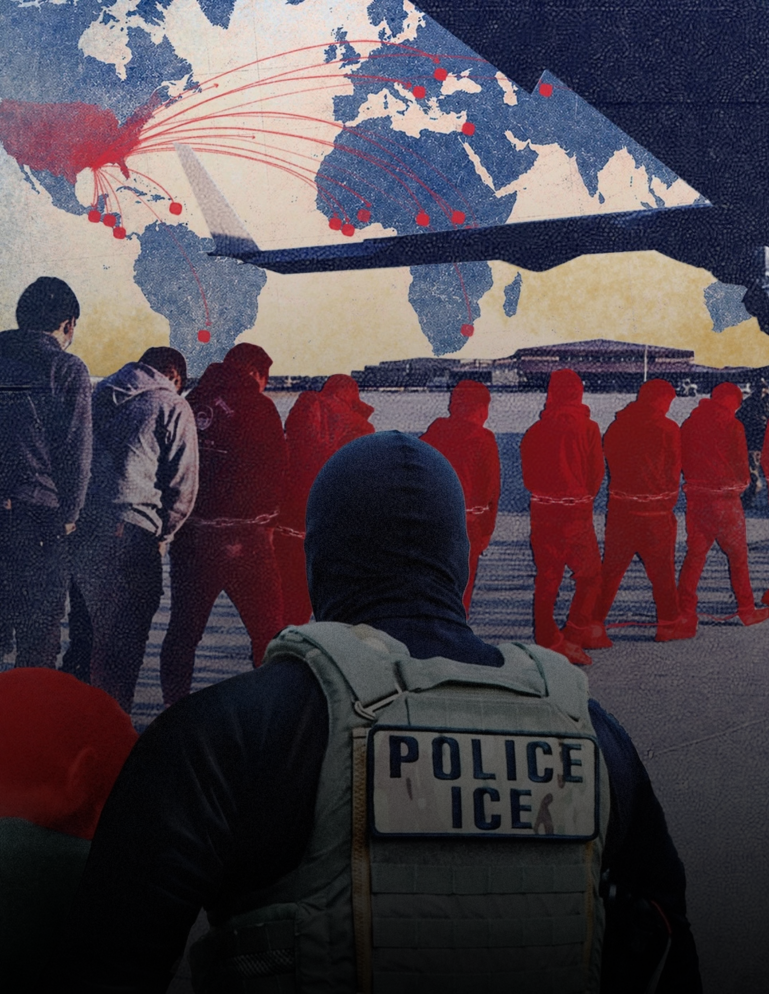
Journalists trying to investigate these practices increasingly face obstruction and legal pressures. 32 journalists were arrested last year in the U.S. Nearly 90% of them were covering ICE protests. In Cameroon, journalists on assignment for Associated Press were threatened while investigating the agreement. This is why Forbidden Stories teamed up with 26 media organizations in 15 different countries. For six months, a consortium of 72 journalists conducted over 100 interviews with third country nationals, government officials, lawyers, and experts as part of The Deportation Project to shed light on how the US deported tens of thousands to countries they had no ties to, and the impact this policy has on their lives.
A US federal appeals court ruled to halt these removals on September 18, arguing that they violated due process. The decision stated that migrants weren’t given notice sufficiently in advance that they’d be removed, denying them a chance to contest the decision. The suit was filed by the National Immigration Litigation Alliance (NILA), Northwest Immigrant Rights Project (NWIRP), and Human Rights First “on behalf of a nationwide class of noncitizens threatened with removal to third countries,” according to a Human Rights First press release. The ruling upholds a February lower court ruling that the administration must offer hearings to contest these removals.
The administration is likely to appeal this decision before the Supreme Court, according to legal experts. For now, however, third country deportations should be on hold, said Trina Realmuto, executive director of the National Immigration Litigation Alliance, who was among the team of attorneys who brought the class-action case. “This is a major victory,” she said. “The third country deportations that have occurred were illegal,” adding that the ruling was “effective now.” In the case of a Supreme Court appeal though, she said the existing policy would likely continue.
James Percival, General Counsel to the Department of Homeland Security claimed on X that the ruling was “not currently in effect,” however. “If you claim fear in your home country, DHS has the right to send you elsewhere,” he wrote.
The Washington Post, a member of the consortium, obtained internal State Department records that show the US government planned to spend at least $410 million to secure agreements with third countries. Of that sum, $81 million were earmarked for signatory governments through fast-tracked contracts that have drawn objections from congressional Democrats for bypassing human rights requirements for foreign aid spending, according to people familiar with the agreements.
What the Trump administration wanted “was fast money, with no strings attached,” said one former official who resigned from the State Department over objections to the policy. “The whole point was to circumvent [congressional] notification that money was being sent to a government known to be corrupt.”
The documents, which have not been previously made public, provide a comprehensive picture of the Trump administration’s fast-growing third country network. They include details on the nature of the deals, which vary widely from country to country; from how many people from which nationalities the US can send, to whether or not they may have a criminal record. They also detail how much money the Department of State planned to spend to make each deal happen. The Office of Remigration, under the Department of State, is responsible for handling these payments.
The activities of the Office of Remigration are clouded in secrecy. It was established as a subset of the Bureau of Population, Refugees and Migration (PRM) during a major State Department overhaul in 2025.
The term “remigration” itself is loaded with racist, far-right connotations, and is widely used in European neo-Nazi circles. US officials told Wired that the office’s goal is “reinstating border security as the primary element of national security and ending mass migration”. How the approximately 15-person team implements such policies, however, has never been made public by the US government.
Million-dollar deals
Convincing a foreign government to take in deportees who are not their own can cost millions. On Christmas Eve last year, the small island nation of Palau signed an MOU with the US that stipulated it would receive $7.5 million in exchange for accepting up to 75 third country nationals. The archipelago of some 340 islands in the Pacific Ocean has a population of under 18,000 people. After capturing it from the Japanese in World War II, the US administered it for decades. In 1994, Palau gained independence under the condition the US provide economic assistance in return for military access to the islands.
The 2025 agreement allocated $100,000 per person deported there, excluding the costs of flights to the Pacific. Palau received the funding to “address the needs of relevant Palau public services,” according to a statement by the US. The MOU also stipulates that deportees would only be accepted if they had no criminal record or their offense was immigration-related. Palau reserved the right to remove people from the flight manifest US authorities send ahead of time.
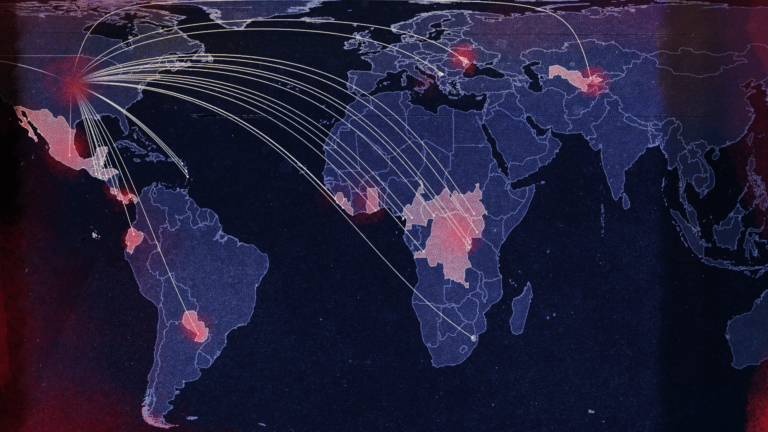
But US Immigration and Customs Enforcement has struggled to find migrants that fit the requirements for third country deportations. When the first plane arrived in Palau, in May, 2026, the US had reportedly submitted ten names for the manifest, but only one man ultimately arrived. Two people were later sent, for a total of three. Halfway across the world in Eswatini, the second smallest country in continental Africa and a repressive absolute monarchy, at least 32 people have arrived since July 2025, out of a possible 160 allowed by the deal. Contrary to Palau, Eswatini accepts deportees with a criminal record. It received over $5 million in exchange for signing a deal.
The Washington Post spoke to sources within the administration who said third country deportations were used to remove migrants who could not easily be sent to their country of origin. Some have removal orders from the US, but obtained “withholding of removal” from immigration judges, a status protecting them from being sent to their country of origin where they would likely face persecution.
In response to our questions, White House spokesperson Lauren Bis said that the “only illegal aliens going to third countries are those whose home countries won’t accept them including dangerous criminals or illegal aliens with orders of removal who have asked to not be removed to their home country.”
According to the internal records, Palau and Eswatini are two of 13 signatory countries that received direct compensation for deportation agreements. But these direct payments represent only 20% of the funds the State Department allocated to secure deals. The remainder was for international aid organizations. Grants totaling over $178 million were intended for the International Organization for Migration (IOM), and over $123 million for United Nations High Commissioner for Refugees (UNHCR). Both these UN agencies, whose mandate focuses on upholding human rights, have received criticism for their perceived ties to the US policy because of such grants.
The UNHCR focuses on refugee aid globally. In response to a request for comment on their involvement, a spokesperson said that “UNHCR is not party to these arrangements, which are based on bilateral agreements between the countries concerned,” and that any US funding was being used in line with its mandate to support countries in “strengthening asylum systems”.
Sweetening the deal
The IOM is an organization related to the United Nations, and “dedicated to promoting humane and orderly migration,” according to its website. When the Trump Administration slashed its funding to international organizations in early 2025, the IOM was hit particularly hard. In 2023, over a third of the Organization’s funds had come from the US. By March 2025, it had lost an estimated 30% in donor funding. But as the US began negotiating third country removal deals, it also started approving funding for humanitarian support to third country nationals upon their arrival to to the receiving countries. In the Department of State records, one finds the US allocated 44% of the funds listed to the IOM. Receiving countries that request IOM assistance can be provided with “Post-Arrival Assistance,” including accommodation, access to essential services, or humanitarian assistance.
“These are sweeteners,” used as incentives during negotiations with foreign governments, a current US official told the Washington Post. “We’re not giving funding to UNHCR and IOM as we were in the past. (…) We’re only giving funding for the most part linked to the agreements,” he said. He also confirmed that the two UN agencies weren’t involved in these bilateral negotiations. Our consortium accessed internal documents that show the US intended for the money to support some specific IOM operations.
Among them is its Assisted Voluntary Return (AVR) program, which assists migrants wishing to return to their country of origin. This includes third country nationals, provided that their request to return is made voluntarily. But according to US immigration attorney Alma David, many deportees feel that returning to their country of origin is the only viable option: they can either return, or remain in precarious conditions where they have no family or friends and often do not speak the local language.
David believes that AVR procedures aren’t adapted to the needs of third country deportees. “They were told in many cases once they were on a plane in handcuffs where they were going. There was no voluntariness or agency involved in them arriving to those countries,” said David.
Some of her clients deported to the Democratic Republic of Congo (DRC), which is in active conflict in parts of the country, faced an impossible choice. Although they risked persecution in their home countries, many see it as the best alternative. According to a State Department document accessed by our consortium, out of fifteen deportees who arrived in the DRC in June 2026, ten ultimately opted to return to their country of origin via the IOM program.

The IOM produces internal reports assessing a country’s security conditions before it intervenes. One “risk assessment” obtained by our consortium for a program supporting third country nationals sent from the US to an African country warns that the IOM might be “perceived as complicit,” potentially triggering negative reactions from IOM partners and “heightened scrutiny by media and human rights actors.”
The risks of not participating are also weighed, particularly concerning the IOM’s relationship with the US, a major donor despite recent budget slashes. Third country nationals “are likely to be left unassisted (or, at best, to be assisted inadequately) in a country they don’t know, with language issues, and unclear legal status,” it found.
On the US side, IOM presence is integral to negotiations and third country deportations. Bureau of Population, Refugees, and Migration officials travelled to Equatorial Guinea 7 months after people first started being sent there. They wrote an internal memo during their trip which states that the IOM’s absence, because its staff wasn’t yet accredited, meant the US could deport fewer people: “If IOM had been present and operational, [Equatorial Guinea] could accept more deportees”, the document reads.
In some cases, funding supports IOM projects that are not directly related to deportations. The documents indicate that $85 million would go to the IOM to secure the Central African Republic deal. Of that, $60 million is for “community stabilization,” which includes building roads and other infrastructure in a nation devastated by a years-long civil war.
On the topic of the US leveraging funding to UN agencies in their negotiations, an IOM spokesperson wrote: “We are fully cognizant that States use financial assistance to advance their national priorities. However, IOM’s decisions to accept funding, provide post-arrival assistance, or support assisted voluntary return are guided by our own mandate and principles, and rest on a single question: whether our engagement will improve the lives of the migrants affected. In these instances, we believe strongly it does. Our engagement is in no way an endorsement of the decisions that led to individuals’ removal.”
The tip of the iceberg
Tin Nguyen, an immigration attorney who represents Vietnamese and Laotian men deported to Eswatini and South Sudan, called the system a form of human trafficking, with migrants used as barter for countries seeking to curry favor with the Trump administration. “Human bodies are being pawned off and traded in order to get concessions from the US government,” Nguyen told the consortium.
Many countries also receive supplemental funds from the US soon before or after agreeing to accept third country deportations. On the same day that the Palau deal was announced, it was promised millions in other funds for domestic policies, including $6 million for reforms to its pension plan. In some countries, restrictions on visas for the US and tariffs were lifted after a deal was signed.
According to Michael Bochenek, senior counsel at Human Rights Watch, this proximity is one of the signs that there’s more on the table: “There are US contributions to various programmes that may have nothing to do with the deportations or the transfers, but there are often policy changes happening simultaneously. Those policy changes are, I think, the telling factors,” he said. “Why the US is trying to keep these things under wraps as long as it seems able to do so is an open question. But it does suggest that US Officials know that what they’re doing is at least very, very suspect.”
Even when faced with backlash from their population, governments seem determined to implement the deals. Before the first arrivals to Palau in May, the government had been wrestling over the agreement for months. In January, lawmakers voted to temporarily block any transfers of third-country nationals and hold a public referendum. But the Palau Supreme Court rejected suspending the deal. “The agreement appears nonbinding and framed in discretionary language. The order emphasized that nothing in the MOU creates enforceable legal obligations under domestic or international law,” the Palauan newspaper Island Times reported at the time.
Support us so that we can continue investigating
We need your help to expose what the enemies of the press try to keep quiet.
“Safe for whom?”
The Trump administration has attempted to fast-track third country removals by creating non-binding documents called “Third Country National Agreements” (TCNA). This is what Palau signed. This type of arrangement ensures the administration can quickly sign and implement them, according to State Department officials. Prior to the current administration, removals of migrants to third countries were harder to approve. During the first Trump term, “Safe Third Country Agreements” (STCA) were negotiated with Guatemala, Honduras, and El Salvador. Under these older models, foreign governments must make legal guarantees that deportees will not face torture or persecution and will have a right to apply for asylum in those countries.
With these legally binding documents, “you have to make sure a country has a legitimate asylum system, whereas these [TCNA’s] are more informal,” said a current US official. Only the Guatemala deal was ever implemented, and the US sent under 1,000 people there before transfers were suspended in the midst of the 2020 pandemic.
The nature of the agreements also led to much closer congressional scrutiny. On September 25, 2019, a man named Michael Kozak appeared before the Senate to defend the DOS’s Guatemala deal. Kozak, a diplomat for over 50 years, was the Senior Official of Western Hemisphere Affairs in charge of US relations in the Americas. When questioned before the Senate about whether he thought Guatemala was a safe country, he said, “The question is safe for whom.”
He argued that Guatemala, which has one of the highest homicide rates in the world, wasn’t necessarily dangerous for migrants who weren’t at risk of being persecuted there on account of their race, “religion or political opinion.” For them, Kozak said, “a country that has a crime problem or something” could be considered safe. This assessment didn’t convince Senate Democrats, who later published a report calling for the agreement’s termination.
The new TCNA format was created precisely to avoid the hurdles faced in the first Administration. They are still being signed in some countries today. To compensate for the sometimes complex implementation of these asylum agreements, some countries have signed not one, but two deals – one of each type.
Costa Rica for instance signed a Safe Third Country Agreement back in 2025 according to the Department of State documents, but it has yet to be implemented. Transfers to the Central American country had been on hold for almost a year when the second deal was signed, a non-binding Third Country National Agreement this time. The new deal allows for 25 people per week, a high quota which US officials have been eager to reach. In five months, almost 400 people were flown to Costa Rica under this scheme.
In 2025, Kozak returned to Western Hemisphere Affairs to pursue deals in Central and South America. His signature shows up on at least 5 agreements struck by the DOS, including the first Costa Rican agreement.
“What is refuge, really, right?”
Ehrhardt’s boss, Andrew Veprek was one of the main instigators of the State Department overhaul. In late August, 2026, he was promoted to manage Foreign Assistance, Humanitarian Affairs, and Religious Freedom, a bureau that oversees the Population, Refugees, and Migration and the Remigration offices. “We have changed the orientation of the bureau completely,” he said at a conference in April. The PRM, previously a “humanitarian assistance bureau,” was now focused on “implementing the president’s immigration agenda,” he said.
Agency staffers who used to manage humanitarian relief programs were reassigned to work on the deportation contracts. “Everybody feels pretty conflicted,” said a person who left the office earlier this year. “Morale is bad and it’s busy, and people do not want to be doing what they’re doing. It was a very painful thing.”
Veprek, 51, had already worked in the PRM in 2019, when the Guatemala deal was signed and has been a years-long ally of Stephen Miller, the architect of many of Trump’s hardest-line immigration policies, including third country deportations. One former colleague said Veprek was “kind of like a protege” of Miller, even though he was a decade older.
Veprek believes that the international asylum system is too lenient and thinks persecution is instrumentalised “for all kinds of mischief by talented lawyers,” he has said. Sources inside the PRM told The Washington Post he’s pushed relentlessly for third country deportations and the unprecedented restriction of refugee resettlement in the US under Trump–(some 17,500 people are now granted resettlement per year, compared with 125,000 under Biden), and on granting priority resettlement to Afrikaners (white South Africans) for protection.
Ultimately, Veprek advocates for a global redefinition of asylum, starting with making the status temporary: “What is refuge, really, right?”, he said at a conference.
In a statement, the Department of State said Ehrhardt and Veprek are “dedicated public servants who have worked tirelessly to promote prosperity and security for the American people.”
The Trump administration’s aspirations to reform asylum policies extend beyond America’s borders. Today, plans for “return hubs,” similar to third country removal policies, are being drafted in Europe. The term “remigration,” once confined to fringe ultra-nationalist movements adhering to the racist “great replacement theory”, has become more normalized. Germany’s AfD, a pro-Russian far-right party, explicitly mentions remigration as a political goal in its platform. Parts of their manifesto closely echo Veprek’s views on asylum.
In late May 2026, the most extreme proponents of mass deportations gathered in Portugal at the “Remigration Summit.” Martin Sellner, one of the organizers, is a former neo-Nazi from Austria who helped popularize the term. Gregory Bovino, Trump’s former Border Patrol Commander, was one of the main speakers.
Back in 2025, Sellner had supported the creation of the Office of Remigration according to Wired. Several US institutions have since regularly used the word on social media, bringing it into the mainstream.
Under President Trump, replacement migration will never be the standard. The United States objects to the Global Compact on Migration and UN efforts to facilitate replacement migration. https://t.co/KCuMjoi32L pic.twitter.com/2ASW0NqGIg
— The White House (@WhiteHouse) May 13, 2026
White House spokesperson Lauren Bis rejected the term having any racist connotations: “Not everything you dislike is racist. Remigrate literally means to migrate back. By returning illegal aliens to their origin country, we are simply enforcing our nation’s laws,” she said.
In September 2026, Ehrhardt and other senior State Department officials will meet with delegations from Africa and Latin America on the margins of the annual UN General Assembly in New York, according to reporting from the Washington Post. A map of Africa from the Office of Remigration dated March 2026 shows that out of the 54 countries that make up the continent, 49 had been approached about third country deportations. Nine of those were said to be in ongoing negotiations.
“We’ve never seen before the whole US diplomatic corps prioritise an administration’s deportation agenda (…) over various other issues at this scale,” Savi Arvey of Human Rights First said. “It also seems to send a message to immigrant communities across the United States that if they don’t give up their legal claims and self deport, they could be sent at a moment’s notice (…) to a country they’ve never heard of.”
Protect your stories
US journalists are already regularly safeguarding their ongoing investigations with Forbidden Stories.
Are you also a journalist under threat because of your reporting? Secure your information with the SafeBox Network.
See also